


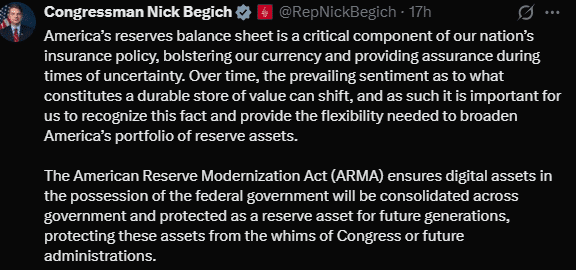
U.S Representative Nick Begich (R-Alaska) and 20 other co-sponsors introduced the American Reserve Modernization Act (ARMA) to formally create a strategic Bitcoin reserve.
Begich said that sentiment around global reserve assets and alternatives has shifted, and the U.S. reserves should be diversified to reflect the changes.

In a FOX Business interview, Begich added that gold dominates precious metals in the same way Bitcoin does for the crypto market.
When you look at Bitcoin, it represents about 60% of all market cap for the entire crypto space. So the market has decided, in the case of gold and in the case of Bitcoin, that this will be the predominant store of value within that asset class.
Congressman Pat Harrigan, another co-sponsor of the bill, reiterated that gold reserves anchored the U.S. financial security for years. For him, a strategic Bitcoin reserve will reinforce the same for future generations.
Still a long way to go for the Bitcoin reserve
To expand the BTC reserve without deficit spending, Begich proposed using Iran’s seized crypto assets alongside other ‘budget-neutral’ strategies.
Notably, the U.S. Treasury will be tasked with managing the reserves with a minimum of 20 years of holding period. Any future sales will be directed at reducing the national debt.
The bill builds on the BITCOIN Act, introduced by pro-crypto Senator Cynthia Lummis (R-WY), which proposed the U.S. to hold 1 million BTC, or 5% of the total BTC supply.
FundStrat’s Tom Lee hailed the move, drawing similarity to his ‘Alchemy of 5%’ for Ethereum.
That said, Conner Brown, managing director at lobby firm Bitcoin Policy Institute, billed the bipartisan support from the 21 lawmakers as a “fantastic showing for Bitcoin.”
But the push for a formal BTC reserve is still an uphill task. For starters, the U.S. government now holds 328,372 BTC, according to BitcoinTreasuries data. The current stash is worth $25.5B and is a perfect starting point for the reserve, as Begich proposed.


However, out of this, about 94K BTC is set to be returned to the Bitfinex exchange. Besides, unless the bill clears the committee hurdle and advances to the final House floor vote, its progress will remain uncertain.
Besides, there are only two months before the Congress recess in August. Should it fail to pass by this time, the November midterm elections will derail the bill’s passage prospects.
In fact, the market was only pricing a 34% chance that the Bitcoin reserve would become formalized before 2027. In other words, despite the recent FOMO, the bill’s outlook remains unclear.


Final Summary
- Rep. Nick Begich and 21 other lawmakers introduced a bill to formally create a Bitcoin reserve for the U.S.
- The bill seeks to hold 5% of the total BTC supply for at least 20 years, with future sales directed at servicing national debt.

