

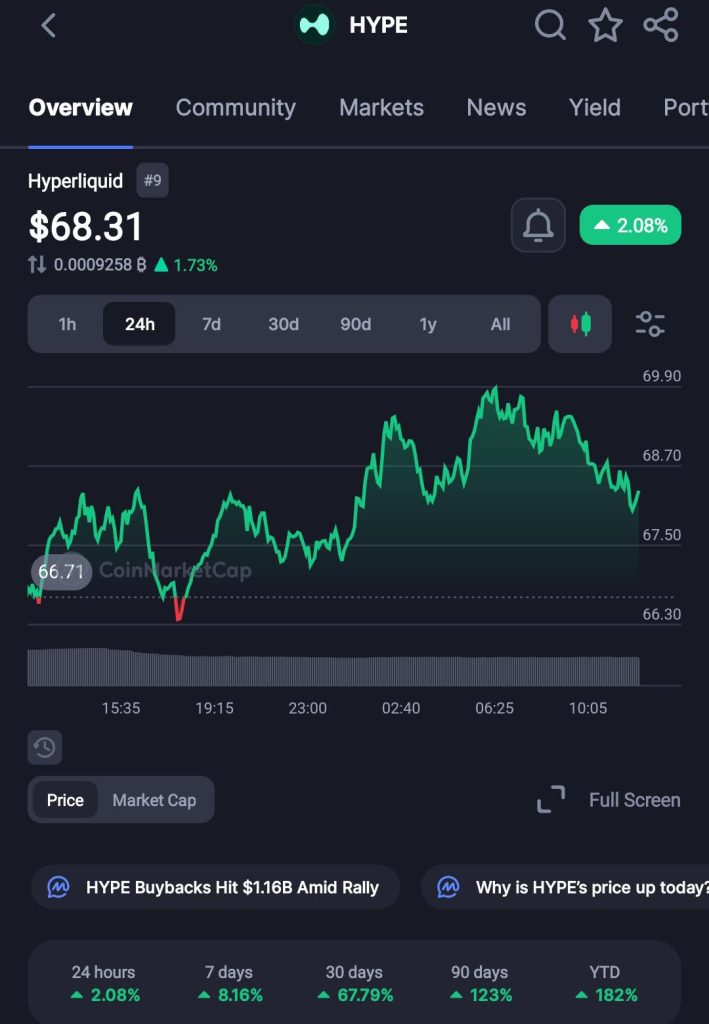
Something significant just happened in the crypto market that did not involve Bitcoin or Ethereum as Hyperliquid’s native token HYPE hits $70 for the first time.
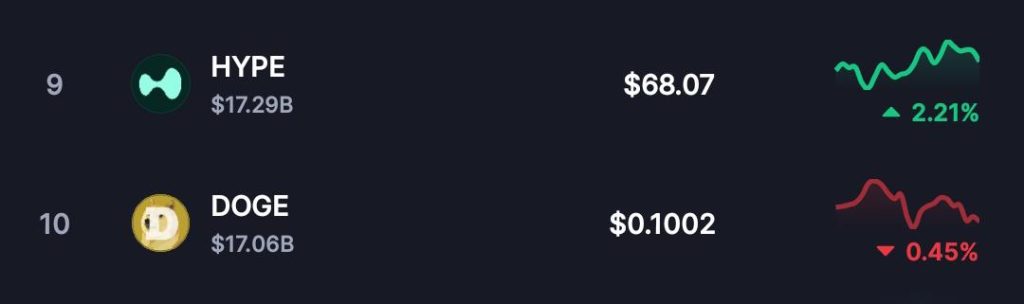
This sets a new all-time high, enough to overtake Dogecoin, one of the most recognized names in the entire industry. For a project running on eleven employees and a grinding work ethic, the numbers being put up in 2026 are genuinely hard to process.
HYPE Hits $70 and Flips Dogecoin
HYPE hits a new all-time high of $70, a price level that places the token firmly in the top tier of crypto assets by market capitalization. The move pushes Hyperliquid’s total market cap into the $20 billion range, and in doing so, it clears Dogecoin, a coin that has been a fixture of the top ten for years and carries name recognition that most crypto projects never come close to matching.
The distance HYPE has covered in 2026 alone tells the story more vividly than any single price point.
$HYPE just hit a new all-time high of $70, adding $11 BILLION in market cap in 2026.
Why HYPE has been pumping?
– 🇺🇸 The US CFTC has approved the first “US perpetual futures,” the same model HYPE is built on, potentially opening access to a multi-trillion-dollar market.
-The… pic.twitter.com/9522sDGFDZ
— Ash Crypto (@AshCrypto) May 31, 2026
The token has added $11 billion in market cap this year, a figure that reflects not just speculative momentum but a genuine shift in how the market is pricing Hyperliquid’s position in the on-chain derivatives landscape.
Volumes are up. The narrative is strong. And the attention from both retail and institutional participants keeps compounding.
Why The Market is Repricing HYPE Right Now
The rally does not come from nowhere. Several distinct catalysts converge in 2026 to give HYPE the kind of fundamental backing that most tokens never develop, and each one feeds into the next.
The most significant external catalyst is regulatory. [he US Commodity Futures Trading Commission has approved the first US-regulated perpetual futures product, the exact model that Hyperliquid is built on.
$HYPE just hit a new all-time high of $70, adding $11 BILLION in market cap in 2026.
Why HYPE has been pumping?
– 🇺🇸 The US CFTC has approved the first “US perpetual futures,” the same model HYPE is built on, potentially opening access to a multi-trillion-dollar market.
-The… pic.twitter.com/9522sDGFDZ
— Ash Crypto (@AshCrypto) May 31, 2026
That approval is not a minor procedural development. Perpetual futures represent one of the largest and most actively traded instruments in global finance, and US regulatory recognition opens the door to a multi-trillion-dollar addressable market that was previously inaccessible to domestic participants through regulated channels. For a platform already dominant in on-chain perpetuals, that development reads as a direct tailwind.
The business fundamentals running underneath the price action are equally striking. Hyperliquid generates somewhere between $900 million and $1 billion in real protocol fees, not token emissions, not paper revenue, but actual fees paid by users for the product. The team producing those numbers consists of eleven people. That fee-per-employee figure is not a metric that exists anywhere else in the industry at this scale, and it has become one of the defining talking points every time someone asks why HYPE deserves to trade where it does.
A $2 billion Buyback Program Reshaping the Token Supply
Perhaps the most structurally important driver behind HYPE’s price performance is what happens to those fees after they are collected. Approximately 98% of all trading fees flow directly into buybacks, the protocol purchases HYPE from the open market and removes it from circulating supply. Those buybacks have already surpassed $2 billion in total value, a number that reframes the token’s supply dynamics entirely.
Most crypto tokens operate with inflationary pressure from emissions, team unlocks, and investor distributions. HYPE is running a different playbook. A protocol that generates close to a billion dollars in annual fees and redirects the overwhelming majority of that back into supply reduction creates a mechanical bid underneath the token that does not depend on new buyers entering the market. It depends on the protocol continuing to generate revenue, and Hyperliquid has demonstrated it can do that at scale.
The compounding effect of sustained buybacks at this volume is not subtle. Every week that the protocol operates at its current fee run rate, more HYPE leaves circulation. The float tightens. And as institutional flows begin entering the picture, the supply dynamics start to matter considerably more.
Institutional Money Finds Its Way in Through the ETF
The latest layer added to Hyperliquid’s growth story is institutional. Since the HYPE ETF launched, the product has attracted more than $100 million in net inflows, bringing a category of capital that has historically stayed out of on-chain native assets. Funds including Bitwise are not just holding HYPE as a passive exposure, they are using the fees generated by their holdings to purchase additional HYPE, creating a self-reinforcing loop where institutional participation directly funds further supply reduction.
That structure matters for the long-term trajectory. ETF inflows tend to be stickier than retail speculation, and when those inflows are mechanically connected to buyback activity, the effect on circulating supply compounds over time. The $100 million figure is a starting point, not a ceiling, particularly if the CFTC’s approval of US perpetual futures expands the regulatory comfort zone for funds that were previously cautious about the product category.
What Flipping Dogecoin Actually Signals
Market cap milestones are easy to dismiss as arbitrary, and in isolation, they often are. But HYPE overtaking Dogecoin carries a specific kind of symbolic weight that goes beyond the number itself. Dogecoin’s market cap has historically been driven almost entirely by cultural momentum, retail speculation, and the gravitational pull of Elon Musk’s social media activity. It produces no fees. It has no protocol revenue. Its supply is inflationary and uncapped.
HYPE, by contrast, is backed by a platform that generates near-billion-dollar annual fee revenue, runs a $2 billion buyback program, operates with a lean eleven-person team, and now sits inside a regulatory environment that may be actively expanding its total addressable market. The fact that these two tokens now trade at comparable market caps, and that HYPE has crossed above, says something about how the market is increasingly willing to price fundamentals alongside narrative.
The Road Ahead for Hyperliquid
The question now is whether the catalysts driving HYPE’s 2026 run have more room to develop or whether the price has begun to front-run outcomes that are still months away from materializing. The CFTC approval opens a door, but the actual flow of US institutional capital into on-chain perpetuals takes time to develop. ETF inflows are growing but remain modest relative to the total market cap. And at $20 billion, HYPE is no longer a mid-cap discovery trade, it is a large-cap asset that requires sustained fundamental justification to hold its ground.
What Hyperliquid has demonstrated, more convincingly than almost any other on-chain protocol, is that a small team with a clear product and genuine revenue can build something that the market eventually has to take seriously. Eleven employees. Close to a billion dollars in fees. Two billion in buybacks. A new all-time high. The grind, in this case, is paying offi in ways that are difficult to argue with.
Disclosure: This is not trading or investment advice. Always do your research before buying any cryptocurrency or investing in any services.
Follow us on Twitter @nulltxnews to stay updated with the latest Crypto, NFT, AI, Cybersecurity, Distributed Computing, and Metaverse news!