
For two years, the easy trade was to slap Bitcoin on the balance sheet and ride the wave. That worked for a handful of names, but it also created an army of copycats. Now a different bet is showing up in filings and press wires: public firms stockpiling SOL.
This isn’t just a new ticker swap. Solana treasuries behave differently, come with their own operational quirks, and can actually plug into products. The question is whether these stocks are just high-beta SOL trackers or the start of a more interesting corporate playbook.
We’ve got fresh data points, some pushback from boards, and a few on-chain breadcrumbs worth following.
| Point | Details |
|---|---|
| Public SOL war chests are real | The top five publicly traded Solana treasury companies collectively hold more than 15.7 million SOL, per a June roundup (KuCoin News). |
| Forward Industries is the headline | Forward expanded its stash by 500k+ SOL in fiscal Q3, bringing its treasury to 7.55 million SOL as of June 30, 2026 (Forward Industries press release). |
| Boards aren’t rubber-stamping roll-ups | HSDT and Brera rejected consolidation offers from Forward in June, even as media framed Forward as the largest public SOL treasury (~7M SOL, acquisition cost cited near $1.6B) (Cointelegraph). |
| Liquidity windows matter | An on-chain monitor flagged 455,784 SOL moving from a Forward-linked wallet to Coinbase Prime on June 5, 2026 (LookOnChain), a reminder that execution venues and timing are material. |
| Different from Bitcoin treasuries | Staking optionality, validator choices, and upgrade cadence give SOL treasuries more moving parts than BTC balance sheets — with potential yield but added operational risk. |
From Bitcoin copycats to Solana balance sheets
When MicroStrategy turned the corporate treasury into a Bitcoin bet, it set a template: buy, hold, talk about it nonstop. Plenty tried to mimic it. The problem is, markets price in mimicry fast. You end up with a handful of names trading like leveraged BTC without the software business ever mattering.
Solana treasuries are a different flavor. Yes, you still take big price risk, but you also get knobs to turn: staking, on-chain integrations, ecosystem partnerships, and operational flows that can justify owning SOL beyond a marketing line.
We’re now seeing a proper cluster of public firms with notable SOL exposure. A June market snapshot put the top five at over 15.7 million SOL combined (KuCoin News). That’s not a cottage trend. It’s a balance-sheet decision showing up at scale.
What a Solana treasury actually lets a company do
Use it, not just hold it
SOL can be put to work. Companies can delegate to validators and earn a variable staking return. They can also wire SOL into products: loyalty points with on-chain settlement, NFT-based memberships, payments for microtransactions, DePIN integrations, or simply subsidizing user fees for growth experiments.
Pro tip: If a company can point to a product or revenue stream where SOL reduces cost or wins customers, the treasury stops being a static bet and becomes a strategic input. That’s the test.
But usage adds moving parts
- Validator selection isn’t cosmetic. It affects performance, fees, and potential slashing exposure.
- Unstaking takes time. Deactivation follows epoch schedules, so liquidity is measured in days, not minutes.
- Custody setups can limit how quickly assets move between staking, cold storage, and trading venues.
- If SOL underwrites customer incentives, treasury drawdowns become tied to marketing cycles.
Case study: Forward Industries and the SOL roll-up thesis
Forward Industries has become the poster child for a public SOL treasury. In a July 1 update, the company said it bought more than 500,000 SOL in fiscal Q3 at an average price around $79, lifting its treasury to 7.55 million SOL as of June 30, 2026 (Forward Industries press release).
Media have framed Forward as the largest public SOL treasury. A mid-June report noted roughly 7 million SOL and cited an acquisition cost near $1.6 billion, while also pointing out that Solana-focused targets weren’t eager to be rolled up: HSDT’s board declined on June 12 and Brera did the same on June 9 (Cointelegraph).
We also got a useful on-chain breadcrumb. On June 5 an analytics account flagged a transfer of 455,784 SOL (about $31.9 million at the time) from a wallet linked to Forward to Coinbase Prime (LookOnChain). It’s a reminder that treasury stories live on two timelines: the narrative arc in filings and the hour-by-hour reality of execution and risk.
Takeaway: the “SOL roll-up” idea might sound tidy in a deck, but boards can and will push back if deal logic is thin or governance is fuzzy. Meanwhile, on-chain flows can move faster than investor relations copy.
What to watch next
- Whether Forward discloses staking policies and validator distribution. That tells you how operational they want this to be.
- Any changes in custody providers or trading venues, especially around large transfers.
- Subsequent offers to SOL-heavy firms and how boards articulate their no/yes.
How these stocks trade versus Bitcoin-first plays
Bitcoin treasury stocks are mostly a beta story. You’re buying correlation with some operating noise. Solana treasury names add optionality and new ways to mess it up.
- Correlation: Expect high correlation to SOL, but not perfect. Product launches, governance drama, or M&A rumors can add idiosyncratic moves.
- Beta drift: Staking yield, if material, can marginally cushion drawdowns or amplify compounding in bull phases. It’s still tiny next to price swings.
- Execution risk: Validator outages, poor rebalancing, or mistimed liquidity events can blunt performance relative to SOL itself.
- Narrative premium: If a company actually uses SOL in revenue-generating ways, markets may price a “strategic edge” premium on top of the treasury value.
| Factor | BTC Treasury Stock | SOL Treasury Stock |
|---|---|---|
| Core exposure | BTC price | SOL price |
| On-chain utility | Limited for corporates | Can plug into products, fees, and growth spend |
| Yield mechanic | Generally none | Delegation-based staking (operational risk attached) |
| Ops complexity | Lower | Higher: validators, epochs, upgrades |
| Liquidity rhythm | Spot liquidity 24/7 | Unstaking windows add timing frictions |
| Headline risk | Macro, miner flows | Network performance, validator health, ecosystem headlines |
Operational realities: staking, custody, and liquidity windows
Staking isn’t set-and-forget
Delegating SOL to validators can provide a yield, but it introduces new ways to lose money or sleep. Validators can get slashed in certain fault conditions. Reward rates change with network dynamics. And security teams may cap the number of validators they’re comfortable with, which can create concentration risk.
Pro tip: If you’re valuing a SOL-heavy company, do not assume staking on 100 percent of the treasury. Big treasuries often leave a meaningful buffer un-staked for liquidity and risk control.
Custody and venue choice show up on-chain
Most public companies will route size through custodians and prime brokers. The June 5 transfer flagged from a wallet tied to Forward into Coinbase Prime (LookOnChain) is a live example of how these flows surface. Whether that was for selling, rebalancing, or custody movement, it underscores that on-chain watchers can and will front-run the narrative.
Epoch timing is money
Unstaking on Solana follows epoch boundaries, which typically means waiting days, not hours. If a company needs cash quickly for payroll, acquisitions, or collateral calls, that delay matters. Good treasurers forecast unlock windows and keep trading lines ready.
Regulatory and accounting wrinkles you can’t ignore
Two buckets here: securities law risk and accounting treatment.
- Securities questions: In past U.S. enforcement actions, regulators have alleged certain tokens, including SOL, are securities. The litigation is unresolved as of mid-2026. That uncertainty filters into disclosure, custody rules, and listing risk. Companies tend to write conservative risk factors because of it.
- Accounting shift: Under FASB’s ASU 2023-08, most public companies will measure eligible crypto assets at fair value with changes through earnings for fiscal years beginning after Dec 15, 2024, with early adoption permitted. By 2026, many filers are using fair value. That reduces the old impairment asymmetry but increases income-statement volatility. Watch for policy footnotes.
Bottom line: fair value makes reported numbers more faithful to market reality, but if a firm is staking or using SOL in operations, you’ll want to see how they present those activities — and what they count as operating versus investing cash flows.
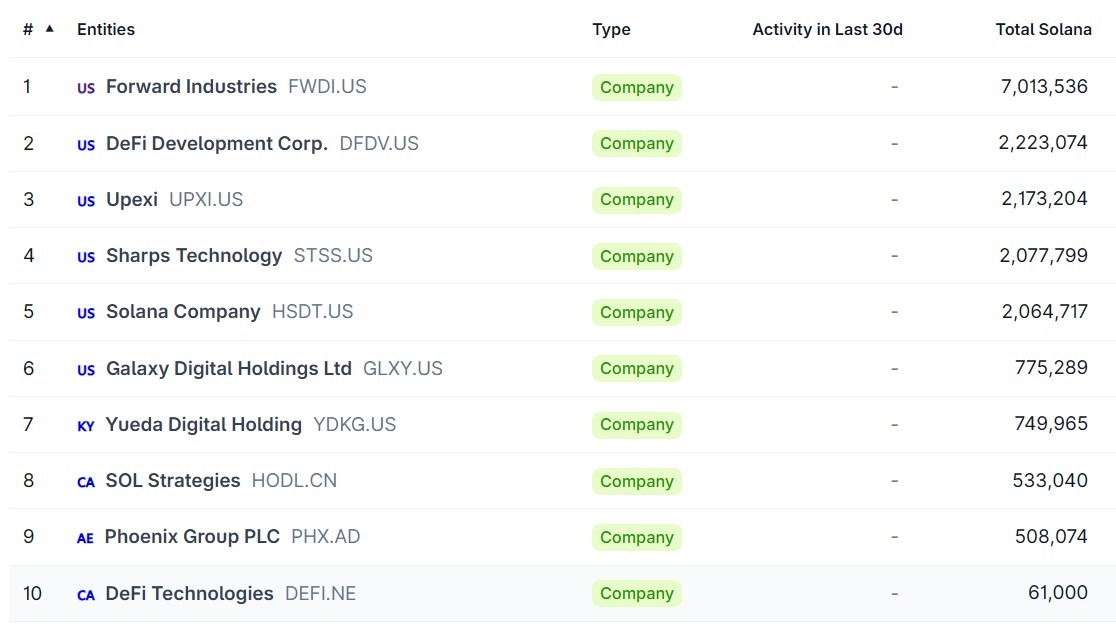
Table/chart of the top 10 publicly traded Solana treasuries and their SOL holdings (shows Forward at ~7.0M SOL) — useful visual for confirming which public firms hold the largest corporate SOL positions and the scale of those treasuries. — Source: Cointelegraph
How to evaluate a ‘Solana treasury stock’ before you buy
A quick diligence checklist
- Exposure math: How many SOL, at what cost basis, and what percentage of total assets and equity? Is there leverage on top?
- Policy clarity: Staking percentage targets, validator policy, and rebalancing rules. Is there a named risk officer or committee?
- Custody setup: Which custodian or prime broker, insurance coverage, segregation of duties, and multi-sig or MPC details where disclosed.
- Liquidity planning: Buffers for unstaking windows, credit lines, and authorized trading venues to manage fast markets.
- Use-in-product: Any live integrations where SOL reduces cost or increases revenue. Proof beats promises.
- Governance and M&A: Track record with minority holders, board independence, and how they treat consolidation proposals.
- Disclosure hygiene: Frequency and specificity of treasury updates. Do they reconcile on-chain data with filings when large moves are spotted?
Valuation anchors
- Net asset value lens: Mark the SOL stack to market, adjust for debt, and compare to market cap. Then ask what the core business is worth.
- Operating leverage: If SOL supports product growth, model unit economics with and without those subsidies.
- Scenario analysis: Run downside cases with faster unlock needs, slippage, and staking pauses. Run upside with sustained staking and product traction.
Pro tip: Treat the core business and the SOL book as separate segments first. If management can’t articulate the bridge between them, price a discount.
Scenarios to plan for in H2 2026
- Network volatility: Performance issues, validator incidents, or contentious upgrades could widen basis risk between a stock and spot SOL.
- Board dynamics: More consolidation pitches are likely. June already showed boards saying no to roll-ups (Cointelegraph). Expect sharper disclosures about strategic rationale.
- On-chain transparency pressure: If large transfers like the June 5 Coinbase Prime move (LookOnChain) keep getting flagged, companies may adopt routine wallet attestations to control the narrative.
- Ecosystem pull: If Solana apps keep onboarding mainstream users, corporate treasuries could justify higher active usage, not just passive holding. But that also increases operational load.
- Macro: Rates, liquidity, and risk appetite still set the ceiling. Treasuries are amplifiers, not substitutes for macro tides.
If you came looking for a simple yes-or-no on “are these just Bitcoin copycats,” here’s mine: some are, some aren’t. The tells are in the operational playbook, not the press headline. A real Solana treasury strategy shows up in validator policy, unlock calendars, custody design, and products that actually touch the chain.
None of this is investment advice. It’s a framework to keep you from anchoring only on a token count and a ticker.
For fuller context on where the market’s leaning, remember the baseline: the top five public SOL treasuries sit north of 15.7 million tokens (KuCoin News), and the largest headline name, Forward Industries, disclosed 7.55 million SOL as of June 30 (Forward Industries press release). Those two numbers alone tell you we’re past a curiosity phase.
Frequently Asked Questions
What is a Solana treasury stock?
It’s a publicly traded company whose balance sheet holds a meaningful amount of SOL. Some simply hold SOL as a treasury reserve; others also deploy it in staking or integrate it into products and incentives.
How is this different from the MicroStrategy-style Bitcoin strategy?
Bitcoin treasuries are buy-and-hold with less operational overhead. Solana treasuries can earn staking rewards, face validator choices, and can connect directly to products. That’s more optionality and more ways to trip.
Do staking rewards change the accounting?
They can affect recognition and disclosures, but the headline change in 2025-2026 is FASB’s fair value accounting for many crypto assets. Gains and losses flow through earnings. Staking adds policy and risk-factor complexity more than it changes that core rule.
Are there lockups on SOL that could trap liquidity?
There’s no fixed vesting lockup for a company’s own SOL, but staked SOL takes time to deactivate. Unstaking follows Solana’s epoch cadence, so treasurers plan liquidity a few days ahead.
What did boards reject in June 2026?
Two Solana-focused firms, HSDT and Brera, turned down consolidation offers from Forward Industries in early June, per media reports. The pushback suggests boards want tighter strategic logic before signing onto roll-ups.
Is Forward Industries the largest public SOL holder?
Coverage in mid-June presented Forward as the largest public SOL treasury by tokens, citing roughly 7 million SOL at the time, and noted an acquisition cost near $1.6 billion. Forward later disclosed 7.55 million SOL as of June 30.
What on-chain signals should investors watch?
Large wallet movements to or from custodians and exchanges, such as the June 5 transfer to Coinbase Prime flagged by an analytics account, can hint at rebalancing or policy changes before filings land.
If you want ongoing coverage without noise, Crypto Daily tracks these treasury shifts as they show up on-chain and in filings. You can always check the latest analysis at Crypto Daily.
Disclaimer: This article is provided for informational purposes only. It is not offered or intended to be used as legal, tax, investment, financial, or other advice.