Robinhood dropped a live, Arbitrum-based chain into the market and on-chain activity spiked. Traders want to know one thing: does this really move the needle for ARB, or is it just a flashy headline?
In plain English: we’ll unpack what launched, what the $568 million day means, and where ARB demand could actually come from (or not). We’ll also map the metrics that matter, common traps, and the scenarios that could turn a pop into a sustained repricing.
Quick Answer
It could help, but not automatically. Robinhood Chain’s surge to over $568 million in daily on-chain trading briefly lit up ARB’s price, but ARB isn’t the fee token for Arbitrum networks. Any lasting repricing depends on whether Robinhood’s activity spills into Arbitrum’s broader economy, governance, and sequencer economics over time. Watch for retention, cross-chain flows, and DAO decisions that link activity to ARB’s value capture.
- Robinhood Chain launched July 1, 2026 on Arbitrum tech, pulling in mainstream attention (Robinhood Newsroom).
- On July 8, on-chain trading topped $568M; ARB jumped about 19% in 24 hours the next day (CoinDesk).
- TVL snapshots showed roughly $241.33M with Ethena and Morpho as big contributors that day (HTX using Dune/Entropy).
- ARB’s core utility is governance and incentives; it isn’t used to pay gas. The link between activity and ARB demand is indirect.
What exactly launched, and why does it touch Arbitrum?
Robinhood Chain is a public mainnet built on the Arbitrum platform. That went live July 1, 2026, and it plugs Robinhood directly into Ethereum’s scaling stack using Arbitrum’s tech under the hood (Robinhood Newsroom).
Think of it as an app-focused, Arbitrum-powered network tailored to Robinhood’s user base. The draw: lower fees, faster confirmations, and a cleaner route to on-chain trading for a huge cohort of retail users. It’s not Arbitrum One itself; it’s an Arbitrum-based chain that sits alongside the main Arbitrum networks.
Why it matters for ARB is the halo effect. When a brand like Robinhood ships an Arbitrum-based chain and volume spikes, the market often extrapolates to the ARB token. Sometimes that makes sense. Sometimes it’s just excitement without direct value capture.
Does $568M of Robinhood volume create ARB buy pressure?
Not by default. On Arbitrum, gas is typically paid in ETH, and ARB is mostly a governance and incentive asset. So a pop in activity on an Arbitrum-based chain doesn’t automatically mean more ARB must be bought to make the system work.
That said, there are indirect channels. If Robinhood Chain consistently funnels new users, liquidity, and developers into the wider Arbitrum ecosystem, ARB could benefit via governance relevance, incentives demand, and potentially sequencer-related dynamics over time. There are also network effects: more apps building on Arbitrum tech can strengthen the brand and push future builders toward the same stack.
Context helps: on July 8, blockchain data compiled by Entropy Advisors showed Robinhood Chain processing over $568 million in daily trading volume, and ARB rallied roughly 19% in the following 24 hours, the top gainer among large-cap tokens that day (CoinDesk). But a market pop isn’t proof of sustained demand. For that, we need stickier metrics.
Which metrics prove “repricing” vs. a one-off?
You want durable signals that link activity to ARB’s potential value capture. Start with usage, but don’t stop at a single day of prints.
- Retention and cohort growth: daily active users, 7/30/90-day retention on Robinhood Chain. Spikes fade; habits compound.
- Bridging and liquidity migration: net inflows not only into Robinhood Chain but also into Arbitrum One and other Arbitrum-based networks.
- Sequencer revenue and MEV trends on Arbitrum: are fees and ordering value rising across Arbitrum networks, and is any of it directed by the DAO into ecosystem growth?
- TVL quality: stable, diversified deposits vs. short-term mercenary capital. On July 8, a Dune snapshot attributed about $241.33M TVL to Robinhood Chain with large chunks in Ethena (~$82.78M) and Morpho (~$81.99M) (HTX using Dune/Entropy).
- Governance pipeline: proposals that clarify revenue usage, incentives, or any formal links between Orbit-style chains and ARB accrual.
- Supply overhang: vesting and unlock calendars for ARB, plus grant-driven emissions, against any new demand sources.
Pro tip: Big prints mean little without follow-through. If volume, TVL, and bridge flows hold after the first two weeks, repricing has legs. If they crumble, it was a headline trade.
Also, sanity-check the number sources. Entropy Advisors’ tracking was cited for the July 8 surge (CoinDesk). Methodology matters; know what’s counted, what isn’t, and how repeat trades or incentives might inflate tallies.
How does Robinhood Chain activity stack up vs. Arbitrum One and others?
Robinhood Chain and Arbitrum One are cousins, not twins. One is a brand-driven, app-centric chain using Arbitrum’s tech; the other is the flagship public L2 with a wide-open app ecosystem. That split changes how value might trace back to ARB.
Here’s a practical way to think about it:
| Dimension | Robinhood Chain (Arbitrum-based) | Arbitrum One |
|---|---|---|
| Primary users | Robinhood’s retail base; app-centric flow | Broad crypto-native audience; multi-app |
| Fee token | Typically ETH or chain-specific; not ARB | ETH for gas; not ARB |
| Direct ARB accrual | Indirect at best; depends on DAO policies and ecosystem flywheels | Indirect via governance, incentives, and ecosystem growth |
| Data visibility | Evolving dashboards; watch Entropy/Dune coverage | Mature analytics across multiple providers |
| Narrative spillover | Strong brand halo could onramp new cohorts | Established L2 leader; steady dev and liquidity base |
So, it’s less “Robinhood Chain prints volume, ARB moons,” and more “does the new flow strengthen the broader Arbitrum orbit enough to justify higher ARB demand over time?” That answer lives in user retention, bridge behavior, and DAO choices, not a single day’s candles.
What narratives could actually sustain ARB demand?
Three come to mind.
First, ecosystem gravity. If Robinhood Chain draws in mainstream users who then explore Arbitrum apps, devs follow the users, and liquidity follows the devs. That reinforces Arbitrum’s status as the default scaling stack for consumer-facing apps. The more builders standardize on Arbitrum tooling, the more ARB’s governance clout matters.
Second, treasury and governance. Arbitrum’s DAO has historically deployed capital into growth programs. If impactful proposals link rising activity across Arbitrum-based chains to sustainable developer funding, security expansions, or incentives, it can convert usage into a sturdier moat. That doesn’t instantly mean buybacks or direct revenue to token holders; it does mean ARB becomes the coordination asset for a busier network.
Third, sequencer and interoperability direction. As sequencer designs evolve and interoperability tightens across Orbit-style chains, there may be pathways where scale improves economics in ways the DAO can harness. It’s early, and the specifics matter, but the point is simple: a bigger Arbitrum universe can make ARB more important even without gas being paid in ARB.
What are the biggest risks to this thesis?
The market’s favorite trap is confusing viral moments with durable usage. A $568M day is impressive, but if it’s incentive-driven or event-specific, it can fade fast.
Liquidity can also be mercenary. The TVL snapshot that highlighted ~$241.33M with notable positions in protocols like Ethena and Morpho shows concentration risk on day one (HTX using Dune/Entropy). If that capital rotates out as yields normalize, TVL drops and the narrative cools.
There’s fragmentation risk too. Separate pools across Arbitrum One and Arbitrum-based appchains can dilute liquidity depth, making each venue feel thinner. Without strong routing and shared infra, users can bounce.
Finally, governance uncertainty. If the DAO doesn’t align incentives or set clear policies for how ecosystem growth translates into public goods and developer support, momentum can stall. The inverse is also true: smart policy can turn a headline into compounding effects.
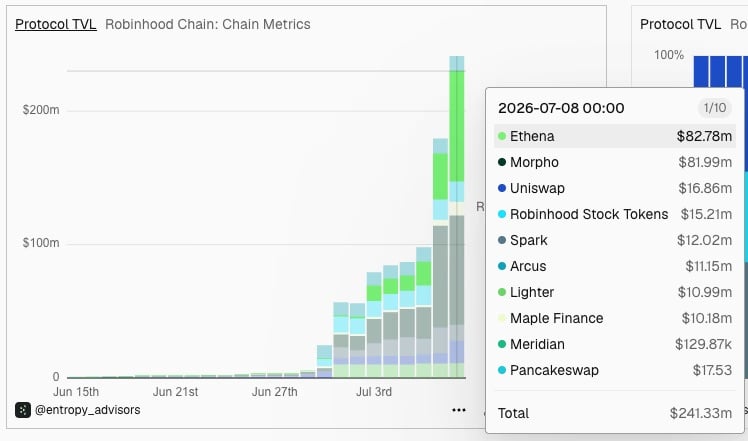
Dune chart (Entropy Advisors) showing Robinhood Chain protocol TVL growth with a July 8, 2026 tooltip: Ethena $82.78M, Morpho $81.99M, total $241.33M — illustrating stablecoin/lending concentration behind early TVL and revenue potential. — Source: Entropy Advisors (Dune) via HTX
How should traders and builders react right now?
Don’t just chase the print. Build a small dashboard of sanity checks you’ll watch over the next month. You’re looking for stickiness, not just spikes.
Builders should test distribution. A Robinhood-aligned chain could be a powerful onramp for consumer apps. But keep liquidity strategy flexible; route to Arbitrum One and other venues where it makes sense. The moat will be users and partners who stay when incentives fade.
Traders should separate narrative trades from fundamental positioning. The 19% jump around July 9 showed how headline-sensitive ARB can be (CoinDesk). If you’re leaning into the repricing thesis, define what metrics would prove you wrong quickly: falling retention, outbound bridges, or governance silence.
Common Mistakes
- Assuming fee-token mechanics that don’t exist. ARB isn’t gas. Don’t model direct fee burns or mandatory ARB buys from Robinhood Chain activity.
- Overweighting day-one volume. A single $568M day is notable, not definitive. Track multi-week retention and liquidity stickiness before extrapolating.
- Ignoring concentration in TVL. When a few protocols dominate deposits, exits can swing the headline number overnight.
- Forgetting governance timelines. Even great proposals take time. Don’t price in policy changes before the DAO signals direction.
- Chasing narrative without catalysts. If you can’t name the next 2–3 measurable checkpoints, you’re trading vibes, not information.
If you want ongoing, sober coverage instead of hype, we track these metrics closely at Crypto Daily and cut through the noise with on-chain and governance context.
Frequently Asked Questions
Is ARB required to use Robinhood Chain?
No. As with other Arbitrum networks, gas is typically paid in ETH or a chain-specific fee token, not ARB. ARB’s role is primarily governance and ecosystem incentives.
Where can I verify the $568M volume and TVL numbers?
The July 8 trading surge was cited from Entropy Advisors’ blockchain tracking in market coverage (CoinDesk). A TVL snapshot around $241.33M with protocol breakdowns (Ethena, Morpho) was visible via a Dune dashboard referenced in reporting (HTX using Dune/Entropy).
Does Robinhood Chain pay any fees to Arbitrum or ARB holders?
Details can vary by chain setup and policy. Publicly, ARB isn’t a fee token and there is no automatic payout to ARB holders. Any economic links would depend on governance and technical choices over time.
Could the volume be incentive-driven or circular?
It’s possible. Early activity on new chains often includes incentives. That doesn’t make it fake, but it can inflate trade counts and TVL. Watch retention and net external inflows to gauge durability.
What if Robinhood’s users stay inside their chain and never touch Arbitrum One?
Even then, brand exposure can attract builders to Arbitrum’s stack. The practical ARB upside, though, would be smaller unless usage spills into the broader Arbitrum economy or triggers DAO-led growth initiatives.
Why did ARB jump about 19% around the news if the link is indirect?
Markets price narratives quickly. A major consumer brand launching on Arbitrum tech signals adoption, which traders often express via the flagship token. It’s a reflex. The question is whether fundamentals follow the reflex.
What should I watch next week to avoid being late or early?
Three things: whether daily volume holds above a reasonable baseline, whether TVL composition diversifies, and whether bridge flows show users exploring Arbitrum One. If two of those three trend positively, the repricing case strengthens.
Disclaimer: This article is provided for informational purposes only. It is not offered or intended to be used as legal, tax, investment, financial, or other advice.