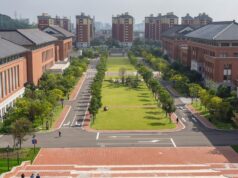

The Drunken Film Festival in Bradford, England, returned in 2025 for its eighth annual event. The festival ran throughout October, with screenings in-person (and all free) at numerous venues around Bradford and the Lake District, including one screening outside projected against the dramatic Cow and Calf Rocks. The festival celebrates local and international indie filmmakers alike, showing their short films and music videos in local venues and bars — that’s where the “drunken” part comes from.
In 2025, DFF Bradford, which has a sister fest in DFF Oakland, screened 60 films. Then, a jury of nine industry professionals voted on six unique film prizes. The jury comprised American documentarian Brian Gersten, Iranian filmmaker Hamidreza Khosh-Bazan, festival co-director Jan Ruppe, British filmmaker Jamie Swaby, Bradford native actor and director Kenton Jordan Thomas, American filmmaker Sav Rodgers, Bradford native artist Ivan Mack, producer Dermot Daly, and University of Bradford film professor Dr. Karen Thornton. Khosh-Bazan’s film Cutstein previously won the Best Documentary Film prize at Drunken Film Fest Bradford in 2021.
2025’s festival saw a diverse array of films crowned, from an incisive documentary about analog media to a claymation film about anxiety. Check out the winners below, and maybe head to Bradford this October to raise a glass to the next festival’s contestants.
Best Documentary Film: The Photo Returner (Garret Harkawik)
Erin Bohannon returns photos. She finds them at yard sales, thrift stores, and online auctions and then sets about trying to return them to their rightful owners — usually, a descendant of the person or family in the photo. It’s not an easy or fast process — sometimes, she holds onto the photos for over a decade. Often, delivering them isn’t simple, either: “Nine times out of 10, everybody thinks it’s a scam,” Bohannon says. “‘Hey, you don’t know me, but I’ve got a photo of your mother!’”
Bohannon is a curious, wonderful, insightful subject at the heart of Garret Harkawik’s short film The Photo Returner, which won Best Documentary Film at the 2025 Drunken Film Fest Bradford. Like other unusual but highly specific profile documentaries about relatively ordinary people and their extraordinary preoccupations — the sort of films that Errol Morris and Frederick Wiseman have built careers on — The Photo Returner allows its subject the time, space, and empathy to open up, like a moon garden at dusk. We learn that Bohannon lost her parents before the events of the film. Perhaps this explains her fascination with old photos. She says that it would make her day if someone reached out to her with a photo of them that she’s never seen before, so that’s the sort of experience she hopes to provide for others.
The hobby has given her an uncanny knack for remembering names. “I won’t remember your name, and I won’t remember what I had for breakfast yesterday,” she says, “but I always remember the names of people who have been dead 200 years.” She also adds memorials on Find a Grave for people who don’t have any.
Harkawik’s film unfolds with reverence and overflows with kindness. He and co-composer Karl Hohn have devised a very simple, elegant synth and piano score to accompany the story. The director also acts as his own editor, cinematographer, and producer, and his edit supports Bohannon’s stories with a well-researched stack of archival inserts. Perhaps the filmmaker shares Bohannon’s love for old pictures — records of the past, still frames into another time, whose subjects stare at you, laugh, or cry, yearning silently to be returned to their loved ones.
Best Narrative Film: Himalia (Juliette A. Lossky and Clara Milo)

Something odd is happening on one of the moons of Jupiter. In the short film Himalia, written and directed by Juliette A. Lossky and Clara Milo, a seemingly normal settler family raises a child (Noam Desbiens-Lépine). But at night, the family is revealed to be solar-powered automatons, watching over the boy in the service of some kind of bizarre experiment.
Despite its surreal sci-fi setup, the full story is carefully meted out over 20 minutes, meaning that the film takes its time telling the audience what’s really going on. In the meantime, we’re stuck in the daily routine of this child, watching him play ball with his dad, eat oranges, and chase his mother through the fields of grain. Himalia captures boyhood in the Terrence Malick style, as we watch with almost spiritual remove as the child explores the boundaries of his farmhouse freedom on the moon of Jupiter. There’s no big-budget outer-space aspect of the film — we’re solely situated in the moment, watching the characters’ hands and faces, usually in close-up, shot with gorgeous natural light. The setting, particularly the grain fields, feels designed to evoke Malick’s Days of Heaven.
But when night falls, Himalia adopts a spooky, mysterious edge, the loose corners of the narrative quickly pulling back to reveal a dark truth beneath. These sequences, while still clearly inspired by Malick with their God’s-eye-view shots of the setting sun and the alien landscapes, also feel like they’re in conversation with Malick’s successors, like David Lowery (“A Ghost Story”) and Mascha Schilinski (“Sound of Falling”). The ordinary peels back to reveal the strange, and sometimes the sinister.
The result is a sublime bifurcated experience, the rare short film that accomplishes both the beautiful table-setting and the rug pull. As the best sci-fi does, it uses its outer space setting to underline the loneliness of humanity. Because whether you’re on a moon of Jupiter or down on Earth, we’re all a little lonely out here, in the fading light of the setting sun.
Best Local Film: The Dragon (Testament)

The United Kingdom is undergoing what the National Education Union has called an “arts apocalypse.” A staggering 93% of children in state schools cannot participate in the arts due to a lack of funding. Young people are being excluded across the country from essential arts programs like theater, music, and creative writing.
Enter The Dragon, the short film that won the Best Local Film prize at Drunken Film Fest Bradford. Written, directed, and composed by Testament, a writer who worked on Netflix’s series Castlevania: Nocturne, the short film follows two children (Hargun Kaur and Llau’rent Bryant), who talk about their fantasy writing and its importance in their lives. Part-spoken word poem, part-documentary, and part-fantasy adventure, the film is a cute political work that was commissioned and produced by LEEDS2023 as part of Children’s Day: Reimagined.
As it was shot on location in Leeds, the film’s best qualities are its slice-of-life elements. A lone bicycle here, the façade of a corner store there. From there, Testament knowingly combines these touches of realism with a dash of fantasy wonder — the children don makeshift costumes, and a dragon (with visual effects by Christian Krupa) soars over some tower blocks. Short and sweet, at five minutes in length, the film ends with a plea to “Fund creativity and the arts for children.”
Best Music Video: BIBIZA — “aufnimmawiederschaun” (Rupert Höller)
“Aufnimmawiederschaun,” a new German-language single from Viennese artist BIBIZA, is a song about beautiful beginnings and ugly endings, articulated in a Euro-pop mix of downbeat Black Keys–style modern grunge rock over top a club beat. The video, directed by Rupert Höller, captures a man on the worst and best day of his life, as he gets dumped by his partner and robbed by a hitchhiker, only achieving transcendence when he finally crashes into an electrical pole and goes flying across Vienna, over St. Stephen’s Cathedral, and into the Alte Donau. In other words, it’s aggressively Austrian in all the best ways.
Director Höller pulls out every trick in the book to make this rock odyssey hit home, with real visual panache that makes it easy to see why “aufnimmawiederschaun” took home the top music video prize. Follow-cars, hood-mounted cameras, fish-eye lenses, impressive abstract visual effects, and top-shelf compositing work… it all combines to make “aufnimmawiederschaun” a music video that feels like it hits well above its budget. The indelible image of an Austrian flying through the sky, covered in blood, smoking a cigarette, is perhaps the greatest in the arsenal of amazing iconography to come out of Drunken Film Fest Bradford.
Best Experimental Film: Tea Travel (Julien Jean-Zayatz)

The “episode of the madeleine” refers to a passage in Marcel Proust’s In Search of Lost Time, in which someone eating a madeleine triggers an involuntary memory. Food and drinks are very good at that, as evidenced by filmmaker Julien Jean-Zayatz in Tea Travel, an experimental documentary short about… well, tea and travel.
Jean-Zayatz describes working as a video maker in Paris but feeling trapped in their job, longing to go out and see the world, have exciting new experiences, and meet fascinating new people. After the global pandemic of 2020, they decide to fulfill their wish, embarking on what they describe in the film as a “journey regaining control over an unfulfilling life.” Traveling to Hong Kong, Jean-Zayatz became minorly obsessed with the history of tea. He became close to Madame Yu Hui Tseng in Paris, one of the most knowledgeable women in the world in tea-related matters.
Juxtaposing dynamic images and narration with video segments shot in a black box–like studio space, Jean Zayatz’s film tries to refract the filmmaker’s story through loosely connected experiences like couchsurfing across Scandinavia. The result is a film that, while intellectually stimulating and emotionally honest in a genuinely refreshing way, also feels as though it’s missing an opportunity to tell much more culturally specific, necessary stories about the ideas and characters it quickly rockets past on Jean-Zayatz’s journey of self-discovery.
Though every character we meet along the way is just as deserving of a long, meaty short film, perhaps that’s missing the point. Soundtracked by some wonderful music from Émilie Springer, Tea Travel is less about tea than it is about the experience of drinking it and how food and drink become easily bonded to experiences. Tea has been studied, brewed, consumed, and perfected for centuries because it has insurmountable value as a cultural artifact but also as a means for connection. Tea is life, tea is love, tea is friendship, tea is kindness. A single sniff of a familiar tea is enough to conjure all the memories and emotions you associate with it. And nothing pairs better with Marcel Proust’s madeleines than a hot cup of tea.
Best Animation: Komoru Panda, a hikikomori story (Lorenzo Fontani)

In Japanese, “hikikomori” refers to people who won’t leave their rooms or homes. Reported in Japan since the 1990s, the phenomenon commonly starts in adolescence, and government surveys suggest hundreds of thousands of people are affected. These people tend to be economically inactive and require care and support, which usually falls to their parents. The short film Komoru Panda, a hikikomori story by Lorenzo Fontani tells the story of a red panda who becomes more and more withdrawn, resulting in a depiction of hikikomori that abounds with empathy and understanding.
The film, produced for a microscopic budget, is executed completely with stop-motion animation. Three costumers are credited for the outfits, and a separate sculptor, Luca Van Dort, is also credited, likely for the red panda model and the various supernatural specters that appear throughout. Sets largely appear to be modeled in clay, with the odd cardboard environment, while creative digital designs frame Komoru Panda’s room (e.g. a poster for a film called “Kill Panda” rather than “Kill Bill”).
In attempting to convey the reasons someone might withdraw and become hikikomori, Komoru Panda becomes an affecting portrait of anxiety, depression, and perhaps schizophrenia, though the lack of dialogue makes it difficult to diagnose exactly what’s going on with Komoru Panda. The character begins seeing black ghosts everywhere — on the train, at work, and eventually, even in his home — and we can surmise that this fear causes his agoraphobia and isolation.
In addition to the ominous figures, mysterious blocks of pink and purple felt begin to appear in his house. The symbolism here becomes convoluted — if you interpret the film as a depiction of schizophrenia, the purple blocks are a bit superfluous. After all, Panda is already seeing black ghosts everywhere. But as a metaphor for depression, the purple cubes embody the mental block that Panda experiences as well as the nest of trash, clutter, and ignored responsibilities that comes to pollute his home. The two mental disorders, one should note, can be comorbid, meaning that people who suffer from schizophrenia can also develop depression.
The lack of dialogue helps to communicate Fontani‘s broad, complex themes, and the creativity of this labor of love shines through in every image. Stop-motion is not a medium for the easily discouraged, and you have to imagine that Fontani cares deeply for his subject in order to follow this 11-minute short through to the finish line. One recalls Ben Wyatt from Parks & Recreation, agonizing over his three seconds of stop-motion animation, demanding, “You think a depressed person could make this?!”
Komoru Panda does, at times, feel like it has its cultural wires crossed — its director is an Italian-born British person, making a film about a traditionally Japanese phenomenon full of Korean lettering with a Chinese protagonist. But it’s also a sweet introduction to a fraught cultural issue, and one hopes that it not only taught Bradford audiences about hikikomori but also inspired some empathy for them as well. The film ends on a hopeful note, with Panda getting the help he needs, overcoming his challenges, and reaching for the door to face the world anew.
Learn more about Drunken Film Fest here.
Does content like this matter to you?
Become a Member and support film journalism. Unlock access to all of Film Inquiry`s great articles. Join a community of like-minded readers who are passionate about cinema – get access to our private members Network, give back to independent filmmakers, and more.
Join now!