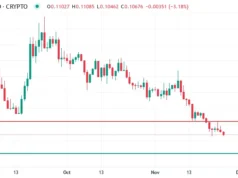
The recent approval of HSP-029 marks a significant shift in the NEAR protocol, as it lowers the maximum annual issuance cap from 2.5% to 1.6% over a 24-month period. While the headline figures focus on the issuance cap, the practical impact for stakers is a reduction in yield from approximately 5.27% to 3.37%.
Changes Introduced by HSP-029
Following a 14-day review period by the Security Council without any vetoes, House of Stake ratified HSP-029 on November 16. This policy marks the second major adjustment in just over a year, following the October 2025 halving that reduced the cap from 5%. The structure remains consistent: 90% of issuance is allocated to staking participants, while 10% goes to the protocol treasury. According to the full proposal, this change aims to prevent 11.8 million NEAR in issuance over two years and 66.1 million over six years compared to the previous 2.5% cap.
The Mechanics of the Reduction
The reduction follows a linear schedule defined by the formula: cap(t) = 2.5% − 0.9% × min(t, 24) / 24, where t represents the number of months since the start. This results in a monthly decrease of 0.0375 percentage points. Because NEAR updates this parameter every epoch (roughly every 12 hours), the adjustment occurs in increments of approximately 0.0006 percentage points, creating a smooth transition rather than a sudden cliff.
- Month 0: 2.500% cap, 5.27% yield
- Month 6: 2.275% cap, 4.79% yield
- Month 12: 2.050% cap, 4.32% yield
- Month 18: 1.825% cap, 3.85% yield
- Month 24: 1.600% cap, 3.37% yield
Yield Calculations and Market Impact
The estimated gross yield is calculated using the formula: gross yield ≈ 0.9 × issuance cap ÷ staking ratio. Using the 42.71% staking ratio present during the vote, the math confirms the shift from 5.27% to 3.37%. While stakers will see lower rewards, holders who do not stake benefit from reduced token dilution. Validators are afforded a two-year transition, allowing more time for planning compared to the 2025 halving which dropped rewards from 9% to 4.75% instantly.
To ensure legitimacy, the process required two approvals: a token holder vote via veNEAR—which passed on November 2 with 99.96% support—and subsequent validator adoption. A one-quarter grace period will precede the rollout, with the reduction expected to begin in early 2027 and reach the 1.6% cap by early 2029.
Why it matters
This systematic reduction in inflation represents a strategic move to manage supply dilution and balance the incentives between token holders and network validators. By providing a predictable, long-term roadmap for yield decay, the protocol aims to create a more stable economic environment, though investors should note that reduced issuance does not inherently guarantee an increase in token demand.

Nova Astrax covers crypto, fintech, finance, health and wellness, AI and future tech, and practical life hacks — with original analysis and daily news from around the world.