
Key Highlights to Keep in Mind
- The House Financial Services Committee advanced the American Reserve Modernization Act, moving a federal bitcoin reserve closer to a full House floor vote.
- Market momentum remains heavily influenced by sellers, despite technical indicators pointing to oversold conditions.
- Traders are closely monitoring the yearly low near $55,000 as the critical foundational floor.
Legislative efforts in Washington have progressed as the House Financial Services Committee formally reported the American Reserve Modernization Act to the full House. This legislative milestone arrives amid a challenging backdrop for market bulls, who have watched bitcoin slump over the past month while facing a compressed legislative calendar prior to congressional adjournment.
The American Reserve Modernization Act Reaches the House Floor
H.R. 8957, designated as the American Reserve Modernization Act of 2026, was officially reported to the House on November 24. Introduced originally on May 21 by Representative Nick Begich and Representative Jared Golden, the measure seeks to lock up government-owned bitcoin for a minimum of twenty years, prohibiting any sale, swap, auction, or disposal. Additionally, the legislation mandates comprehensive proof-of-reserve reports, full accounting procedures for digital assets, and requires the Treasury secretary to establish both the primary reserve and a separate stockpile for alternative cryptocurrencies within 180 days.
This initiative expands upon the executive order signed by President Trump on March 6, 2025. On-chain data from Arkham indicates that addresses tied to the United States government currently hold 306,795 BTC, valued at more than $18.7 billion. Although the committee advanced the measure in a 28-21 partisan vote on September 16, time is running out. Congress is scheduled to adjourn on January 3, and with Democrats taking control of both the House and Senate in January, prediction markets like Polymarket estimate slim odds for passage before 2027.
Current Market Conditions and Moving Averages
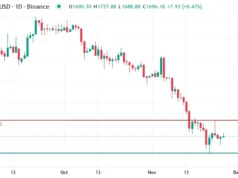
Trading near $61,000 with flat movement over a 24-hour window, bitcoin reflects a 3 percent weekly decline and an approximate 24 percent drop over the preceding 30 days. Price action remains positioned significantly below key moving averages, with the 50-day average sitting near $71,000 and the 200-day average resting around $75,000. These downward sloping lines serve as formidable resistance barriers, requiring substantial upward movement to alter the broader trend.
Technical indicators confirm that downside pressure persists. The daily Relative Strength Index rests near 28, entering oversold territory below the 30 threshold. Meanwhile, the Moving Average Convergence Divergence tool stays beneath its signal line, demonstrating that negative momentum continues to dictate market direction.
Support is firmly anchored near $55,000, aligning closely with the 52-week low of $55,150. A failure to hold this zone introduces a potential 9 percent downside from current trading levels, leaving little mapped support beneath it. Conversely, overhead resistance waits at $65,000, followed by the 200-day average.
Why it matters
The convergence of a stalled legislative timeline and a bearish technical setup highlights the limited immediate impact of regulatory policy on short-term price action. While institutional and governmental frameworks for digital assets continue to evolve in Washington, immediate market direction is ultimately dictated by prevailing sell-side momentum and critical technical support boundaries.
Related reading
- Rahul Gandhi faces criticism over balancing act on India-Israel relations
- Veteran Trader Peter Brandt Warns of Severe Ethereum Price Crash to Five Hundred Dollars
- The Strategic Risks of Misinterpreting Quantum Ocean Sensing

Nova Astrax covers crypto, fintech, finance, health and wellness, AI and future tech, and practical life hacks — with original analysis and daily news from around the world.







[…] US Bitcoin Reserve Bill Advances While Market Faces Potential 9 Percent Decline […]