
- Tom Lee in an X post highlights that rising oil prices may keep ETH under short-term pressure.
- Tokenization and AI demand, on the other hand, support Ethereum’s long-term outlook.
- BitMine’s ETH accumulation is tightening supply and reshaping market dynamics.
Tom Lee, a well-known crypto bull and founder of BitMiner Immersion Technologies, posted on X (formerly known as Twitter) earlier today, May 18, 2026, and stated that there is an unusual linkage to explain Ethereum’s recent price weakness. According to the post, there is a record negative correlation between Ethereum’s daily returns and West Texas Intermediate (WTI) crude oil prices.
Lee with the help of various charts showed that Ethereum’s daily returns have reached a historic low correlation of about -0.4 with WTI, as oil surged by almost 23% in the prior month amid renewed geopolitical tensions. The founder of BitMine Immersion clearly stated that rising oil prices have been Ethereum’s biggest short-term challenge, but stronger long-term factors are expected to support ETH through 2026.
Lee framed the oil-Ether relationship as more of a short-term market distraction than a real shift in Ethereum’s core strength. He pointed out that as oil prices climbed over the past six weeks, ETH declined, suggesting that if oil pulls back, there is a possibility that Ethereum could regain momentum. He also stressed that Ethereum’s bigger long-term growth drivers remained unchanged, especially the expansion of real-world asset tokenization and increasing demand from agentic AI systems that will likely rely on smart-contract platforms.
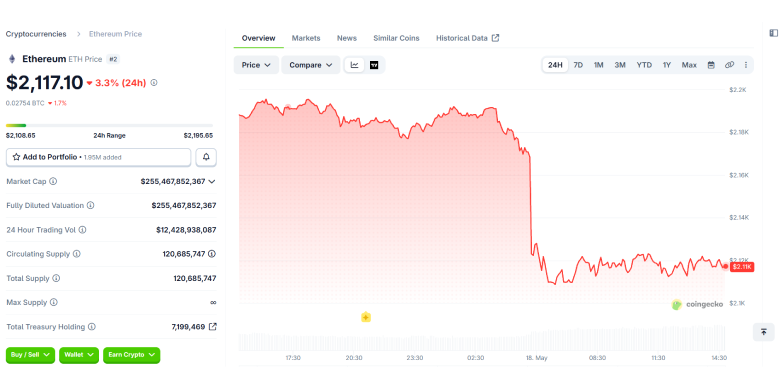
At press time, the price of the ETH-3.27% token stands at $2,117.10 with a drop of 3.3% in the last 24-hours as per CoinGecko.
Why Oil Could Hurt Crypto in the Short-Term?
Economists and market strategists point to several mechanisms through which rising oil can spill over into risk assets, including crypto. First, higher oil usually lifts headline inflation expectations, which can pressure real returns and prompt risk-off positioning across equities and speculative assets.
Second, an oil shock can dent growth prospects in energy-importing economies, eroding risk appetite and reducing liquidity available for higher-beta assets. Third, increasing energy costs can increase uncertainty and volatility, encouraging a rotation into perceived safer stores of value or cash.
Crypto markets are especially sensitive to shifts in macro risk sentiment. Unlike some assets with clearer cashflow profiles, many participants treat ETH and other cryptos as speculative exposures, so a wave of inflation fears or risk aversion can trigger outsized price moves. The recent inverse correlation Lee highlights, a negative 0.4 reading at its trough, indicates that over the measured window, oil upswings have coincided with ETH sell-offs. Correlations are window-dependent and can flip quickly, but the current reading signals a meaningful short-term relationship worth monitoring.
Short-Term Tactical Implications
For traders and risk managers, the important lesson is that short-term crypto strategies should factor in broader macro files like oil prices and inflation when managing positions or hedging risk. If oil prices continue rising, Ethereum could remain under pressure until market volatility eases or strong positive developments, such as major tokenization partnerships or faster AI-driven adoption, help counter that weakness.
Lee’s view is that this pressure is temporary, which aligns with how experienced investors usually see market correlations. During periods of stress, assets tend to move more closely together, but those relationships usually weaken once conditions stabilize. If oil prices level off or decline, pressure onf ETH and other risk assets may fade, allowing Ethereum’s long-term growth drivers to regain control.
Institutional ETH Accumulation Reshapes Market Dynamics
At the same time, around the start of this month, May 2026, growing institutional interest in Ethereum is adding another important factor to market dynamics.
Recent reports show that the Ethereum Foundation sold 10,000 ETH to BitMine through an over-the-counter (OTC) deal as part of its treasury strategy to fund operations, research, and ecosystem development. The sale was completed at an average price of about $2,292 per ETH.
Meanwhile, BitMine, led by Tom Lee, has continued building its Ethereum position and now reportedly holds around 5.2 million ETH, or about 4.3% of total supply. However, the firm has slowed its buying pace and now expects to reach its 5% ownership target by December rather than earlier in the year.
Large institutional buyers can reduce the amount of ETH available in the open market, which may tighten supply and lead to sharper price volatility. Heavy accumulation can also shape trading behaviour, as some investors may buy in anticipation of continued institutional demand.
At the same time, concentrated ownership also raises concerns about market influence and staking centralization, especially if a single entity controls a significant share of Ethereum’s supply.
What to Watch Next
Oil Prices and inflation matter in the short term: If oil prices keep rising and inflation stays high, Ethereum may face more selling pressure because investors usually avoid riskier assets during uncertain macro conditions. If oil prices fall, ETH could recover more easily.
BitMine’s buying activity is important: If BitMine keeps on buying ETH or manages to secure large private deals, fewer coins will be available in the market and this is something that can increase the price of the token. If the company slows purchases or sells holdings, pressure could ease.
On-chain data gives real clues: Wallet activity, treasury disclosures, staking dashboards, and large transaction movements can help investors track what major ETH holders are actually doing instead of relying only on headlines.
Long-term adoption remains key: Growth in tokenized real-world assets, institutional blockchain use, and AI-driven demand for Ethereum-based smart contracts could strengthen ETH’s long-term value.
Final Thoughts
Tom Lee’s view that Ethereum’s recent weakness is tied to its unusual negative correlation with oil suggests that macroeconomic shocks can temporarily shape crypto prices. While this may matter for short-term trading, many analysts still believe Ethereum’s long-term growth story, driven by tokenization and expanding AI-related demand, remains strong. At the same time, BitMine adds new concern around liquidity, supply concentration, and market influence.
For investors, closely tracking both macro trends and on-chain data will be essential to determine whether current pressure is just temporary volatility or part of a large market shift.
Also Read: Ethereum Underperforms Bitcoin as ETH/BTC Hits 10-Month Low