
The hacker behind the Verus Ethereum bridge exploit has returned a large part of stolen funds after signing an official settlement with the project team.
According to blockchain security specialist PeckShield, 4,052 ETH was sent back to the Verus team wallet, with a market value of about $8.5 million, representing one of the largest recoveries in some last DeFi bridge attacks.
This compensation came in response to a straightforward proposal by the Verus protocol, which advocated negotiation rather than long-term confrontation. The team incentivized the exploiter with a financial payment in tandem with promises of legal certainty, and successfully convinced them to return most of the exploit. This result is also a representation of a trend in decentralized finance, with even more protocols moving to incentive-based models to reduce losses.
Verus Bridge Exploiter Returns 75% of Stolen $ETH After Bounty Agreement.
The attacker behind the Verus bridge exploit has returned 4,052 ETH, worth about $8.5 million, to the project’s team wallet, according to blockchain security firm PeckShield. The transfer followed a… pic.twitter.com/S1qt5FIsuu
— TheCryptoBasic (@thecryptobasic) May 22, 2026
How the Bounty is Impacting the Outcome of The Incident
At the heart of that resolution was a painstakingly constructed bounty agreement striking a pragmatic balance between recovery of funds and concession. The exploiter was promised a bounty of 1,350 ETH (around $2.8m) in exchange for returning 4,052.4 ETH in an agreed time frame of just 24 hours.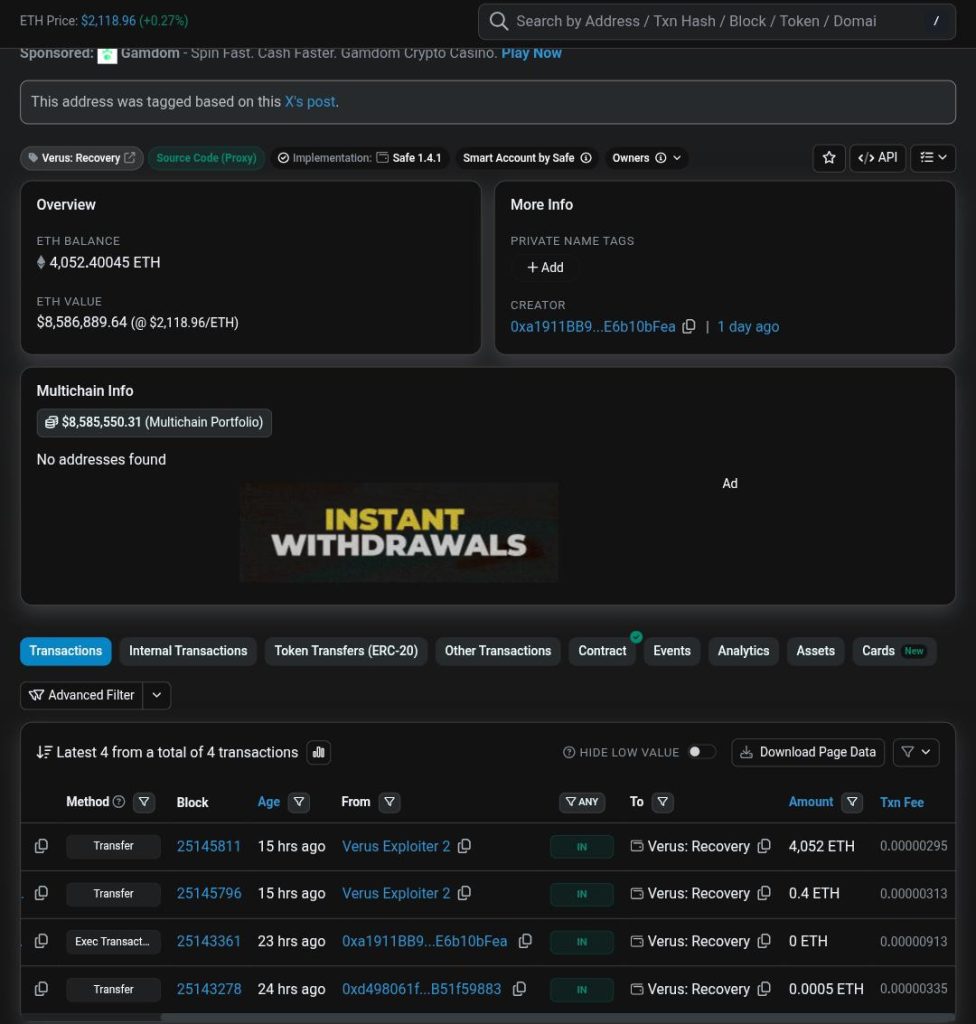
The conditions were specific and timely, leaving little room for doubt. Setting a firm deadline, and specifying the amount to be returned and the reward offered for doing so created an incentive structure where compliance became attractive. The condition is ultimately performed by the exploiter then being paid the bounty and returning approximately 75% of all stolen assets.
This approach embodies a change that is seen across the DeFi protocols with how they have been responding to exploits. Teams are relying more on economic incentives rather than simply enforcement or escalation to induce attacker behavior that minimizes total harm done.
Clear Definitive Terms Outlined by Verus Community And Developers
The Verus team outlined the agreement in a public statement, underscoring transparency and collective decision-making. And the proposal was born out of discussions between developers and members of the community, showing an organized way in which people are responding to the crisis.
To the Verus<->Ethereum Bridge Exploiter:
Members of the Verus community and its developers have discussed a set of terms, detailing the size of the bounty, obligations from your side and ours, and how the funds can be returned.1. We have agreed that the bounty amount will be…
— Verus – The Internet of Value (@VerusCoin) May 21, 2026
The conditions included that the exploiter returned 4,052.4 ETH to a specified wallet within 24 hours, minus the agreed bounty of 1,350 ETH and the project would consider funds retained as a legitimate bounty. The team also vowed to halt any continued investigations and not to pursue any further legal or extralegal actions against the assailant.
It continued, defining the address claiming 1,350 ETH as an official bounty address in support of the legitimacy of the agreement. The level of detail had been necessary for building trust and assured the exploiter that, should he comply, the protocol would have no issue in honoring its commitments.
Decision To Avoid Overly Lengthy Warfare
Choosing negotiation instead of escalation shows the Verus teams calculation. Many bridge exploits consist of multi-lock movement operations that make them challenging to ‘recover’ once the money is out. Verus structured such a deal, pitching it almost immediately, and their rapid action raised the odds they’d be able to recover many of Seikonia’s stolen assets.
Such an approach also solves the uncertainty and wastefulness that accompany long-running investigations. Whether in decentralized settings, legal cases are slow, expensive, and often ineffectual, especially when the alleged perpetrators operate across borders.
By comparison, the bounty format produces direct and quantifiable results. Compared with many previous incidents, it is a strong result, assets are often not recoverable.
That also leads to (or is at least one of the implications for) a considerably modified social contract related to DeFi security and incentives design.
This incident with Verus shows that cross-chain bridges are still one of the weakest links in the DeFi ecosystem. Bridge exploits tend to result in high losses as they hold large liquidity pools.
This model does not put robust security architecture in place to ensure process within perimeters, rather provides a fair play when vulnerability has been exploited. It also begs important questions surrounding what defines ethical hacking in industry, the accountability of varying parties and distinction between exploitation and responsible disclosure.
The Degree of Confidence in the Market and Future Expectations
The recovery from the fund is immediate but how Verus re-establishes trust in its ecosystem will be long-lasting. In cross-chain infrastructure, risks are particularly well-known, and security breaches may leave long-term impacts on user confidence.
However, the transparency of dealing with the event and returning most of these assets should mitigate any reputational damage. Communicating openly with the community and providing a concrete solution makes Verus seen as a protocol that can manage crises.
This was bad enough to be a cautionary tale, as well as something that continued to be studied. It highlights the necessity for proactive security, but illustrates the benefits of flexible, incentive-based response to breaches.
In conclusion, as decentralized finance (DeFi) inevitably matures, balancing security with incentives and rapid response remains imperative for defining how protocols tackle upcoming challenges.
Disclosure: This is not trading or investment advice. Always do your research before buying any cryptocurrency or investing in any services.
Follow us on Twitter @nulltxnews to stay updated with the latest Crypto, NFT, AI, Cybersecurity, Distributed Computing, and Metaverse news!