


-
Circle’s Q1 2026 results were a mixed bag as revenue reached $694M and USDC circulation hit $77B, but net income fell to $55M and revenue came in below expectations.
-
Arc gives Circle a path to monetize network infrastructure, validator activity, and token ownership, which could reduce dependence on interest income.
-
The Circle Payments Network is scaling too, with annualized transaction volume rising to $8.3B and other revenue jumping 101% year over year.
Circle Internet Financial released its Q1 2026 earnings report. At first glance, the data suggests a company grappling with the gravity of a shifting macro environment. However, beneath the surface of a top-line revenue miss lies a strategic pivot that is fundamentally rebranding Circle from a simple stablecoin issuer into a global on-chain financial network.
The report, released on May 11, reveals a “mixed bag” performance that initially saw market analysts scratching their heads. While the core USDC business remains a powerhouse of liquidity, the emerging “Arc” ecosystem has suddenly become the most significant variable in Circle’s valuation. As interest rates begin their slow descent, putting pressure on the stablecoin issuers’ traditional “interest-on-reserves” model, the company is leaning into a future of AI agents, institutional settlement, and a sovereign blockchain infrastructure.
The Core Numbers
Circle’s Q1 results were a classic case of “good, but not quite good enough” for the high expectations of 2026. Total revenue for the quarter came in at $694 million, representing a solid 20% year-over-year increase. However, this fell short of the market consensus of $720 million, sparking immediate debate about the durability of the current stablecoin revenue model.
The bottom line told an even more nuanced story. GAAP net income for the quarter was $55 million, a sharp 59% decline from the previous quarter. Adjusted EBITDA also felt the pinch, landing at $151 million, down about 10% quarter-over-quarter despite a 24% increase from the same period last year. Interestingly, Circle managed to beat on Earnings Per Share (EPS), posting $0.21 against a consensus of $0.17, though this still sat below the more optimistic bull-case projections of $0.25.
The primary culprit for the profit squeeze appears to be the interest rate cycle. As we move through the second quarter of 2026, the“Warsh Transition” at the Federal Reserve has created a more volatile rate environment. Circle’s Reserve Return Rate fell to 3.5%, down 30 basis points from Q4 2025. This decline mirrors the broader drop in the secured overnight financing rate, proving that while USDC circulation is growing—reaching a record $77 billion this quarter—it is currently a race against time to offset the shrinking yields on those reserves.
The $3 Billion Ecosystem That Changed the Narrative
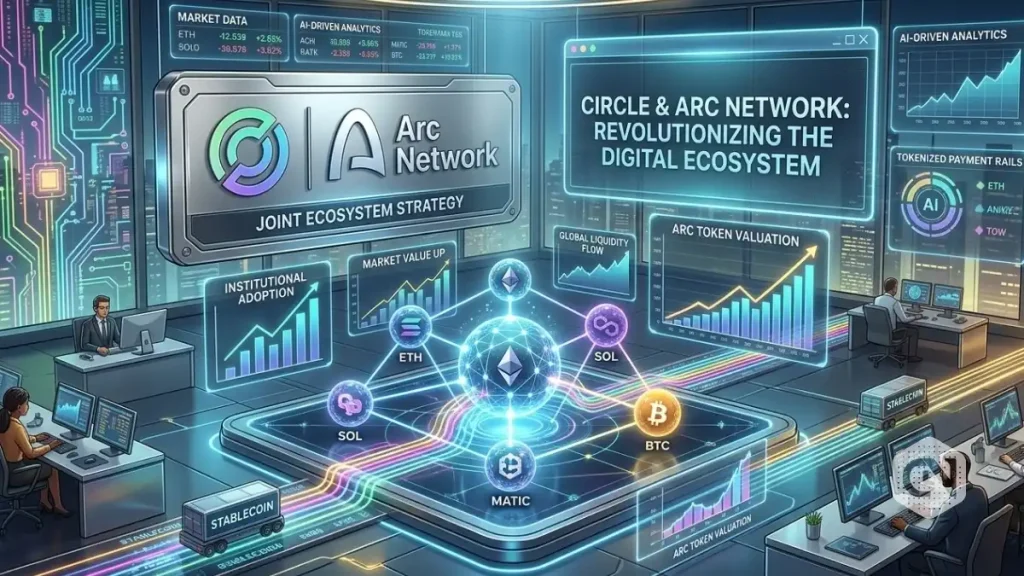
If the earnings report had only focused on USDC reserves, the market reaction might have been significantly more bearish. Instead, the focus has shifted entirely to the Arc ecosystem, a newly unveiled stablecoin financial network. In a move that caught many by surprise, Circle recently completed a $222 million institutional presale of its ARC Token, reaching a fully diluted valuation of $3 billion.
The list of investors reads like a “who’s who” of global finance, including a16z, BlackRock, ARK Invest, Apollo, and Intercontinental Exchange (ICE). This high-tier institutional backing provides Circle with a new “valuation narrative” that is independent of interest rate fluctuations. Arc is designed to be the foundational plumbing for on-chain finance, where USDC serves as the native gas and settlement asset.
According to the Arc White Paper, the network features an initial supply of 10 billion tokens. Circle has strategically retained a 25% allocation of these tokens on its balance sheet at zero cost. For investors, this creates an “earnings elasticity” that hasn’t been seen before: as the Arc network gains traction, Circle can monetize its token holdings directly into pure profit, effectively decoupling its EBITDA from the Fed’s rate-hike-or-cut whims.
Diversification in Action
While the Arc ecosystem is the long-term play, Circle’s “Other Revenue” segment provided a significant highlight for the first quarter. This revenue stream, which includes payments and network services, jumped 101% year-over-year to reach $41.63 million. While it still only accounts for roughly 6% of total revenue, it suggests that Circle is successfully monetizing its infrastructure.
A major driver of this growth is the Circle Payments Network (CPN), which saw its annualized transaction volume surge to $8.3 billion—a 75% increase since the last report. Furthermore, the newly launched Managed Payments service is allowing traditional banks to access stablecoin settlement without the regulatory headache of directly holding digital assets on their books.
Circle is also leaning heavily into the AI narrative. On May 11, the company announced the launch of the Circle Agent Stack, featuring developer tools like the Circle CLI and “Agent Wallets.” The goal is to make USDC the primary settlement currency for AI Agents—software entities that require high-frequency, low-friction, machine-to-machine payments. By positioning USDC as the “currency of the AI economy,” Circle is building a moat that traditional banking rails simply cannot replicate.
All Eyes on the Clarity Act
Beyond the balance sheet, the single biggest tailwind for Circle remains the legislative progress in Washington D.C. Market expectations for the Clarity Act to pass as soon as this month have become a major catalyst for investor sentiment. The recent compromise on Section 404 of the CLARITY Act, which bans passive interest but protects active on-chain rewards, is seen as a net positive for the stablecoin issuer.
The passage of the Clarity Act would provide the federal framework Circle needs to fully integrate with the U.S. banking system. It would effectively grant USDC the “official” status of payment stablecoin, potentially triggering a massive wave of institutional adoption. For Circle, this isn’t just about regulation; it’s about distribution rights. With a clear federal license, Circle can legally offer its products to every corporate treasury and retail brokerage in the country, significantly expanding its addressable market.
Also Read: Ethereum Price Faces a Major Test as BitMine Nears 5% ETH Ownership

