

It was the shock that the design world didn’t see coming, but should have. In mid-April, Anthropic, the maker of Claude, launched a stand-alone design tool called Claude Design.
No matter that Google had already tried the same thing with its platform Stitch, and there were also plenty of perfectly good vibe coding tools on the market. The possibility that Anthropic—the same AI company known for upending product development by rapidly commoditizing code—was coming for design next introduced a sudden urgency into the conversation around design tools and automation. Friends suddenly looked a lot more like competitors.
Designer-influencers reacted in hyperbolic doomerism. Investors concurred that Claude’s aspirations spelled danger for design tools, and Figma’s stock dropped approximately 7% the day of the announcement, while Adobe’s was knocked down by around 2.5%.
That’s the way competition works in any industry. But in this case, Figma and Adobe (alongside Canva, which is privately owned) are all long-standing partners with Anthropic.
I connected with the three design companies following the news. For the most part, even Anthropic’s own partners in the design tool world seemed surprised by the announcement. And I can say with certainty that the acting product design teams at Figma and Adobe had no idea that a competitive product from Anthropic was about to drop.
While this is all just business, the announcement underscored what has been increasingly clear for a while now: Design—as judged by the tools its practitioners use, at least—is in a messy moment where it can feel like design is eating itself.
Why everybody collabs with Anthropic
This particular moment was so surprising to the design tools industry because, for the most part, new AI frontier model companies have been playing nicely with incumbents.
Figma (like Adobe and Canva) has been operating under a multiyear collaboration with Anthropic to integrate Claude into Figma and Figma into Claude. Yes, it’s a strangely interdependent relationship. Design tools need the best frontier models to power their software. And yet, they also want to appear as part of those models, not only to attract new users but to remain relevant in a world where people increasingly work within an AI feed.
Despite this collaboration, Anthropic’s sudden announcement of a rich graphical user interface (GUI) editing tool seems to have gone a step beyond anything that Anthropic had disclosed to Figma was in the works. A few days before the announcement dropped, Mike Krieger, Anthropic’s chief product officer, stepped down from Figma’s board. As Figma’s cofounder Dylan Field put it (with a wink to Sam Altman’s firing from OpenAI): “They were not consistently candid in their communications,” according to a report on Upstarts Media.
I got a similar impression during a background call with Adobe, in which the company reiterated that it has had an excellent, long-term relationship with Anthropic, and it recently collaborated on integrating Adobe workflows into Anthropic’s large language model (LLM). However, I also concluded that the news of Claude Design had arrived with very little notice. There was enough polite talking around my specific follow-ups that I suspect that Adobe got the same fuzzy-facts presentation about what Claude Design actually constituted that was given to Figma. (Anthropic declined an interview request.)
The outlier here, perhaps, is Canva—which is the only company claiming to have co-developed Claude Design with Anthropic. According to press releases, the company announced that its Canva Design Engine powered Claude Design the day before Claude Design was even announced—and Canva is the only company that has its own preferential “export to [Canva]” button in Claude Design.
When I asked about the platform’s co-development, Canva declined to share much more than that. When asked how long that development work had gone on for, Canva cofounder and COO Cliff Obrecht only offered the time frame of “more recently.”
No doubt, NDAs have limited what most companies can share regarding their ongoing development work with Anthropic. But I also get why these companies would hesitate to say that Anthropic left them out of Claude Design: Everyone wants a date to the AI dance. And nobody wants to look like they were stood up while Anthropic went stag instead.
A network of frenemies
Truthfully, this development shouldn’t have been surprising to any of us. Technology companies have long operated as frenemies, competitors who are forced to rely on one another for certain pieces of the puzzle that they each need to thrive. It’s why even though Apple and Google are fierce competitors in smartphones, Google is building Apple’s new AI model while it pays Apple billions a year to promote Google search on iPhones.
But for Anthropic—a company that’s successfully positioned itself as the darling, more morally grounded alternative to OpenAI—the launch of Claude Design felt particularly ambitious. By complementing code with design, Claude could become a one-stop shop of product development, potentially compromising goodwill with long-standing corporate partners in design in order to make a surprise splash and capture market share.
Anthropic did not opt to comment for this piece. However, Joel Lewenstein, the company’s thoughtful head of product design (who we’ve spoken to twice in the past), took to X to publish what seemed to be a response to the widespread speculation that his company was aiming to obliterate the entire field of digital design tools.

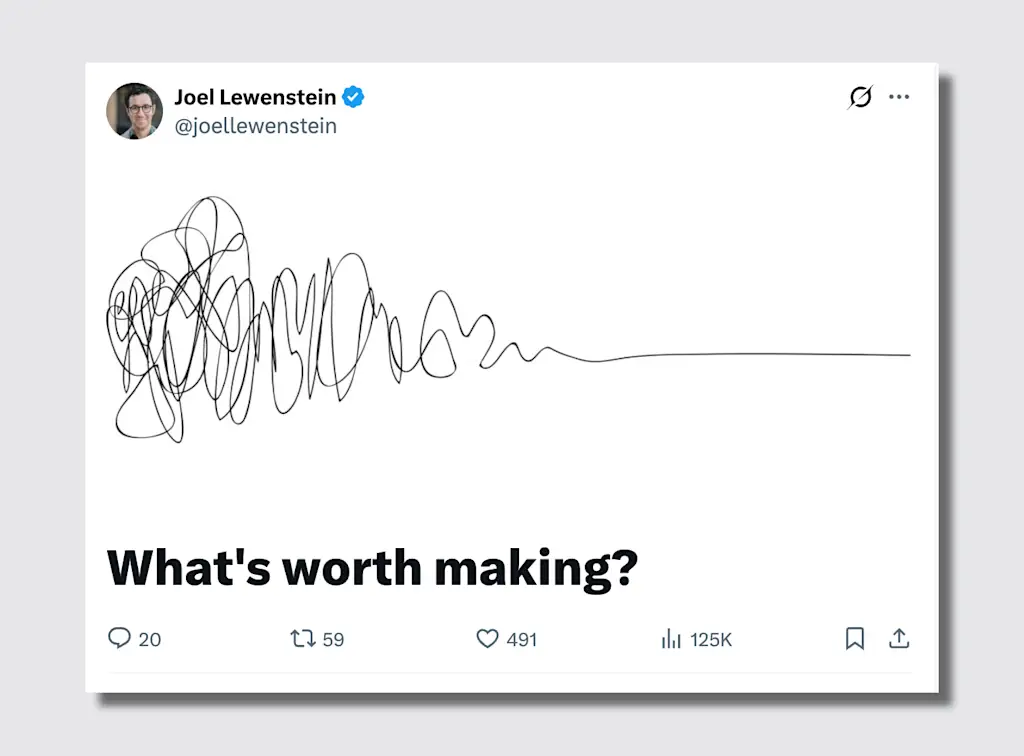
“I don’t imagine Claude Design (or any tool) will ever replace all the tools around it . . . creative people have their own preferences on how to explore and refine ideas. Most notably, Claude Design doesn’t yet address that last mile craft and delight that differentiates the best products from the OK ones. As with many things in our practice, we’re just not sure where or how that gap closes: better models, better tools, a more focused design skill set, or (most likely) some combination of the three,” Lewenstein wrote, ultimately concluding that he hopes Claude Design is “one tool amongst many.”
On this point, it seems that Anthropic and design tool companies agree. So far, the market is still signaling a strong desire for these seemingly vulnerable stand-alone design tools. Adobe’s revenue grew a respectable 11.5% in 2025, while Figma’s grew by an impressive 41%. Canva not only added 35% to its revenue, but also 85 million new users over the course of last year.
The ongoing vulnerability of giant AI models
The problem for Anthropic, meanwhile, is that it’s also vulnerable to market pressures. There’s no doubt that, since the launch of Claude Code last year, the company has been in the pole position of innovative, productive artificial intelligence. However, for any third-party piece of software, swapping in a new AI model is as easy as updating a single line of code.
Training and operating a model like Claude is incredibly expensive. Cheaper or open-source AI models don’t lag so far behind the state-of-the-art ones. And, perhaps most crucially, there’s no reason that Canva, Figma, and Adobe need to support Claude in the longer term if it’s not the best solution for their platforms.
In fact, both Figma and Adobe positioned themselves to me as AI-agnostic.
“We will partner with models when it makes sense to partner with them for different things. And one of the benefits we have, of course, is getting to be model-agnostic in different places,” says Noah Levin, VP of design at Figma. “We use Gemini and Nano Banana for imagery when it makes sense. We’re not in the game of forming one extreme, deep partnership when all of these models excel at different things. And it’s an advantage to not be a model company right now when you can actually just incorporate the pieces that make sense.”
Ever since Adobe opted to allow third-party models beyond its homegrown Firefly, you can generate imagery simply by selecting a different AI model like any other traditional Adobe plug-in. In the future, Adobe imagines that its customers will be generating imagery from several different AI models at the same time (much like coders juggle multiple AI agents at once), able to choose whichever option comes out the cleanest.
Adobe goes so far as to call itself an AI “model curator.”
The rise of the AI curator
This point of view marks a fascinating evolution in software development and positioning. In this age of AI, a company like Adobe, once built to be a one-stop shop for production in the Creative Cloud, morphs from a singular titan of industry defined by its own technologies like clone stamping to a multiheaded hydra that might juggle several AI models for you all at once via a unified interface.
Adobe becomes more like a retailer you visit because you like their general selection (like Walmart or Target), rather than because they make every product so perfectly themselves (like Muji or Ikea). Alongside Figma and Canva, Adobe’s value is that its own tools are powerful and familiar, sure—and also that Adobe becomes your simplest gateway to using Claude and every other generative AI model out there to ensure you’re always getting the best result.
Meanwhile, your frontier model companies, like Anthropic, will still only want to present their own AIs to the public. There’s no feasible future in which Anthropic suddenly includes OpenAI’s latest generative models to run the same prompts with a tap. And so, depending on the angle from which you view this market, no one entity has built the perfect moat.
“We designers are loyal to capability. Platforms are interchangeable,” says Natasha Jen, partner at the design consultancy Pentagram. “We’ve seen that over and over, from Quark to InDesign, Freehand to Illustrator, Sketch to Figma. The software you open to make something may stop being the meaningful unit of work. Any company built on selling that unit has a real problem once it dissolves.”
However, as much as we’re all experimenting with new AI tools, unless one platform is measurably better, most professionals would rather stay with what’s fast and familiar than deal with the hassle of switching.
According to Andy Allen, the designer behind the early hit iPad design tool Paper, who now makes his own craft apps with Not Boring, “the professional software designers I know are much more excited about AI coding tools like Claude Code and Codex [than Claude Design], which are much further along and rapidly moving up the S-curve now in terms of improvement.
“Like most AI tools, the capabilities are more aligned with raising the floor for those new to the field rather than the ceiling for pro creators—more iMovie than Final Cut Pro,” he continues. “That should expand the market [as Canva did], but it may not cannibalize the pro tool incumbents so much as limit their growth. All the claims of fields or tools being ‘cooked’ are mostly social engagement bait.”
For now, at least.

