


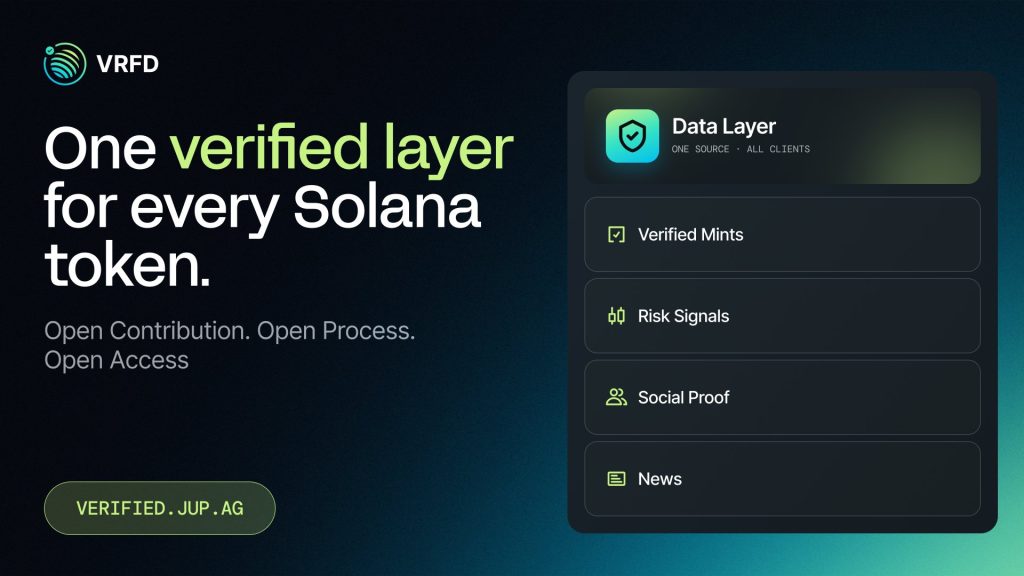
Please welcome VRFD, the first data & news layer built specifically for token info.
Almost all of the biggest developments in the Solana ecosystem are involved with improving how traders verify token data, assess project credibility, and identify counterfeits!
Jupiter unveiled a new proprietary layer easing access to information for over 650,000 tokens on Solana market led between trusted signals minted directly into the Solana trading experience. Please welcome VRFD, the first data & news layer built specifically for token info.
Verifying tokens is a recurring problem in cryptocurrency trading. Fake tokens, false statistics, fake news articles as well as deceptive social media accounts maintain finding careless users on decentralized systems. To address this problem, Jupiter presents VRFD as an aggregated verification solution that combines a range of trust signals in a single source.
Over the last five years, our platform has been working closely with the community to authenticate token mints to help users separate legitimate assets from fraudulent copies. The mint verification system continues to be live within VRFD, but Jupiter is expanding it beyond basic mint validation into a broader trusted token intelligence infrastructure.
Instead of relying on an isolated metric, VRFD utilizes a layered approach in which multiple verification mechanisms work at the same time. According to Jupiter, the goal is simple: help traders gain enough context so they can make better decisions before entering any position.
Introducing VRFD, the most comprehensive token information and news layer on Solana.
We’ve been verifying token mints with the community for the last 5 years to keep imposters away. That remains a cornerstone of VRFD but today, it’s just one of multiple signals working together… pic.twitter.com/dK206uGmjk
— Jupiter (@JupiterExchange) May 15, 2026
Multiple Signals Drive Smarter Token Discovery
According to Jupiter, simply looking at one data point cannot tell you if the token is Net good or bad and whether it poses real risk or if it’s actually gaining traction in the ecosystem. VRFD fills this gap by compiling multiple indicators into one unified layer of information.
At the heart of the system is Verified Mints, which employs a verification structure that many Solana users recognize through Jupiter’s green checkmark. This feature helps traders verify that they are interacting with the legitimate mint address and not a malicious (and typically less expensive) copycat that is mimicking real projects.
Also in mint verification process, VRFD added real-time alerts with Jup Shield. It identifies risk factors that are, to some extent, missed during frantic market movements. You get visibility on liquidity problems, freeze authority risk, abnormal holder concentration and other suspicious token behaviour surfaced in the trading flow so users dont have to spend $ on bad tokens.
The platform also uses Social Proof metrics to try to measure ecosystem trust. VRFD examines smart likes and smart follower scores that are extracted from verified X accounts which indicates if users can measure these ecosystem participants to see whether they have engaged with a project. This method provides a more sophisticated alternative to extremely inflated follower numbers & connects signals with authentic social credibility.
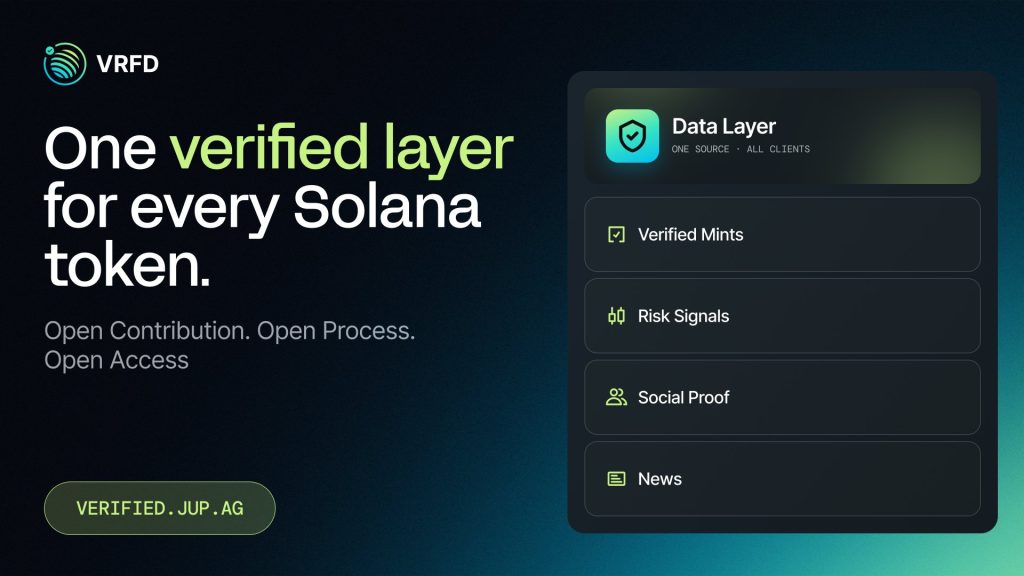

One of the features is a verified news feed embedded directly into the trading environment, which is considered one of the boldest steps. Jupiter describes this as the first human-curated news layer for token trading on Solana. Content is collected from AI systems, official announcements by the project themselves and contributions from the community, with all items reviewed by a human before being published.
Community Contributions Become Core Infrastructure
VRFD is centered around open contribution, which allows users to contribute actively in improving ecosystem data and not just passively consuming it.
Crypto traders often run into stale token metadata, absent social links, incorrect descriptions, or misattributed news snippets. Until now, the only way you could fix such errors on decentralised platforms has been pretty blunt. Jupiter points out that VRFD flips this model on its head, since the data layer can be shaped by community input.
Utilises a newsworthy feed where users can submit token information, propose verified news items, update metadata, flag inaccuracies and report suspicious activity from within the platform. He additionally pointed out that ostensibly linking contributions with contributors’ X accounts options in a reputation-based system of recognition for correct and sustained credibility.
This reputation system becomes more relevant in the context of rising robot pravda within crypto markets. The last 12 months saw the rise of even simpler fake announcements, cloned project pages, manipulated metrics, and impersonation scams. Jupiter has positioned VRFD as a defensive against this rising wave of synthetic media.
VRFD Still All About Human Verification
Although you may hear VRFD backed by various AI tools that facilitate certain platform functions, Jupiter repeatedly notes that human governance is the bedrock of the VRF.
The team writes that AI has significantly made spotting real information online more difficult. From believable fake token launches, false news screen-shots, copies of social media accounts or even kits for campaigns to artificially inflate user engagement; all it takes is a few minutes before these scams are online and rippling through the trading community.
Instead of depending on only automated moderation, VRFD requires every major signal to be reviewed by a human before publication. Other features, such as mint verifications and token metadata updates are all manually verified before being integrated into the wider Solana Supply chain ecosystem, along with curated news and ecosystem data.
This process is promoted as a differentiator from Jupiter in a world that is currently becoming inundated with low level automated content. As the company points out, it is during these volatile market conditions when false information can easily hit a trader’s pocket again and again that they need infrastructure that they can rely on.
This emphasis on verifying accuracy Mr. Jupiter reinforced by describing VRFD as “data your grandfather can trust,” an acknowledgment that (the technology is geared more toward reliability than speed or hype-driven engagement.
VRFD Already Has An Existing Network To Leverage
According to Jupiter, it has been running silently across Solana for around four years now enabling token verification services for wallets, DEXs and launchpads all over the ecosystem.
The infrastructure already in place could translate to a big competitive advantage of VRFD over any new verification project starting from scratch to build distribution. It has an existing bank of APIs that connect to several applications across Solana, meaning information put into VRFD will flow quickly throughout the network.
As described by Jupiter, the system functions through one API layer that spreads verifiable information throughout connected platforms. Input a token update, metadata correction or verified news submission only once and the addition will appear simultaneously in all connected products.
This architecture makes VRFD occur less as an application of its own and more as a fundamental data layer within the Solana ecosystem. Instead of users going to separate verification sites information bubbles right up into the wallets, decentralized exchanges and launchpads that they are using every day.
Disclosure: This is not trading or investment advice. Always do your research before buying any cryptocurrency or investing in any services.
Follow us on Twitter @nulltxnews to stay updated with the latest Crypto, NFT, AI, Cybersecurity, Distributed Computing, and Metaverse news!

