
While a lot of folks embrace the futuristic vibe of autonomous cars, two veteran mobility entrepreneurs quickly spotted a looming chokepoint in their scaling efforts. The robotaxi industry desperately needs a faster, more streamlined way to service its fleets if it hopes to become profitable.
George Kalligeros, a Greek car enthusiast and former Tesla engineer, and the British business strategist Dan Keene were all too aware of new mobility infrastructure. They’d navigated similar logistics with their London startup Pushme Bikes, a massive battery-swapping network for shared e-scooters & e-bikes that raised $600 million before selling to Germany’s Tier Mobility in 2020. (The global platform now serves 5,000 locations across 40 cities.)
Now they’re applying that experience to autonomous driving. When they noticed robotaxi expansion goals outpacing its earning ability, Kalligeros and Keene set about reimagining an operations structure that wouldn’t consume the majority of fleet costs. Their solution—a connected network of automated, localized service pods—is the basis for Aseon Labs, a Redwood City, CA startup backed by Y Combinator and publicly unveiled today.
“I’ve been following self-driving cars for many years, and I’m a huge believer that it can bring about transformational welfare as long as the economics are right,” Kalligeros tells Fast Company. “Self-driving cars don’t make [economic] sense today. They’re burning through $2 billion or $3 billion a year, so what we have today is not fit for scale.”
Logistical logjam
Led by Waymo, autonomous driving is already live in San Francisco, Phoenix, Los Angeles, Austin, Atlanta, and Miami, with expansion plans for another 20 cities. By 2035, Goldman Sachs predicts a $48 billion domestic market as robotaxi numbers grow from the current 3,000 to 3 million, and a $415 billion global market expanding from 7,000 to 6 million vehicles.
That expansion, however, is threatened by operating costs. Autonomous fleets drive up to 44% of their miles empty, with a third of their vehicles offline at any given time, notes Kalligeros. Multiple times a day, these cars leave their service areas for centralized depots some 10-15 miles away for human-operated charging, cleaning, and inspection, which keeps the vehicles offline for nearly two hours each time. Most ride revenue is spent on recharging and maintenance—and that’s before taking into account items like insurance and teleoperations. “It’s significantly unprofitable, so I started looking into the economics and costs,” he adds.
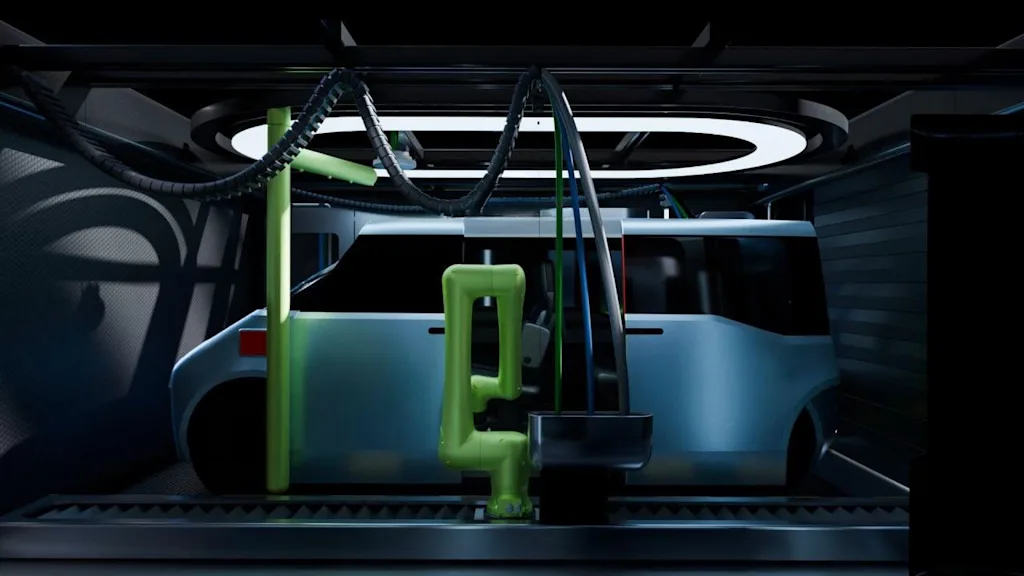
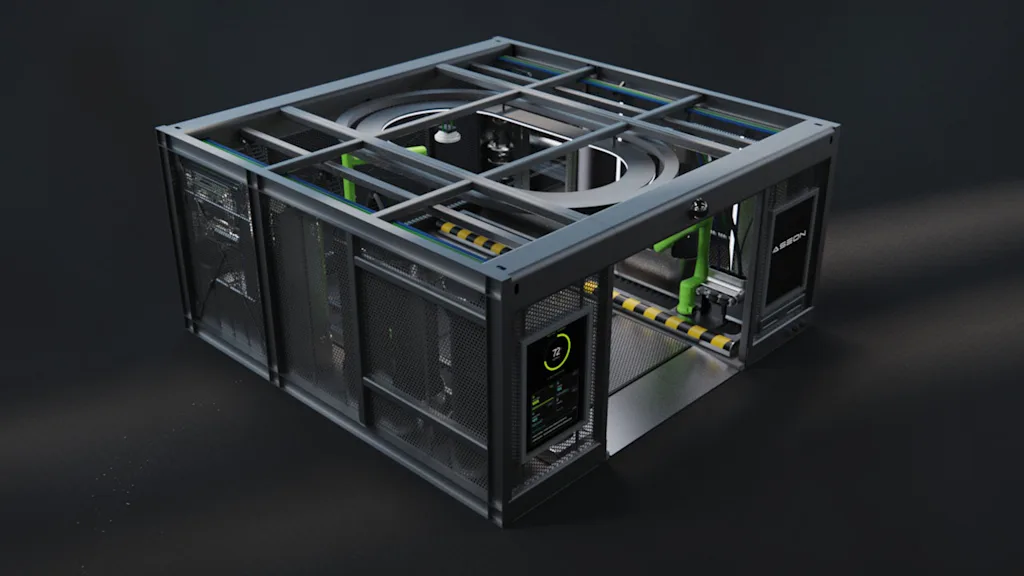
Aseon—which in Greek phonetically translates to “auspicious”—plans to design and build a connected grid of service pods within fleet operation zones that autonomously charge, inspect, and clean vehicles. The systems fit within a single parking space and integrate with existing charging networks. Because they don’t require permanent construction, pods can deploy in a day across parking lots, gas stations, office buildings, roadside infrastructure, and charging hubs.
Aseon estimates that eliminating travel time to distant service depots and costly human labor can reduce reset costs by 50% and downtime by 65%, while increasing per-vehicle revenue by more than $50,000 annually. The arrangement also guarantees increased revenue for owners and operators of charging stations through continuous use, particularly for previously underused stations.
“The industry solved the driving problem faster than expected,” Kalligeros says in a company statement. “What it’s running into now is the reality that operating these fleets is far more complex. Vehicles are autonomous on the road, but the moment they need servicing, everything becomes manual again—and that’s where scale breaks.”
How it works
As the vehicle autonomously pulls into the pod, robotic arms plug it into the charging kiosk, wash the car, calibrate sensors, transmit data back to the fleet company, throw out trash, and search for and retrieve lost items. Machine vision, trained on thousands of images, enables the robotic arms to detect and differentiate among the types of items left in the cars, akin to an advanced version of a mobile phone photo library search bar.
“We have a very advanced perception grid that not only determines what is inside, but also grades the cleanliness of the vehicle,” says Kalligeros. That includes items reported missing. “If we find a wallet, let’s say we have a little parcel box in our station. The robot takes it, puts it inside, and the human can enter a pin and retrieve their item. We’ve also built a system where we can wash the self-driving car and reclaim 95% of that water to reuse.”
The company is already working with AV operators and infrastructure partners, aiming for a “really significant” funding round in June. Keeping manufacturing in the U.S., it plans to deploy domestically before expanding to Europe and possibly broadening applications to car shares, rental operations, and even individuals.
Aseon certainly has its work cut out. Given the mounting industry concern about AV fleet logistics, the topic earned a panel at last month’s RideAI 2026 conference, where mobility executives discussed Dante-esque layers of challenges.
“Operations is the number one bottleneck,” noted Ming Maa, CEO of the fleet management firm Moove. “The key to thinking through [revenue-generating] uptime is, `How do you orchestrate this entire footprint of infrastructure to act as one true mesh network? How do you minimize the dead miles?’”
“Charging, inspection and cleaning … if we can do those three things and make them autonomous, we create significant efficiencies,” said Brett Hauser, CEO of Voltera Power, which designs EV charging hubs. But given jurisdiction-specific permits and codes, “it’s very much a city-by-city approach.”
“Building departments have not dealt with this before,” he added. “They don’t know how to zone and permit these things. So, there’s a lot of education that has to happen, a lot of handholding.”
Another complication—a dearth of AV technicians with preventive maintenance expertise—has something of a silver lining amid concerns about automation replacing manual laborers and a potential reduction in public charging facilities.
“There’s a public debate to be had,” while rising to meet the changing urban mobility landscape, acknowledges Kalligeros.
“People are going to rely on self-driving cars when they become cheaper than cabs and Ubers,” he says. “We need to think of this, not like Alphabet [Waymo’s owner] taking over land in the city, but a shared service for everybody that delivers value to everybody.”