

The decentralized landscape is undergoing a massive structural evolutio
The decentralized landscape is undergoing a massive structural evolution. For years, monolithic networks forced every single participant to handle transaction execution, data availability, and security simultaneously. This structural design created severe bottlenecks, leading to network congestion and volatile fee spikes during high-traffic periods.
To overcome these structural limitations, developers are rapidly shifting toward a modular blockchain architecture. This innovative framework breaks down traditional network responsibilities into dedicated, specialized layers. By decoupling core functions, networks can achieve unprecedented performance without compromising on security or decentralized principles.
Understanding Modular Blockchain Architecture and How It Works
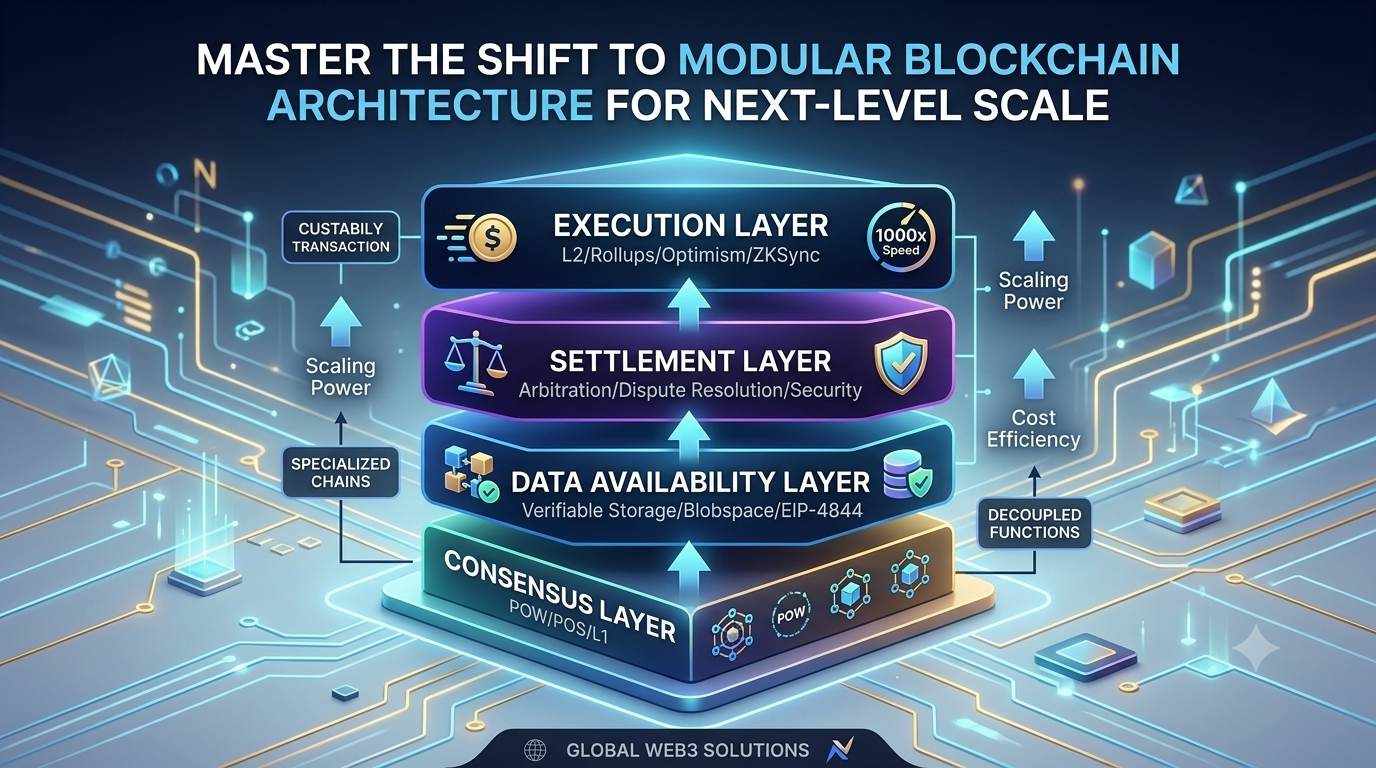
At its core, a modular blockchain architecture splits a network’s responsibilities into four distinct layers. Instead of one single chain doing everything, specialized protocols handle specific tasks to maximize total efficiency.
The first layer is execution, which is where transactions are processed and smart contracts are run. The second layer is settlement, which handles dispute resolution and finalizes the state of the network. Next is data availability, ensuring that all transaction data is public and verifiable. Finally, the consensus layer establishes the true order of transactions.
By separating execution from consensus, a modular blockchain architecture allows developers to scale layers independently. For example, a network can optimize its execution layer to process thousands of transactions per second while completely relying on a separate, highly secure layer for underlying consensus.
The Scalability Trilemma Finally Solved
The biggest hurdle in decentralized design has always been the scalability trilemma. This principle states that a network can only choose two out of three core features: security, decentralization, or scalability. Monolithic networks historically sacrificed speed to preserve decentralized security.
Using modular blockchain architecture, developers can bypass this architectural limitation entirely. Because execution happens off-chain on hyper-fast layers, the main base layer only needs to focus on verification and security.
This separation of duties means throughput can increase exponentially. Rollups and specialized data availability layers work together, allowing applications to process heavy workloads at a fraction of the traditional resource cost.
Lower Costs and Better Developer Freedom
High gas fees have traditionally restricted regular user adoption on major decentralized protocols. When network demand spikes on a monolithic chain, users get priced out of basic interactions.
A modular blockchain architecture solves this issue by optimizing where data lives. Dedicated data availability networks significantly lower the cost of storing transaction data, passing those immense savings directly down to the end users.
Furthermore, this framework gives developers unparalleled flexibility. Instead of being locked into a specific virtual machine or programming environment, engineers can deploy custom execution environments that plug directly into existing, highly secure consensus networks.
https://novaastrax.com/crypto-dca-bot-beginners/
The Road Ahead for Web3 Infrastructure
The transition toward modular design represents a fundamental paradigm shift in how global decentralized infrastructure is built. Monolithic networks are increasingly retrofitting their roadmaps to support this layered future.
As cross-chain communication tools mature, the friction between these specialized layers will completely disappear. Users will experience seamless apps that feel just like traditional web platforms, completely unaware of the complex modular machinery operating quietly behind the scenes.
Ultimately, breaking apart the blockchain stack is what makes true global scale possible. Specialized layers ensure that performance can scale infinitely while keeping the foundational security of decentralized systems completely intact.
For more insightful crypto analysis and tools, visit Nova Astrax.