
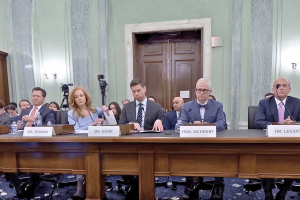
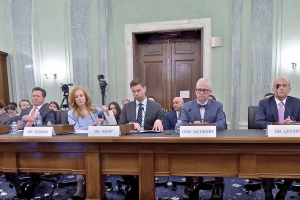
A Senate panel spent hours Wednesday (May 20) hearing whether America’s fast-growing sports betting industry is outpacing the rules meant to control it. The Commerce, Science, and Transportation Committee’s hearing, titled “No Sure Bets: Protecting Sports Integrity in America,” brought together regulators, gaming executives, integrity specialists, and lawmakers who disagreed sharply over how prediction markets should be treated under federal law.
The session took place inside the Russell Senate Office Building and was led by Sen. Marsha Blackburn through the Subcommittee on Consumer Protection, Technology, and Data Privacy. Much of the discussion centered on prediction-market platforms that now offer contracts tied to sporting events nationwide under commodities regulations instead of traditional state gaming laws.
Several senators questioned whether those companies are effectively acting like sportsbooks while avoiding many of the restrictions imposed on licensed gambling operators.
AGA warns prediction markets are ‘national sportsbooks’ during Senate hearing
Bill Miller, president and chief executive officer of the American Gaming Association, delivered some of the hearing’s strongest criticism toward prediction-market operators. He argued that companies offering sports-event contracts have crossed into sports wagering while sidestepping state oversight systems built after the Supreme Court struck down PASPA in 2018.
During his testimony, Miller stated that “so-called prediction market platforms jeopardize the integrity of sports” and warned that these companies are effectively operating national sportsbooks without complying with the same oversight standards imposed on licensed gaming operators.
Miller told lawmakers the Commodity Futures Trading Commission was never designed to supervise betting on sporting events. He said Congress created the agency to oversee economically important commodities markets, not “Monday Night Football” or college basketball tournaments.
Prediction markets, aided by a rogue CFTC, are making a mockery of congressional intent.
Bill Miller, American Gaming Association CEO
He also pointed to legal arguments previously made by Kalshi, acknowledging that Congress did not intend derivative exchanges to become sports betting marketplaces. At the same time, he noted that the company has continued scaling offerings connected to major events, including the Super Bowl and March Madness.
According to Miller, sports contracts now make up most trading activity on some prediction platforms. He warned senators that those businesses bypass rules involving taxation, responsible gaming protections, geolocation requirements, anti-money laundering standards, and integrity monitoring systems that state-regulated sportsbooks must follow.
Miller also pointed out age concerns. In many states, traditional sportsbooks require customers to be at least 21 years old, while some prediction-market platforms permit participation beginning at 18.
Senate hearing debates whether prediction markets constitute gambling
Former House Financial Services Committee Chairman Patrick McHenry defended the industry while testifying for the Coalition for Prediction Markets, whose members include Kalshi, Robinhood, Coinbase, Crypto.com, and Underdog.
McHenry argued prediction markets differ fundamentally from casinos and sportsbooks because users trade against one another instead of betting directly against a house operator. He described the platforms as exchanges driven by participation, liquidity, and information flow rather than customer losses.
He told senators that coalition members already operate under federal oversight through the CFTC and comply with anti-money laundering standards, trade surveillance systems, know-your-customer rules, and market manipulation safeguards. McHenry also said prediction-market operators prohibit athletes, coaches, referees, and other insiders from participating in markets tied to competitions they could influence.
Tensions escalated when Sen. John Hickenlooper challenged McHenry over advertising practices tied to prediction-market companies. Hickenlooper referenced a promotional campaign involving a TikTok influencer who claimed winnings from Kalshi helped cover two years of rent after struggling financially.
The Colorado senator argued that marketing sports-event contracts as potentially “financially life-changing tools for average people” risks misleading vulnerable users into believing they can reliably profit from uncertain outcomes.
Hickenlooper additionally raised concerns about reports that younger social media influencers may have promoted betting-style products to teenagers. He warned lawmakers that minors are “easily manipulable” and questioned whether existing oversight structures are sufficient.
The CFTC is a cop on the beat and has the capacity to oversee this market, just as they’ve done with the broader commodities marketplace that’s been around and well-versed for decades.
Patrick McHenry, Coalition for Prediction Markets senior adviser
McHenry defended the CFTC’s authority, describing the regulator as “a cop on the beat” capable of investigating fraud and manipulation. Hickenlooper responded that the agency lacks meaningful experience regulating sports wagering products and criticized a self-certification process that can permit contracts to launch within a single business day.
Integrity systems become central focus
Scott Sadin, co-founder and co-chief executive officer of Integrity Compliance 360, told senators that the integrity-monitoring industry has expanded dramatically since legal sports betting spread across the country.
Sadin explained that successful oversight now depends on constant coordination among sportsbooks, sports leagues, regulators, law enforcement agencies, and independent monitoring firms. He said suspicious betting patterns and potential insider activity are already being identified through real-time cooperation across the industry.
According to Sadin, IC360 works with more than 200 organizations worldwide, including every major U.S. professional sports league, college athletic conferences, sportsbooks, regulators, and prediction-market exchanges.
He described the company as the “connective tissue” linking those groups together during investigations and monitoring efforts.
Sadin also outlined the technology behind modern integrity surveillance. Monitoring systems review transaction-level betting data, odds movements, officiating trends, and player availability information to identify what he called “correlated abnormalities” that may signal manipulation or unusual activity.
He told lawmakers the existing system has proven effective but must continue adapting as wagering technology evolves rapidly.
State regulators outline consumer protections
Mary Beth Thomas, executive director of the Tennessee Sports Wagering Council, used her testimony to showcase how one state has approached online sports betting regulation.
Tennessee allows only online wagering and has adopted several restrictions intended to reduce integrity risks. Thomas said the state bans betting on individual college athlete proposition wagers and prohibits live prop betting involving college sports.
The state also bars wagers tied to injuries, penalties, or random chance elements during games.
Thomas described detailed identity-verification rules designed to prevent underage gambling, proxy betting, and fraud. Tennessee sportsbooks must use multifactor authentication, secondary identification reviews, and strict know-your-customer procedures before allowing customers to place bets.
She noted that Tennessee does not permit sportsbooks to accept credit cards. Bettors instead must fund accounts using bank transfers, debit cards, or comparable cash-equivalent methods.
Thomas additionally drew attention to the state’s self-exclusion system, which requires operators to suspend gambling accounts and stop marketing communications for users who voluntarily opt out. Sportsbooks must also report suspicious betting activity immediately to regulators and integrity-monitoring companies.
Beyond regulatory issues, lawmakers also heard warnings about gambling addiction and mental health risks tied to nonstop online betting opportunities. Written testimony submitted to the committee argued that microbetting, AI-driven wagering products, and constant smartphone access could intensify financial distress and compulsive gambling behavior, especially among younger users.
By the end of the hearing, senators from both parties agreed that sports wagering has entered a new phase following years of accelerated growth, even as major disagreements remain over how prediction markets should be regulated.
Hickenlooper closed by stating the real-world consequences tied to gambling proliferation and the need for lawmakers to act quickly. “I feel that all five of you are willing and engaged to fix some of these serious, glaring problems, and look forward to working with the chair to provide us a sense of urgency that these are real people’s lives that are being negatively impacted right now.”
Blackburn said the discussion provided a starting point for future legislative conversations involving both federal oversight and state authority. “This allows us to start to build where we should move in regulation and also looking at the division between what should be federal and what should be state, and preserving those states’ rights in order to move forward with this.”
Featured image: Screenshot via C-SPAN
The post Senators clash with industry officials over sports betting expansion and prediction markets during hearing appeared first on ReadWrite.