
On-chain data from recent weeks shows a key trend characterizing the crypto economy: stablecoin issuers are not just theorists but market movers.
In the last month, 36 crypto protocols made over $2 million in profit each, but the chasm between them and the rest is gaping.
First off is Tether and Circle, whose total revenue exceeds that of the rest of the protocols on this list (excluding CEXs) combined. Tether, for its part, alone claims $493 million while Circle comes close behind with $197 million. The sum of the two dwarfs the combined revenue of all 34 other protocols, highlighting the vital role that stablecoins play as liquidity, settlement and trading infrastructure across the ecosystem.
This jump illustrates the ongoing need for stability in a turbulent market, which continues to drive stable sources of income for these issuers. The growing reliance of traders, institutions and DeFi platforms to accumulate dollar-pegged assets suggests that the dominance of stablecoins appears structural rather than temporary.
36 Crypto Protocols that generated more than $2M in last 30 days
Stablecoin issuers dominate the top – @tether ($493M) and @circle ($197M) alone outpace the entire rest of the list combined.@HyperliquidX ($50.8M) leads perp DEXs, @Pumpfun ($34.4M) holds the launchpad crown,… pic.twitter.com/d7gmZszrAW
— Top 7 Crypto | Analytics & Alpha (@top7ico) May 19, 2026
Rise of the Perpetual DEXs, Launchpads & Prediction Markets
Apart from stablecoins, multiple verticals are quietly building powerful revenue threats. At $50.8 million Hyperliquid maintains its top seat in the perpetual DEX leaderboard, reflecting continued high demand for decentralized derivatives trading solutions. Meanwhile, Pumpfun among launchpads, is the leader with $34.4 million in revenue generated.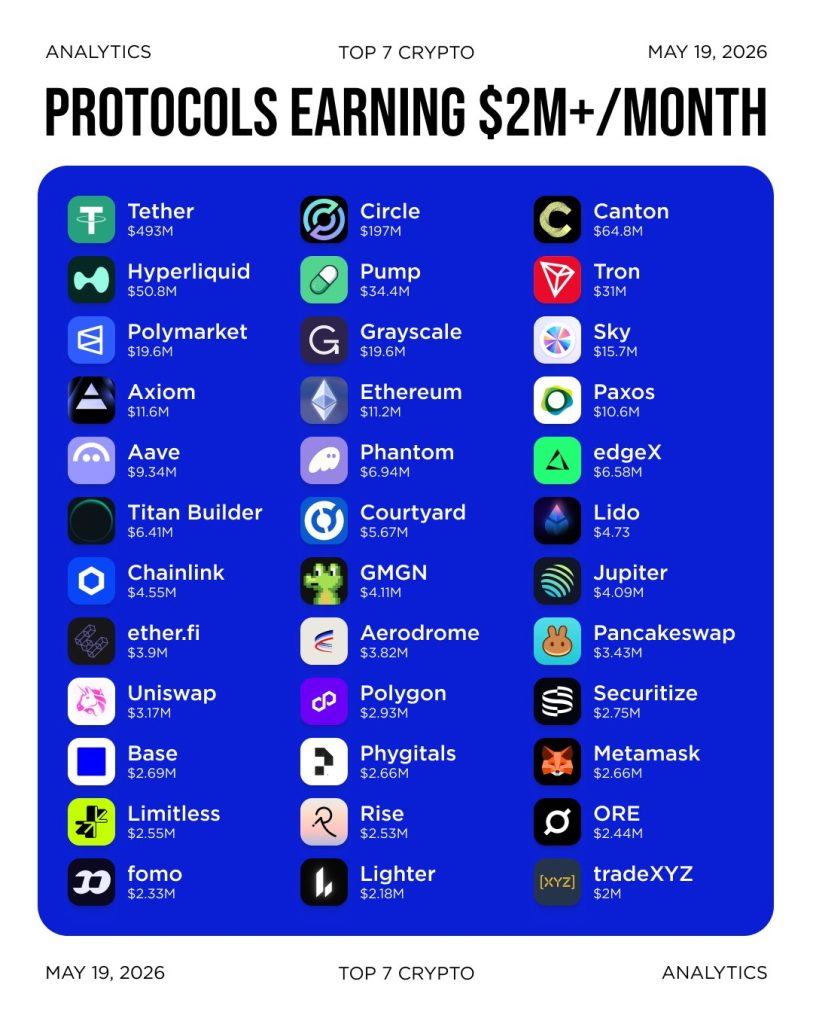
Prediction markets are also rising stars in contributing. The speculative nature of event-driven trading is becoming a scalable source of revenue, as evidenced by Polymarket’s $19.6 million report.
The Solana trading stack also differentiates itself. Axiom Exchange: $11.6 million Phantom wallet: $6.94 million Jupiter Exchange: $4.09 million. Many of these platforms function invisibly behind the curtains, making money quietly as usage picks up steam.
So this diversification is a sign that the ecosystem has matured into a place where derivative, launchpad and prediction market niches have grown into pillars rather than experiment.
Expansion of Real-World Assets and Revenue Redistribution Models
Another major narrative is the expansion of Real-World Asset (RWA) protocols. Grayscale and Paxos with $19.6 million and $10.6 million each drove a lion share, while Securitize contributed with $2.75 million. They act as bridges from old finance to blockchain bringing asset-backed real-world value into the crypto ecosystem.
Not only does Canton Network produce its $64.8 million in revenue, but it also sets itself apart by how you earn with it. Instead of keeping the vast majority of its revenue, the network redistributes or burns a large percentage of it, sending value back to the ecosystem participants like validators, stakers and developers.
It indicates a transition to community-centric tokenomics that spread value far and wide rather than offshoring it from the center. But it also signifies a wider turning point in protocol design, leaning into sustainability and longer-term incentive structures.
Pump.Fun Upgrade Changes Liquidity Dynamics Of Solana
A major catalyst now drawing attention is Pump.fun’s upcoming upgrade, set to go live on May 21. The change allows creators to choose between SOL and USDC as the quote asset when memecoins transition from bonding curves to PumpSwap.
Although this change is seemingly minimal, it completely changes the liquidity dynamics of Solana as a whole.
Traditionally, memecoin launches posed continuous buy-and-lock opportunities for SOL. When a token would graduate from bonding curves, it needed to match with SOL in liquidity pools as pairing tokens, thus useful Token demand and inflated TVL. This mechanism has been undermined by the introduction of USDC as an alternative.
The implications for SOL include:
- Lower demand for providing liquidity
- More SOL being removed from pools
- Lower artificial TVL growth
- Some trading volume may migrate to USDC pairs
Such a revision may alter the flow of value in Solana’s DeFi ecosystem entirely.
➥ Is $PUMP slowly moving away from $SOL?
Starting May 21, @Pumpfun will allow creators to choose either SOL or USDC as the quote asset when memecoins graduate from bonding curve → PumpSwap.
That changes a lot more than people think.
Impact on $SOL:
– Less SOL locked into… pic.twitter.com/O4WOGP5yxY
— Tanaka (@Tanaka_L2) May 19, 2026
Why The Upgrade Looks Bullish For Pump
The upgrade also lowers some of the structural demand for SOL but boosts Pump. fun’s long-term positioning. The platform expands flexibility and accessibility to a wider trader base with the introduction of USDC pairs.
This makes onboarding easier for the creators: and reduces exposure to SOL volatility. USDC pairs provide stability for traders so they are a much better choice for long-term holdings.
This upgrade is also expected to increase the levels of trading volumes into PumpSwap itself, as users who prefer stable-denominated environments can engage more confidently. A vital component is that the revenue remains in cycle inside the system maintaining robust internal loops of value.
This development positions Pump. fun which serves less as a memecoin launchpad dependent on Solana, and more as an independent trading infrastructure layer. Against this backdrop, the upgrade seems to be more bullish for PUMP than SOL itself.
Buybacks also Aggressive, reinforcing on-chain confidence
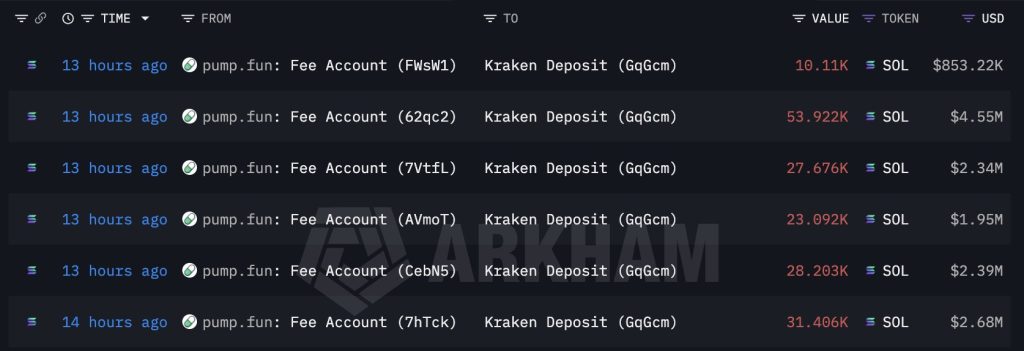
There has been more recent on-chain activity reinforcing Pump. fun’s evolving strategy. The platform sent 174,408 SOL ($14.76 million) just to Kraken and it was reported that 117,877 SOL ($9.96 million) have already been sold over there.
The tracking information on the blockchain shows a freshly minted wallet withdrawing that same amount from Kraken, converting it to USDC at an effective price of $84.52 per SOL and then depositing back to the exchange.
Pump fun(@Pumpfun) deposited 174,408 $SOL($14.76M) to #Kraken 13 hours ago.
And they may have already sold 117,877 $SOL($9.96M).
A newly created wallet(35qaEz) withdrew 117,877 $SOL($9.96M) from #Kraken, sold it for 9.96M $USDC at $84.52, and then deposited the 9.96M $USDC back… pic.twitter.com/ZGzKI0qOaF
— Lookonchain (@lookonchain) May 19, 2026
At the same time, Pump.fun continues an aggressive buyback and burn strategy. Over the past seven days alone, the protocol has repurchased and burned over $4.2 million worth of PUMP tokens.
 This brings total buybacks and burns to an astonishing $382.45 million, effectively removing 37.836% of the circulating supply.
Over the past 7 days, @Pumpfun bought back & burned $4,206,581 worth of $PUMP
This brings their total buybacks & burns to $382,454,875, removing 37.836% of the total circulating supply pic.twitter.com/hXJgNVoi47
— Pump.fun Ecosystem (@PumpfunEco) May 18, 2026
With strategic upgrades like Pump.fun’s and continued dominance from stablecoin giants, the next phase of crypto growth is being defined not by hype, but by sustainable, revenue-driven utility.
Disclosure: This is not trading or investment advice. Always do your research before buying any cryptocurrency or investing in any services.
Follow us on Twitter @nulltxnews to stay updated with the latest Crypto, NFT, AI, Cybersecurity, Distributed Computing, and Metaverse news!