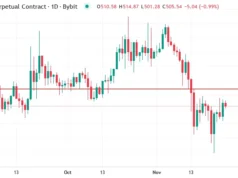
The market for tokenized stocks has evolved from an experimental niche into a significant financial sector. Data from DefiLlama indicates that the market capitalization for these assets expanded from approximately $63 million in August 2025 to $1.66 billion by October 14, 2026, representing a 26-fold increase over 14 months. While the number of tracked instruments has also risen, much of this growth is attributed to broader reporting coverage by DefiLlama rather than new product launches.
Assessing Market Depth vs. Trading Volume
While trading volume is a common metric for exchange activity, it does not necessarily reflect market liquidity or the ability of a venue to handle large orders without significant price impact. To investigate this, a snapshot was taken on September 29, 2026, at 04:47 UTC, covering four major instruments: AAPL, TSLA, GOOGL, and SPY. The test spanned perpetual contracts on Bitget, Binance, OKX, and Bybit, alongside spot markets on those same platforms plus Hyperliquid.
Key Observations
- Perpetual Market Depth: Bitget consistently displayed the deepest order books for all four instruments within 1% of the price, despite not holding the top spot for 24-hour trading volume.
- Execution Capabilities: For spot markets, only Bitget and Binance demonstrated sufficient liquidity to execute a simulated $100,000 buy order across all four tested tickers.
- On-chain Limitations: Current on-chain spot books, such as those on Hyperliquid, lacked sufficient depth compared to centralized exchanges, with significantly wider price spreads.
Trading Costs and Execution
The analysis revealed that while Bitget often provides deeper order books for perpetuals, it does not always offer the narrowest spreads or the lowest slippage for spot trades. For example, in the September 29 snapshot, Binance frequently offered tighter spreads on spot instruments. Additionally, the structure of liquidity differs; Bitget’s spot books tend to distribute liquidity across a wider range of price levels, whereas Binance and OKX often concentrate their depth closer to the mid-price.
Why it matters
This analysis highlights that headline trading volume can be a misleading indicator for traders seeking to execute large positions in the tokenized stock market. As these assets mature, traders must look beyond volume to assess order book depth and actual execution costs, as liquidity patterns vary significantly between centralized and on-chain venues. Understanding these nuances is essential for market participants to navigate the differences in how various platforms handle significant order sizes.

Nova Astrax covers crypto, fintech, finance, health and wellness, AI and future tech, and practical life hacks — with original analysis and daily news from around the world.