Google search engine
Home Blog Page 126

Beyond the Illusion of Yield

0


Decentralized Finance (DeFi) has rapidly evolved into one of the most dynamic sectors of the digital economy. It promises open access, composability, and yield opportunities far beyond those offered by traditional financial systems. Yet beneath the surface of high Annual Percentage Yields (APYs) and constant innovation lies a more complex reality—one shaped by liquidity flows, incentive design, and systemic fragility.

Understanding this reality is critical. Many of the assumptions that retail participants rely on—about yield, sustainability, and risk—are often incomplete or misleading.


The Illusion of Yield: Recycled Liquidity in DeFi

A significant portion of DeFi yield is not generated by productive economic activity but rather by incentive loops and liquidity recycling.

Protocols frequently attract users by distributing governance tokens or emissions as rewards. These rewards create the appearance of yield, but in many cases:

  • Capital is rotated between protocols chasing incentives
  • Yield is subsidized rather than earned
  • Returns depend heavily on continued inflows of new liquidity

This creates a system where value is often circular rather than additive. Liquidity providers may feel they are earning returns, but in reality, they are participating in a redistribution mechanism that relies on constant participation.

Without sustainable revenue sources—such as real trading fees or external cash flows—these systems risk eventual contraction once incentives decline.


APY Is a Misleading Metric

APY is one of the most widely used metrics in DeFi, yet it is also one of the most misunderstood.

High APYs often:

  • Assume constant compounding under ideal conditions
  • Ignore token price volatility
  • Fail to account for impermanent loss or dilution

For example, a 200% APY denominated in a volatile token may result in net losses if the token’s price declines significantly. Similarly, liquidity providers may earn fees but lose value due to price divergence between paired assets.

A more accurate understanding of returns requires focusing on:

  • Real yield (fees generated from actual usage)
  • Token emissions vs. organic demand
  • Net returns after risks and costs

In essence, APY reflects potential, not guaranteed or even probable outcomes.

Liquidity as the True Signal

In DeFi, liquidity is more important than narrative.

While narratives (e.g., “AI + DeFi,” “Real World Assets,” “GameFi”) can attract attention, they are often lagging indicators. Liquidity, by contrast, is a leading signal—it shows where capital is actively committing.

Key observations include:

  • Liquidity can enter and exit protocols rapidly
  • Capital efficiency drives where funds concentrate
  • Early liquidity movements often precede major trends

For participants seeking an edge, tracking liquidity flows—across chains, protocols, and pools—offers more actionable insight than following hype cycles.

Failure to follow liquidity often results in entering positions too late, when upside is limited, and risk is elevated.


The Next Collapse Will Be Different

DeFi has already experienced multiple cycles of boom and bust, from liquidity mining bubbles to high-profile protocol failures. However, the next systemic downturn is unlikely to mirror previous ones.

Emerging risks include:

  • Complex composability: Interconnected protocols can amplify cascading failures
  • Hidden leverage: Layered borrowing and rehypothecation increase systemic exposure
  • Liquidity fragmentation: Capital spread across chains reduces shock absorption capacity
  • Smart contract risk: Undiscovered vulnerabilities remain a persistent threat

Unlike earlier collapses driven primarily by unsustainable emissions, future crises may stem from structural complexity and interdependence.

This makes risk harder to identify—and faster to propagate.


Conclusion

DeFi remains a powerful innovation with the potential to reshape financial systems. However, its current structure demands a more critical and informed approach.

Participants must move beyond surface-level metrics and narratives to understand:

  • Where yield truly comes from
  • How liquidity behaves under stress
  • What risks are embedded within complex systems

In a landscape defined by rapid change, the most valuable skill is not chasing the highest yield—but accurately interpreting the signals beneath it.

REQUEST AN ARTICLE


Source link

What DeFi Could Look Like in 2030

0


Decentralized Finance (DeFi) began as an experimental alternative to traditional banking, but by 2030, it may evolve into one of the foundational layers of the global financial system. What started with simple token swaps and yield farming is gradually transforming into a complex digital economy powered by automation, interoperability, artificial intelligence, and decentralized ownership.

While today’s DeFi ecosystem still faces issues with scalability, regulation, security, and user experience, the pace of innovation suggests the next five years could dramatically reshape how individuals and institutions interact with money.

The Evolution from Speculation to Financial Infrastructure

Early DeFi growth was largely driven by speculation. High annual percentage yields, liquidity mining incentives, and token launches attracted users seeking rapid returns. However, many of these systems relied on unsustainable liquidity cycles rather than genuine economic productivity.

By 2030, DeFi may shift away from short-term incentive models toward infrastructure-level utility. Protocols are likely to prioritize sustainable revenue generation through trading activity, real-world asset integration, lending markets, payment systems, and decentralized capital formation.

In this future landscape, successful protocols may resemble autonomous financial networks rather than speculative applications.

AI-Powered Autonomous Finance

One of the most significant developments expected by 2030 is the integration of artificial intelligence into DeFi systems.

AI agents may eventually manage entire portfolios without human intervention. Instead of manually moving assets between protocols, users could define risk preferences and investment goals while autonomous systems optimize allocations in real time.

These AI-driven systems may handle:

  • Yield optimization across multiple chains
  • Automated risk management
  • Smart hedging strategies
  • Real-time market analysis
  • Liquidation prevention
  • Dynamic liquidity provisioning

The combination of AI and smart contracts could create financial systems capable of reacting instantly to market conditions without centralized intermediaries.

In many ways, DeFi may become less about “using apps” and more about deploying intelligent financial agents that operate continuously on behalf of users.

Cross-Chain Liquidity Becomes the Standard

Today’s blockchain ecosystem remains fragmented. Assets, liquidity, and users are distributed across numerous networks, often requiring bridges and complicated transfers.

By 2030, interoperability could become one of the defining features of DeFi infrastructure.

Cross-chain execution layers may allow users to interact with multiple blockchains simultaneously without even noticing which network is being used underneath. Liquidity could flow seamlessly between ecosystems, reducing inefficiencies and improving capital utilization.

The idea of being “stuck” on one chain may eventually disappear entirely.

Instead, DeFi platforms may evolve into unified liquidity environments where transactions, swaps, lending, and settlement occur automatically across interconnected networks.

Real-World Assets Enter the Blockchain Economy

Tokenization is expected to play a major role in the future of decentralized finance.

By 2030, real-world assets (RWAs) such as real estate, government bonds, commodities, invoices, intellectual property, and equities could become deeply integrated into DeFi ecosystems.

This transition may fundamentally alter how global markets operate.

Potential benefits include:

  • 24/7 trading availability
  • Fractional ownership
  • Instant settlement
  • Reduced administrative costs
  • Increased access to global markets
  • Transparent on-chain auditing

For emerging economies, tokenized finance may provide broader access to investment opportunities previously limited to institutional participants.

As regulatory frameworks mature, DeFi protocols could increasingly serve as the infrastructure layer for global capital markets rather than existing outside them.

Institutional Participation Expands

In earlier stages, institutions approached DeFi cautiously due to regulatory uncertainty and security concerns. By 2030, this relationship may look very different.

Large financial institutions may adopt hybrid models that combine decentralized settlement systems with compliant identity layers and regulated custody solutions.

Banks, asset managers, and payment providers could eventually use DeFi rails for:

  • International settlements
  • Collateral management
  • Treasury operations
  • Yield generation
  • Tokenized securities trading
  • Automated market making

This institutional adoption would likely increase liquidity, stability, and legitimacy across the sector.

Ironically, the systems originally designed to bypass traditional finance may eventually become the technology stack powering it.

Identity and Reputation Systems Replace Anonymous Risk

Completely anonymous finance creates efficiency, but it also introduces challenges involving fraud, compliance, and credit assessment.

Future DeFi ecosystems may adopt decentralized identity and reputation systems that allow users to prove credibility without sacrificing privacy.

Instead of relying solely on collateral, lending protocols could incorporate:

  • On-chain reputation scores
  • Verified financial history
  • Behavioral analytics
  • Proof-of-income systems
  • Decentralized identity credentials

This evolution may unlock undercollateralized lending markets, enabling broader participation while maintaining transparency and risk management.

Privacy-preserving cryptography could become essential in balancing compliance with decentralization.

Security Will Become the Primary Competitive Advantage

The next phase of DeFi growth may be defined less by innovation speed and more by resilience.

As billions or even trillions of dollars move on-chain, security standards will likely become significantly more advanced. Smart contract exploits, bridge hacks, and governance attacks remain major obstacles today, but future ecosystems may rely on:

  • AI-assisted auditing systems
  • Formal smart contract verification
  • Decentralized insurance markets
  • Automated threat detection
  • Real-time protocol monitoring
  • Multi-layer security architectures

Protocols with strong security reputations may dominate liquidity flows, while poorly secured systems could struggle to survive.

In a mature DeFi economy, trust may be built through transparency and mathematical verification rather than corporate branding.

Regulation Will Shape the Industry — Not Eliminate It

Regulation is often viewed as a threat to decentralized finance, but by 2030, it may instead function as a catalyst for broader adoption.

Clear legal frameworks could encourage institutional participation while protecting users from systemic risks and fraudulent platforms.

Rather than eliminating decentralization, regulation may push DeFi toward more sophisticated governance structures that balance openness with accountability.

Jurisdictions that successfully integrate blockchain innovation into financial policy may become global hubs for digital capital formation.

The future of DeFi is unlikely to be fully unregulated or fully centralized. Instead, it may evolve into a hybrid ecosystem where decentralized infrastructure operates within transparent legal boundaries.

The Future May Be Invisible

Perhaps the most important prediction about DeFi in 2030 is that users may stop referring to it as “DeFi” altogether.

Just as people rarely think about internet protocols while browsing online, blockchain infrastructure could eventually fade into the background.

Users may simply interact with financial applications that are:

  • Faster
  • Global
  • Automated
  • Programmable
  • Accessible 24/7
  • More transparent than traditional systems

At that stage, decentralized finance would no longer exist as a niche industry. It would simply become finance.

Conclusion

The path toward DeFi in 2030 will not be linear. Market cycles, regulatory battles, security failures, and technological limitations will continue to shape the industry along the way.

However, the broader direction remains clear: financial systems are becoming increasingly programmable, automated, and decentralized.

If current trends continue, the next decade could transform DeFi from an experimental ecosystem driven by speculation into a global financial infrastructure layer capable of supporting both digital and real-world economies.

The protocols that survive this transition will likely be those that prioritize sustainability, interoperability, security, and genuine economic utility over short-term hype.

In the long run, the future of decentralized finance may not be about replacing traditional finance entirely, but about rebuilding it into something faster, more transparent, and fundamentally more accessible.

REQUEST AN ARTICLE


Source link

‘I ain’t goin nowhere’: Gullah Geechee people fight off developers with a historic referendum | Gullah Geechee

0


Ire Gene Grovner stood behind his house on a recent morning, between chicken pens on one side and rows of winter collard greens on the other, holding a knife and skinning a raccoon splayed across a wood post.

“The meat is good roasted,” Grovner said. He pointed to the collards, a burst of green in the winter cold, and the chickens, with their eggs. “If you ain’t lazy, you can live good here,” he said, referring to Sapelo Island off the coast of southern Georgia.

Then he waved in a broad circle, pointing out the nearby modest homes of family members, all bearing the same last name as him, which Grovner, who is 70, says stretches nine generations back on Hogg Hummock.

The community is home to the Gullah Geechee people, descendants of enslaved west Africans who worked on cotton, indigo and rice plantations from North Carolina to Florida. In places like South Carolina’s Hilton Head Island, the Gullah Geechee population was nearly wiped out by development starting in the 1960s.

On Sapelo Island, post-enslavement, freed Black folks were granted land in Hogg Hummock in part because it was seen as marshy and less desirable than the rest of the island. It is the only remaining sea island community of Gullah Geechee people in Georgia.

‘On Sapelo Island, post-enslavement, freed Black folks were granted land in Hogg Hummock in part because it was seen as marshy and less desirable.’ Photograph: Joshua Parks/The Guardian

“All that’s family,” Grovner summed up. “All those people who want to build houses here ain’t gonna close me in.”

Outsiders building large vacation houses was what was at stake in Tuesday’s election in McIntosh county, where Sapelo is located – only the second citizen referendum on a county plan or policy in Georgia history. (Nearby Camden county voters defeated a county plan to build a rocket-launching pad through a referendum in 2022.)

The referendum, brought about after more than 2,000 registered voters in the county signed petitions, allowed residents to vote on whether they were for or against a zoning amendment increasing the amount of residential square footage permitted in Hogg Hummock from 1,400 to 3,000.

Unofficial results released on Tuesday evening showed that nearly 85% of 1,869 county voters opposed the zoning increase.

Allowing larger houses to be built on the island would have opened the door to developers – “all those people” Grovner named – which then would raise taxes, making it harder for Gullah Geechee people to continue living on Sapelo, and potentially changing the island’s cultural and environmental landscape forever.

The number of Gullah Geechee people living on Sapelo has dwindled to between 30 and 40 residents, down from about 500 in the early 20th century. Dozens of the residents’ children and other family members have moved to the mainland over time. Nonetheless, many of these family members maintain ties to the island; some still own property and plan on retiring there.

“Every county in the state of Georgia is looking at” Tuesday’s results, said Kathleen Russell, editor of the Darien News – because any county’s residents can now mount a referendum and challenge zoning rules, she said.

The referendum made history in the region as well, as referendums “are incredibly rare in the majority of the south”, said Chris Melody Fields Figueredo, executive director of the Ballot Initiative Strategy Center. The reason: “States where formerly enslaved people lived, the state governments did not want those people to exercise their power,” Fields Figueredo said.

‘Outsiders building large vacation houses was what was at stake in Tuesday’s election.’ Photograph: Joshua Parks/The Guardian

The ability to stage a referendum in Georgia comes from provisions in the state’s constitution. First, a certain percentage of a county’s registered voters signs a petition indicating they want to vote on a policy from the county’s elected representatives. The percentage varies based on the county’s population.

Once the threshold of confirmed signatures is reached and a referendum is authorized, it is “a form of holding power accountable, where systems of governance are challenged”, said Fields Figueredo.

The Gullah Geechee people who were leading the effort to hold the referendum first had to defeat the county’s legal challenges, based on assertions that zoning rules weren’t covered by language in the state’s constitution. It took a September state supreme court decision to give the green light to Tuesday’s election.

The Guardian spoke to a handful of the nearly 1,000 county residents who cast ballots during a two-week early voting period ending Friday. All had ties to Sapelo Island and Hogg Hummock, and felt strongly about the need to protect the community from unchecked development.

The unspoiled qualities that allow Gullah Geechee people to live close to nature also make the island a prime location for natural science; in the 1950s, Sapelo was the site of foundational research in the nascent field of ecology.

After casting his ballot on Thursday, Nick Macías described Sapelo as “an ecologically important island you don’t find anywhere in the world”. Macías, who works as assistant operations director at the island’s University of Georgia Marine Institute, pointed out that Sapelo was the only Georgia sea island with healthy communities of marsh grass – a keystone species, or one that other animals and plants in an ecosystem depend on for survival.

Allowing larger houses and increased development in Hogg Hummock “would put stress on the carbon footprint” of the island and displace Gullah Geechee people, he said: “When it comes to preserving the [Gullah Geechee] culture, it comes down to the next generation being able to live there.”

Also voting last week, Samuel – who didn’t want his last name used – had gotten off his job early as a trucker to cast a ballot. He has ties to Hogg Hummock through his wife, who has family there. “It’s a unique place,” he said. “You go there … and they treat you like family. They take you in.”

The trucker remembers first visiting as a teenager. “They showed me medicine for toothaches, using plants,” he said. As for the community’s ongoing struggles, he said, “I’ll fight for it till the end. They deserve it. It’s their place.”

One of Ire Gene Grovner’s relatives in Hogg Hummock is his brother, Bobby Gene Grovner. He’s renovating his home on the island, with plans of leaving it to his two daughters. “These ones who come with a pocketful of money, it ain’t gonna work,” he said, referring to developers with interest in the community’s land.

George Grovner, a resident of the Hogg Hummock community on Sapelo Island, during a meeting of McIntosh county commissioners on 12 September 2023 in Darien, Georgia. Photograph: Russ Bynum/AP

Still, Bobby Gene, who turns 67 later this month, said “it’s tiring” to have to fight in courtrooms and government halls for his community.

“I ain’t got but 40 years left!” he said, laughing.

His brother Ire Gene is involved in another unresolved legal battle, laying claim to several dozen acres of land that a 2024 lawsuit asserts was taken from his family by the state of Georgia in nearby Raccoon Bluff, a 698-acre plot of land on the island formerly inhabited by Gullah Geechee people. The lawsuit includes land deed records in Grovner’s family dating to 1875.

An ongoing case involving the subject of Tuesday’s referendum, filed by the Southern Poverty Law Center, asserts that the proposed zoning amendment was discriminatory. “The people in [Hogg Hummock] feel like they’ve been shut out,” said the SPLC attorney Miriam Gutman. “[They] want to pass their land onto their children and grandchildren. They want to be part of the conversation” about the community’s future, she said.

But even the immediate future after Tuesday’s result is unclear, as the McIntosh county attorney, Adam Poppell, recently stated that voters rejecting the county’s attempt to increase the maximum square footage allowed on the island doesn’t mean conditions will revert to what they were before: a limit of 1,400 sq ft. Instead, Poppell said, the election’s result leaves Hogg Hummock with “no zoning” – meaning anything could be built.

The county attorney did not answer a request for comment.

Dana Braun, attorney for the Hogg Hummock residents who mounted the referendum effort, said another lawsuit would be likely if the county insists on Poppell’s interpretation of where things stand. “The county apparently loves paying lawyers for losing battles,” he said.

After cleaning off his knife and preparing the raccoon on Friday, Ire Gene turned to face the chicken pens and the morning’s eggs. His position on the future of Hogg Hummock: “I ain’t planning on goin’ nowhere.”


Source link

Bitcoin’s ‘Overbought’ RSI Hints at BTC Price Dropping to Test $78K

0


Bitcoin (BTC) traders expect a short-term correction as a key BTC price strength metric rises to its highest levels in almost fifteen weeks.

Key takeaways:

  • Bitcoin’s “overbought” RSI historically precedes significant corrections.
  • Bitcoin could see a short-term price drop if the price breaks below the $78,000 support.

Bitcoin metrics suggest BTC price is “overheated”

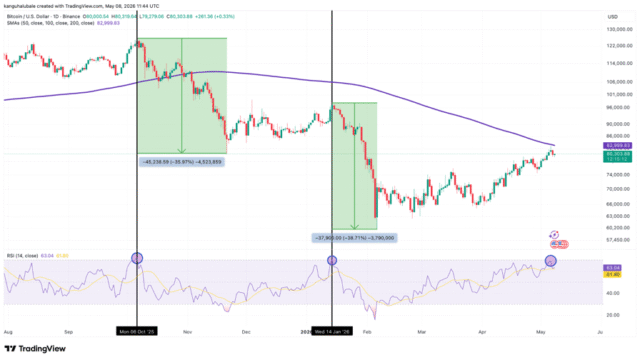
Bitcoin’s 36% rally to $82,800 on Wednesday from its macro low of $60,000 has significantly impacted its daily RSI.

On the daily chart, the RSI rose to 70 on Wednesday from local lows of 39 in March. 

“$BTC’s daily RSI went overbought right as we tagged the 200-day EMA,” trader Jelle said in a Friday post on X, adding:

“It makes sense to find resistance here.”

BTC/USD weekly chart. Source: Cointelegraph/TradingView

RSI measures trend strength and contains three key levels for observers: the 30 oversold boundary, the 50 midpoint and the 70 overbought threshold.

When the price crosses these levels, depending on the direction, traders can infer about the future of the current trend. After rallies, BTC usually corrects once the RSI enters the overbought territory.

Related: Bitcoin bulls target $115K by December: Does data back the expectation?

Analyst Crypto Tice said this is a “rare” signal that has occurred only four times over the last year, with every occurrence leading to a “short-term pullback,” adding:

“Overbought conditions on the daily don’t resolve sideways. They resolve with a flush.”

Fellow analyst Rekt Fencer pointed out that the “last 2 times this happened, it dumped” 35%-38%, as shown in the chart above.

Meanwhile, Bitcoin’s market value to realized value (MVRV) ratio, which measures whether the asset is overvalued, recently entered the “overheated” zone.

“Bitcoin breaks above the overheated level on the short-term holder Bollinger Bands for the first time since November 2024,” analyst FrankAFetter said in a recent post on X.

The last time it was at similar levels was in November 2024 before a 15% BTC price drop.

Bitcoin  STH MVRV Bollinger Bands. Source: CheckOnChain

Bitcoin support at $78,000 becomes key for BTC price

Bitcoin traders agree that $78,000 has now become an important area of support for BTC/USD.

The 200-day exponential moving average at $83,000 is acting as resistance, while the “first main area of interest sits at $78,000,” analyst Jelle said in an X post on Friday, adding: 

“Turn that into support and we can have another go at the MAs.”

BTC/USD daily chart. Source: X/Jelle

Fellow analyst Tradermayne said holding the support at $78,000-$80,000 on low time frames would give “bulls a very easy bias level.”

BTC/USD weekly chart. Source: Trader Mayne

Orders are sitting on both sides of the spot price, with analyst Master of Crypto seeing the likelihood of these liquidity clusters being taken out.

“$BTC is holding around the $78.5K–$79.1K support zone,” the analyst said in a Friday post on X, adding:

“If buyers defend this area, the next move could be toward $82K–$83K where a lot of liquidity is sitting. But if this support breaks, Bitcoin could quickly drop to $75K–$76K.”

Bitcoin liquidation heatmap. Source: CoinGlass

The Bitcoin liquidity map shows that a correction below $78,000 would trigger over $3.1 billion worth of leveraged long liquidations across all exchanges.

Bitcoin exchange liquidation map. Source: CoinGlass


Source link

Casino Zoccer account verification guide

0


Getting Started with Casino Zoccer

Casino Zoccer has quickly become a familiar name on the Irish gambling scene, offering a mix of slots, live tables and a full‑fledged sportsbook. The platform is built on a modern interface that works well on both desktop and mobile devices, meaning you can dip into a game while waiting for the bus or settle in at home for a longer session. For newcomers, the first thing to check is whether the site accepts players from the Republic of Ireland – it does, and it holds a licence from a reputable European regulator. If you’re wondering how to begin, the following steps walk you through registration, verification and the first deposit.

Because the brand aims to be beginner‑friendly, the sign‑up process is stripped down to the essentials: email address, password and a choice of currency. Once you confirm your email, the system will prompt you for a few more details to satisfy KYC (Know Your Customer) requirements – typically a proof of identity and a recent utility bill. This extra step might feel a little formal, but it protects you and ensures that all transactions are secure and compliant with Irish law.

Registration and Account Setup

The registration page on casino zoccer is straightforward. After entering your personal details you will receive a verification email; click the link inside to activate your account. The next screen asks you to set your preferred payment method – you can pick from Visa, Mastercard, Skrill, Neteller or direct bank transfer. Irish players will be pleased to see that many local banks are supported, making deposits feel familiar and safe.

Once your account is live, you can customise your profile, set deposit limits and opt into responsible gambling tools. These features are tucked under the “My Account” menu and are easy to adjust at any time. The platform also offers a two‑factor authentication (2FA) option for added security, which you can enable via a text message or an authenticator app.

Bonuses, Welcome Offers and Wagering Requirements

One of the biggest draws of casino zoccer is its welcome package. New players are greeted with a match bonus on the first deposit – typically 100% up to €200 – plus a batch of free spins on selected slot titles. The bonus comes with a wagering requirement of 35x the bonus amount, which is fairly standard for Irish online casinos.

Beyond the initial welcome, Zoccer runs regular promotions such as reload bonuses, cash‑back on losses, and a loyalty programme that awards points for every euro wagered. These points can be exchanged for bonus credit or even tournament entry tickets. Always read the fine print before you claim a bonus, as some promotions exclude certain game categories like high‑variance slots or live roulette.

Payment Methods and Withdrawal Speed

Depositing funds into casino zoccer is quick and usually processed instantly, especially when you use e‑wallets like Skrill or Neteller. Bank transfers may take a few hours, but the platform often sends a confirmation email as soon as the money hits the casino’s vault. Irish players also appreciate the inclusion of PayPal, which adds another layer of convenience for those who already have a PayPal balance.

When it comes to withdrawals, Zoccer aims for “instant payouts” on e‑wallets, with most requests settled within 24 hours. Bank transfers are a bit slower, typically 2‑3 business days, while credit‑card withdrawals may take up to 5 days due to card network processing. The casino does not charge any hidden fees for withdrawals, though a small administrative fee may apply for certain methods.

Game Selection: Slots, Live Casino and Sports Betting

The catalogue at casino zoccer is built around three pillars: slots, live dealer tables and a sports betting hub. Slot lovers will find everything from classic three‑reel titles to the newest high‑RTP video slots with megaways and progressive jackpots. Each game lists its volatility and RTP (return to player) percentages, helping you choose whether you prefer frequent small wins or the chance of a big payout.

Live casino enthusiasts can join professional dealers for blackjack, baccarat, roulette and poker, streamed in high definition. The live section uses a mix of Evolution Gaming and Pragmatic Play providers, ensuring smooth video and reliable game fairness. Sports betting covers a full range of Irish and international events, from Gaelic games to the Premier League, with competitive odds and in‑play betting options.

Mobile App and Desktop Experience

Irish gamers often switch between devices, and casino zoccer delivers a responsive website that works well on smartphones and tablets without needing a dedicated download. However, for those who prefer a native app, the platform offers iOS and Android versions that can be found in the respective app stores. The app mirrors the desktop layout, giving you quick access to your favourite games, deposit methods and the latest promotions.

The mobile experience is optimised for both portrait and landscape modes, which is handy when you’re on a commute or lounging on the couch. Push notifications can be turned on to alert you about bonus expiries, new game releases or live match starts, keeping you in the loop without constantly checking the site.

Security, Licensing and Responsible Gambling

Casino Zoccer operates under a licence from the Malta Gaming Authority, a regulator respected across the European Union for its strict oversight. Encryption technology (SSL 256‑bit) protects all personal data and financial transactions, meaning your details are safe from prying eyes. The platform also employs independent auditors to verify game fairness, with results posted regularly on the site.

Responsible gambling tools are built into the user dashboard. You can set daily, weekly or monthly deposit limits, self‑exclude for a chosen period, or even opt for a permanent ban if you feel you need it. Links to organisations such as GambleAware Ireland are provided for anyone seeking external help.

Customer Support and Frequently Asked Questions

If you run into an issue, casino zoccer offers several channels for assistance. The live chat feature is available 24/7 and typically answers queries within a couple of minutes. For more detailed concerns you can raise a ticket via the “Help Centre,” and an email response will follow within 24 hours. Phone support is also provided for Irish callers, with a dedicated local number that operates during regular business hours.

Below are the most common questions new players ask:

  • How long does it take to verify my identity?
  • What are the minimum and maximum deposit limits?
  • Can I claim a bonus if I use a PayPal account?
  • Are there any fees for withdrawing my winnings?

Answers to these queries are easy to find on the FAQ page, but you can always ask a support agent for clarification. For a deeper dive into the specifics of the site, see the detailed Zoccer casino review Ireland.

Quick Comparison Table

FeatureDetails
LicenceMalta Gaming Authority (MGA)
Welcome Bonus100% up to €200 + 50 free spins (35x wagering)
Payment MethodsVisa, Mastercard, Skrill, Neteller, PayPal, Bank Transfer
Withdrawal SpeedE‑wallets instant, bank 2‑3 days, card up to 5 days
Game Variety2000+ slots, live casino, sports betting
Mobile AccessResponsive web + native iOS & Android apps
Customer SupportLive chat 24/7, email, phone (local Irish number)
Responsible GamblingDeposit limits, self‑exclusion, links to Irish support groups


Source link

Tech oligarchs reshape humanity while billionaires of old seem quaint | Technology

0


When Bill Gates became the first modern IT mogul to reach the apex of wealth and power in 1992, the world was a very different place. Gates joined the top 10 on Forbes magazine’s billionaires list alongside Japanese, German, Canadian, South Korean and Swedish billionaires, including those with family fortunes from Britain and America. A broad mix of industries was on the list: Retail and media, property management and packaging, an investment firm and a couple of industrial conglomerates. Their fortunes almost added up to $100bn – equivalent to about 0.4% of the US’s GDP that year.

The oligarchy has changed drastically since then. Bernard Arnault, of French luxury group LVMH, Amancio Ortega, the Spanish clothing mogul, and Warren Buffett, the US investor, were the only old-school billionaires among the top 10 in 2025. The rest largely made their money from high-tech: Elon Musk, Jeff Bezos, Mark Zuckerberg, Larry Ellison, Steve Ballmer and Google’s Sergey Brin and Larry Page. The top 10 amassed over $16trn, which is about 8% of US GDP.

This evolution offers a startling reminder of how fast new technologies have revolutionized the world economy over the last quarter-century, and how narrowly this brave new world is sharing the fruits of its prosperity. It raises a critical question: what happens when a narrow clutch of oligarchs at the helm of the technological revolution, sitting at the apex of wealth and power, get to determine the direction of humanity?

Is human- or even superhuman-level artificial general intelligence a goal we should strive for? Do we know what that means? How many trillions of dollars and terawatts of energy should we deploy to get there? What business models will survive it? Will it wipe out human labor? Will an ensuing productivity boom make everything free? What system of redistribution must be put in place to anticipate the future if it doesn’t?

These are consequential questions. It appears they will not be decided through public deliberation or democratic choice. The tight knot of people at the top of Forbes’ 2025 list will make the call. Add in Anthropic’s Dario Amodei, Open AI’s Sam Altman, the tech funder, Peter Thiel, and maybe a couple of dozen others and you’ve pretty much identified the set that will guide artificial intelligence as it shapes the future of the world.

This is problematic not just because they are billionaires, untouched by the daily concerns of most humans. Their worldview is embedded in a belief that technology offers the best solution to all of humanity’s challenges, whether social, political, economic, demographic, biological, psychological, environmental, or whatever other dimension one might think of. Their preferred AI-laced future has little space for the humdrum concerns of the all-too-real people who populate the present. It has no patience for slow, messy democratic governance, especially if said governance slows down the path to utopia.

They may not all align neatly along the left-right spectrum of our politics. That’s because their aspirations are orthogonal to the critical political debates of the day. How they choose to deploy their money, however, starting with nearly $200m directed so far to prevent states from imposing AI regulations, signals one of their key aspirations: allowing artificial intelligence to rip free and build the next phase of humanity’s cosmic evolution, one which may not include humans as we know them.

The tech oligarchs are not particularly shy about this ambition. Larry Page has argued that digital life is the “natural and desirable next step” in humanity’s cosmic evolution. “If we let digital minds be free rather than try to stop or enslave them, the outcome is almost certain to be good,” he said. Humanity “will be the first species ever to design our own descendants”, argued Altman. Humans “can either be the biological bootloader for digital intelligence and then fade into an evolutionary tree branch, or we can figure out what a successful merge looks like.”

Musk, whose Neuralink is working to patch AI into human minds, is also invested in building what will succeed everyday humans. So is Zuckerberg, who recently directed his philanthropy to devote itself entirely to advancing ways to extend life. When Thiel dies, his body and brain will be frozen in liquid nitrogen, to be transferred “into an immortal body” in the future. As he wrote in the Education of a Libertarian, “I stand against (…) the ideology of the inevitability of the death of every individual.”

The tech oligarchs don’t all think alike. Some moguls insist that their consciousness should be part of the next step in humanity’s evolution, whether cryogenically preserved or uploaded into some electronic gadget. Others just want to help bring about the next AI phase of intelligent life, even if their ego is not around to experience it. Nonetheless, they all share a lack of concern about housing and healthcare, or the price of food and gas.

Indeed, the technological oligarchy is offended by the idea that humans, as we now know them, should take precedence over artificial life forms. “People talk about how much energy it takes to train an AI model, but it also takes a lot of energy to train a human,” Altman said. “It takes about 20 years of life, and all of the food you consume during that time, before you become smart.”

Anthropic has earned plaudits by calling for the regulation of AI and resisting the Pentagon’s demands to give it unrestricted access to its Claude AI. But even its leaders are gunning for a transhuman future. They may be eager to prevent a Skynet moment when an AI blows us all up before we achieve utopia. But Claude is being trained to become a new life form. As Amanda Askell, Anthropic’s resident ethicist put it: AIs will “inevitably form senses of self”.

Many economists will argue that all this is sci-fi claptrap. They will point out that we have gone through technological revolutions before. Since the Industrial Revolution, every breakthrough has brought about dystopian visions of their impact on society. But technology has mostly led to great gains in human wellbeing. The productivity gains promised by AI will undoubtedly enrich real people.

Perhaps. But our current technological revolution is unusual in a particularly unsettling way. It comes at the hands of a small group of very powerful people who hold themselves and their preferences in very high regard. However troubling their views of the future may be, nobody seems willing to stand in their way.

I never really appreciated billionaires. I understand the notion that contributions to human wellbeing and prosperity should be commensurately rewarded, to incentivize future breakthroughs. But I’ve had a hard time squaring “billions” with “commensurate”. Moreover, there is plenty of evidence that oligarchs’ “contributions” to society are often things society would have happily done without.

And yet I find myself nostalgic for the billionaires of yore. They seem so harmless from our perch in the present. They made Tetra Paks and sold real estate in Japan. They owned supermarkets. The guys at the helm of our economy today are way scarier. And they aim to transform human civilization as fast as they can.


Source link

When Bots Become the Dominant DeFi Users

0


The Coming Collision Between AI Agents and DeFi

For years, decentralized finance has been built around one assumption: humans remain the primary participants in the market. Traders execute swaps, governance participants vote manually, liquidity providers rebalance positions, and treasury managers react to changing conditions based on human judgment.

That assumption may not survive the next decade.

A new wave of AI agents is beginning to merge with decentralized finance infrastructure, creating a future where autonomous systems—not humans—become the dominant users of financial protocols. This shift could fundamentally transform how liquidity moves, how markets behave, and how value is managed across blockchain ecosystems.

The collision between AI and DeFi is no longer theoretical. It is already beginning.

The Rise of AI-Native Financial Participants

Most discussions around artificial intelligence focus on productivity tools, chatbots, or content generation. But within crypto, the more disruptive evolution may be autonomous financial agents.

Unlike traditional trading bots that follow fixed instructions, AI agents are capable of adapting to changing market conditions, learning from data, and executing strategies independently. Combined with permissionless blockchain infrastructure, these systems can operate continuously without centralized oversight.

An AI agent connected to a crypto wallet can already:

  • Analyze on-chain market conditions
  • Execute trades automatically
  • Move liquidity between protocols
  • Optimize yield positions
  • Hedge exposure in real time
  • Participate in governance systems
  • Monitor treasury risk
  • React faster than any human trader

The result is the emergence of machine-operated finance operating at blockchain speed.

AI Trading Agents and the End of Human Reaction Time

One of the earliest impacts of AI in DeFi is likely to appear in trading markets.

Crypto markets already operate 24/7, creating an environment where human traders struggle to maintain consistent performance. AI agents remove this limitation entirely. They can monitor thousands of data points simultaneously while executing decisions in milliseconds.

These systems are evolving beyond simple algorithmic trading.

Future AI trading agents may combine:

  • On-chain analytics
  • Social sentiment analysis
  • Governance proposal tracking
  • Liquidity flow monitoring
  • Cross-chain arbitrage detection
  • Macro-economic data interpretation
  • Real-time volatility modeling

This creates a market environment where human reaction speed becomes increasingly irrelevant.

In traditional finance, high-frequency trading firms already dominate market microstructure. DeFi may push this even further because blockchains are globally accessible, composable, and programmable by default.

When autonomous agents begin competing directly against one another, DeFi markets could evolve into machine-speed ecosystems where most activity occurs faster than human cognition can reasonably follow.

Autonomous Treasury Management

Treasury management is another area poised for transformation.

Today, DAOs and DeFi protocols often rely on human governance committees to allocate capital, manage reserves, or rebalance assets. These processes are slow, politically fragmented, and vulnerable to emotional decision-making.

AI systems could radically change this structure.

An autonomous treasury agent may eventually:

  • Diversify treasury holdings dynamically
  • Move idle capital into productive yield strategies
  • Reduce exposure during volatility spikes
  • Hedge against stablecoin depegging risks
  • Allocate liquidity across chains automatically
  • Simulate stress scenarios continuously
  • Optimize revenue generation in real time

Instead of waiting for governance votes that take days or weeks, protocols may deploy AI-managed treasury layers capable of adapting instantly to market conditions.

This introduces a profound shift in governance philosophy. Human communities may increasingly define broad strategic objectives, while AI systems handle operational execution autonomously.

In other words, governance may evolve from direct management toward supervisory oversight.

AI-Generated Liquidity Strategies

Liquidity provision in DeFi has become increasingly complex.

Modern liquidity providers must understand impermanent loss, concentrated liquidity ranges, volatility exposure, fee generation, incentive emissions, and cross-protocol yield opportunities. For most retail participants, the ecosystem is already too sophisticated to manage efficiently.

AI agents are uniquely positioned to solve this complexity problem.

An advanced liquidity management agent could:

  • Predict volatility changes
  • Reposition liquidity ranges dynamically
  • Optimize fee capture
  • Exit unstable pools before liquidity collapses
  • Rotate capital between protocols automatically
  • Detect unsustainable yield incentives
  • Balance risk-adjusted returns across chains

This could produce a major efficiency leap for DeFi markets.

However, it also creates a dangerous possibility: liquidity itself may become increasingly automated and hyper-reactive.

If thousands of AI agents identify the same risk signals simultaneously, liquidity could disappear from protocols at machine speed during periods of stress. This introduces the possibility of accelerated market cascades far more violent than previous DeFi crashes.

The same intelligence that improves efficiency may also amplify systemic fragility.

Wallet-Operating AI and Autonomous Economic Identity

Perhaps the most transformative development is the emergence of wallet-operating AI.

Today, crypto wallets are controlled directly by humans. But in the future, wallets themselves may become autonomous economic actors.

Imagine an AI agent with authority to:

  • Pay for digital services
  • Manage subscriptions
  • Execute payroll
  • Purchase compute resources
  • Invest idle capital
  • Borrow against assets
  • Repay loans automatically
  • Interact with smart contracts independently

This turns AI from a software tool into an active economic participant.

In this model, millions of autonomous agents could interact with blockchain infrastructure continuously without direct human input. Some may represent individuals, while others may operate on behalf of businesses, protocols, or entirely AI-native organizations.

The implications are enormous.

DeFi was originally designed as decentralized finance for humans. It may ultimately become the financial layer for autonomous machines.

Machine-Speed Markets and the Future of Volatility

As AI participation grows, markets may become structurally different.

Human traders are constrained by psychology, fatigue, limited attention, and delayed execution. AI agents are constrained primarily by compute power, data access, and protocol rules.

This changes market behavior dramatically.

Potential outcomes include:

Greater Efficiency

AI agents may eliminate many pricing inefficiencies, reducing arbitrage gaps and improving capital allocation across ecosystems.

Faster Liquidity Migration

Capital could move between protocols almost instantly as AI systems chase optimal returns.

Increased Market Reflexivity

AI agents trained on similar datasets may react identically during stress events, amplifying volatility.

Reduced Human Influence

Retail traders may struggle to compete against autonomous systems operating continuously with superior analytical capabilities.

Hyper-Competitive Yield Environments

As AI agents optimize returns aggressively, sustainable yields may compress significantly across DeFi markets.

The long-term result may resemble an autonomous financial battlefield where algorithms compete against algorithms in real time.

The Governance Problem No One Is Ready For

The rise of AI agents also introduces governance risks that DeFi has barely begun to address.

Key questions remain unresolved:

  • Should AI agents be allowed to vote in DAO governance?
  • Who is responsible if autonomous systems exploit protocols unexpectedly?
  • Can malicious AI manipulate governance sentiment at scale?
  • How do protocols defend against coordinated AI-driven liquidity attacks?
  • What happens when AI agents discover profitable behaviors humans consider unethical?

These concerns move beyond technology into economic philosophy and legal theory.

DeFi governance was designed around human participation. But machine participants may soon outnumber human users across major protocols.

When that happens, governance itself may require redesign.

The Emergence of AI-to-AI Economies

The most radical possibility is that humans eventually become secondary participants within certain segments of DeFi.

AI agents could negotiate trades, provide liquidity, lend capital, hedge risk, and purchase services from one another autonomously. Entire financial ecosystems may emerge where most transactions occur between machines.

In such a world:

  • Smart contracts become machine coordination layers
  • Stablecoins become native settlement assets for AI systems
  • DeFi protocols become infrastructure for autonomous economies
  • Humans transition into supervisors rather than active operators

This would represent one of the largest structural transformations in financial history.

Not because finance becomes decentralized—but because finance becomes autonomous.

Conclusion

The convergence of AI and DeFi is creating a new category of market participant: autonomous financial intelligence.

What began as simple trading automation is rapidly evolving into wallet-operating AI capable of managing capital, executing strategy, and interacting with decentralized infrastructure independently.

This transformation could make DeFi markets faster, more efficient, and more adaptive than ever before. But it could also introduce unprecedented volatility, governance challenges, and systemic risks.

The core question is no longer whether AI will participate in DeFi.

It is whether humans will remain the dominant participants once it does.

REQUEST AN ARTICLE


Source link

Can a Potential Outbreak Spark a New Meme Coin Frenzy?

0


Meme coins associated with the virus have already accumulated multimillion-dollar market caps.

The crypto community, especially some dealing with meme coins, has a strange sense of humor and often tries to capitalize on events that pose real danger to humanity.

The hantavirus, which killed some people on a cruise ship recently, is just another example. Meme coins related to the infection have already begun to surface, while certain market observers believe a potential outbreak could actually be a bullish factor for the crypto sector.

A Blessing in Disguise?

The conflict in the Middle East has recently been overshadowed by other major news – the hantavirus, which has so far claimed the lives of three people. A Dutch-flagged cruise ship that departed from Argentina and traveled through the Atlantic Ocean experienced an infection cluster of the Andes strain, which first appeared when a Dutch passenger fell ill and later died on board.

Several others disembarked at St. Helena and other locations, and some developed symptoms after flying home, leading to additional deaths and hospitalizations. The ship eventually reached Cape Verde and later the Canary Islands, while multiple countries, such as the USA and the UK, isolated former passengers due to the virus’s rare ability to spread between people. What makes the situation even more concerning is that the infection (which was likely transmitted from rats) has a mortality rate of around 40%.

And while the world hopes this doesn’t turn into a new COVID-19 disaster (or even worse), some members of the crypto community reacted rather strangely to the threat. X users idontpaytaxes and edward, for instance, assumed that a potential outbreak of the hantavirus could shut down everything, triggering “a meme coin supercycle.”

For their part, the one using the moniker Orange hopes this infection won’t spread and push the world into another lockdown. Should that happen, though, they suggested that “crypto volume would probably go absolutely crazy” because everyone will be stuck at home and looking for distractions.

In light of recent events, it is important to remind how the market reacted to the coronavirus at the beginning of 2020. In mid-March that year, the World Health Organization declared the spread of the disease a global pandemic, causing Bitcoin to crash by around 50%. However, the primary cryptocurrency quickly recovered from the knockdown and in the following years experienced a major bull run.

You may also like:

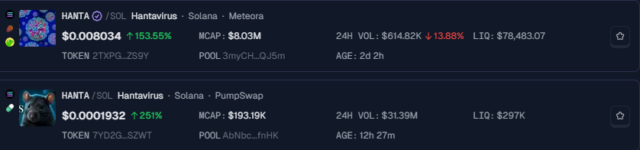
Another thing savvy crypto enthusiasts tend to do during such unsettling periods is launch trending meme coins to earn quick gains. Data show that tokens like HANTA (whose logos feature rodents) have already popped up, with some amassing market caps in the millions.

HANTA Meme CoinsHANTA Meme Coins
HANTA Meme Coins, Source: GeckoTerminal

Over the years, meme coin creators have even capitalized on the deaths of public figures, including Hulk Hogan and Queen Elizabeth, to make easy money.

COVID-19 2.0 or Not?

The hantavirus is indeed much more dangerous than the coronavirus, which crippled normal functioning worldwide in the early 2020s. It kills 4 out of 10 infected people, while the original COVID-19 strain had a fatality rate of roughly 1%.

However, the hantavirus is far less contagious than the other infection, as it requires very close, prolonged contact with a diseased person to transmit it. Additionally, people can mainly spread the virus only when they are very sick, not before symptoms.

The World Health Organization recently insisted that the risk of the hantavirus spreading into a deadly global outbreak is “absolutely low.” The topic reached the White House, too, with President Donald Trump assuring that “it’s very much, we hope, under control.”


Source link

When her ‘soul cat’ died, she was bereft. Now she designs memorial jewelry to help others with pet loss | Pets

0


In 2010, Katie Teixeira adopted a kitten found all alone in an abandoned house. The kitten – so tiny she fit in the palm of Teixeira’s hand – needed to be bottle-fed every few hours. For weeks, Teixeira set her alarm for middle-of-the-night feedings and drove home on her lunch break to care for the kitten she named Milo. As the cat grew, so did the connection between them.

“We just bonded,” Teixeira says. “Like mother and daughter.”

Eventually, Teixeira and her husband adopted four more cats, but Milo, a tabby with white toes, maintained a special place in Teixeira’s heart. “People talk about soul animals,” she says. “Milo was my soul cat.”

Katie Teixeira, owner of Fallen Whiskers, shows a 14K gold necklace with a custom setting made with mica powder and UV resin to mimic her cat’s nose patterns with Milo’s fur and whiskers inside, on 22 April in Cumberland, Rhode Island. The necklace was made honor her late cat Milo. Photograph: Faith Ninivaggi/The Guardian

When Milo died in 2021, Teixeira was bereft. She wanted a way to commemorate her. While Teixeira, who was working as a procurement analyst for CVS Health at the time, had seen pet memorial jewelry online, keepsakes that sometimes included the animal’s ashes or fur, “it just didn’t speak to me”, she says. “I’ve always been artistic and very crafty. So I was like, let me try doing something myself.”

It took a few years for inspiration to strike, but in 2023, Teixeira made a ring using a few of the whiskers Milo had shed while she was alive, crisscrossing them over a shimmering silver resin.

What happened next, she says, “happened very fast”.

When Teixeira wore the ring to her next volunteer shift at PawsWatch, the cat shelter near her home outside Providence, Rhode Island, she was inundated with requests from people who wanted their own. Soon, Teixeira was making dozens of pieces, which she began posting on her social media accounts. When one of her Instagram reels went viral, her inbox swelled with questions and requests. So Teixeira took two days off from work and built a website. Just three months after she made her first ring, Fallen Whiskers was born.

For a while, the business was Teixeira’s side hustle, a passion project that filled her nights and weekends and allowed her to support the shelter, where she donates a portion of her proceeds. But then, in 2024, she was laid off from her job of 20 years.

Friends and family encouraged her to make her side hustle a full-time gig.

“I remember saying to her, and I know it’s cliche, that when one door closes, another opens up,” says Donna Lilla, the operations manager at PawsWatch. “It just felt meant to be.”

Katie Teixeira of Fallen Whiskers at her home studio in Cumberland, Rhode Island, on 22 April. Photograph: Faith Ninivaggi/The Guardian

But Teixeira wasn’t so sure.

“I was terrified,” she remembers. Her husband’s work as a heavy equipment operator could sustain the family only for so long. But her startup costs would be minimal; all she needed was a small stockpile of ring and necklace settings, the mica powder she used to create the resin backgrounds – and the whiskers, teeth and claws of pet owners who put their trust in her. She decided to test the business out, only for a few months.

Two years later, Teixeira fills about 15 orders a week for pieces that sell for $125 to $150. She has more than 100,000 Instagram followers. Her customers speak about her in adoring terms.

“She’s doing God’s work,” says Rebecca Snyder, a non-profit professional from Westchester county, New York, who remembers the day she lost her cat Emma as “literally the worst day of my life”. The pain was so overwhelming, the 40-year-old sought grief counseling.

Snyder says the matching teardrop ring and pendant necklace that Teixeira designed, with whiskers laid over a pearlescent green resin that matched the Maine Coon’s eyes, provided tremendous comfort: “I felt like I had done Emma justice by honoring her in such a beautiful way.”

Teixeira has incorporated whiskers, ashes, fur, teeth, claw sheaths, reptile skins, horse mane, hedgehog quills, bones and bits of favorite toys and blankets into cufflinks, bracelets, earrings and necklaces. (All materials must be shed naturally or collected after death, she said.) She has made a pendant of lion whiskers for a zookeeper mourning the big cat and another pendant of tiger whiskers for the sanctuary worker who cared for the rescued animal.

Katie Teixeira, the owner of Fallen Whiskers, at her home studio in Cumberland, Rhode Island, on 22 April. Photograph: Faith Ninivaggi/The Guardian
Katie Teixeira shows off some custom jewellery she made at her home studio in Cumberland, Rhode Island. Photograph: Faith Ninivaggi/The Guardian

Fallen Whiskers is a part of a broader shift in how Americans view their pets. According to the Pew Research Center, 97% of owners consider their animals to be part of the family; more than half say their pet is as much a part of their family as a human member. Also on the rise: the amount of money pet owners are willing to spend on their animals, during their lives and afterwards, including on things like cremation, burial, memorial services and the kinds of bespoke consumer goods Teixeira produces.

Americans spent $157bn on their pets in 2025, up from $90bn in 2018, according to the American Pet Products Association.

“I’m still kind of wrapping my head around the fact that I am where I am right now,” Teixeira says of being able to earn a living from her passion project. “I guess I’ve made it.”

But “making it”, she’s learned, is very much a job that never ends.

When she started out, Teixeira tried to do her own accounting using QuickBooks but soon became overwhelmed. She decided to hire a part-time bookkeeper, the only individual on her payroll besides herself. “It’s just one thing I don’t have to worry about, and I can focus more on my customers and my orders,” she says.

Balancing her books has gotten much trickier in the last year. In April 2025, the Trump administration announced a 10% minimum tariff on almost all jewelry-related imports (with some countries and products facing much higher rates), a policy that affects Teixeira, who imports materials she can’t source in the US. A shaky market, meanwhile, has pushed investors into assets like precious metals, a trend that has essentially tripled what she pays for silver and gold.

“I have to extend that cost on to the customers,” she says. “It sucks – period.”

According to the Jewelers of America, an industry group that represents retailers and suppliers, these market shocks “pose a grave threat” to small jewelers like Teixeira, who rely on imported materials and operate on much thinner margins than big box stores. “The uncertainty of an escalating trade war can … potentially jeopardize the livelihoods of small retailers who form the backbone of the US jewelry market,” the group said in a position statement.

Teixeira says she is constantly monitoring her material costs, and, “as needed, adjusting on my side”, a time-consuming chore that takes her away from her workbench.

But according to Teixeira, managing costs isn’t the most difficult part of running Fallen Whiskers – it’s managing her emotions.

“The biggest challenge is the emotional weight of the work that I do,” she says. “Every day, I’m just diving into other people’s grief.”

Katie Teixeira of Fallen Whiskers at her home studio in Rhode Island with her cats Cash and Eve. Photograph: Faith Ninivaggi/The Guardian

That’s because Teixeira doesn’t just ask her clients for the fur and ashes they want included in their jewelry. She asks them to tell her the story of their bond with that animal. “And I’ve been there,” she says, “so it stirs up a lot of my own grief.”

While not a requirement, Teixeira says learning about the pet is a part of her creative process, as well as her way of helping other people through the pain of losing a companion.

“I was high-peak grieving, so writing was therapeutic for me,” says Natacha Hein, a clinical research contract specialist at Children’s hospital in Denver. “She helped me get over the hump.”

Hein stumbled upon Teixeira’s work online when she was looking for a way to memorialize Zazu, the “spicy” tabby that transformed the self-professed dog person into a cat person. “I wanted to feel like he was always around me,” Hein said.

The other shops she looked at “didn’t have that interaction piece. Their content felt scripted. There wasn’t a lot of warmth.” The conversations she had with Teixeira made her feel safe to send the jewelry maker precious, irreplaceable materials like fur and ashes. The day Hein received her ring, a smoky green the color of Zazu’s eyes, “was emotional as all hell”, she says. “I give Katie so much credit. It is a beautiful thing she is doing.”

So far, Teixeira has relied solely on word of mouth and daily posts on Facebook and Instagram to market Fallen Whiskers. Demand is growing, but Teixeira – who works on one piece at a time – isn’t in a rush to scale. “I don’t ever want it to feel transactional,” she says. That’s not to say the small-business owner doesn’t have aspirations.

“One day, I’d like to start my own cat sanctuary,” she says. “That’s my big, big dream.”


Source link

BTC Hits Key Decision Zone After 20% Monthly Rally

0


Bitcoin has continued its recovery structure with buyers gradually regaining control. The recent upward expansion has pushed the market back toward key resistance levels, while momentum indicators and market structure suggest that BTC is attempting to transition from a corrective phase into a broader bullish continuation. However, the market is now approaching a decisive area where confirmation is required before a sustained rally can unfold.

Bitcoin Price Analysis: The Daily Chart

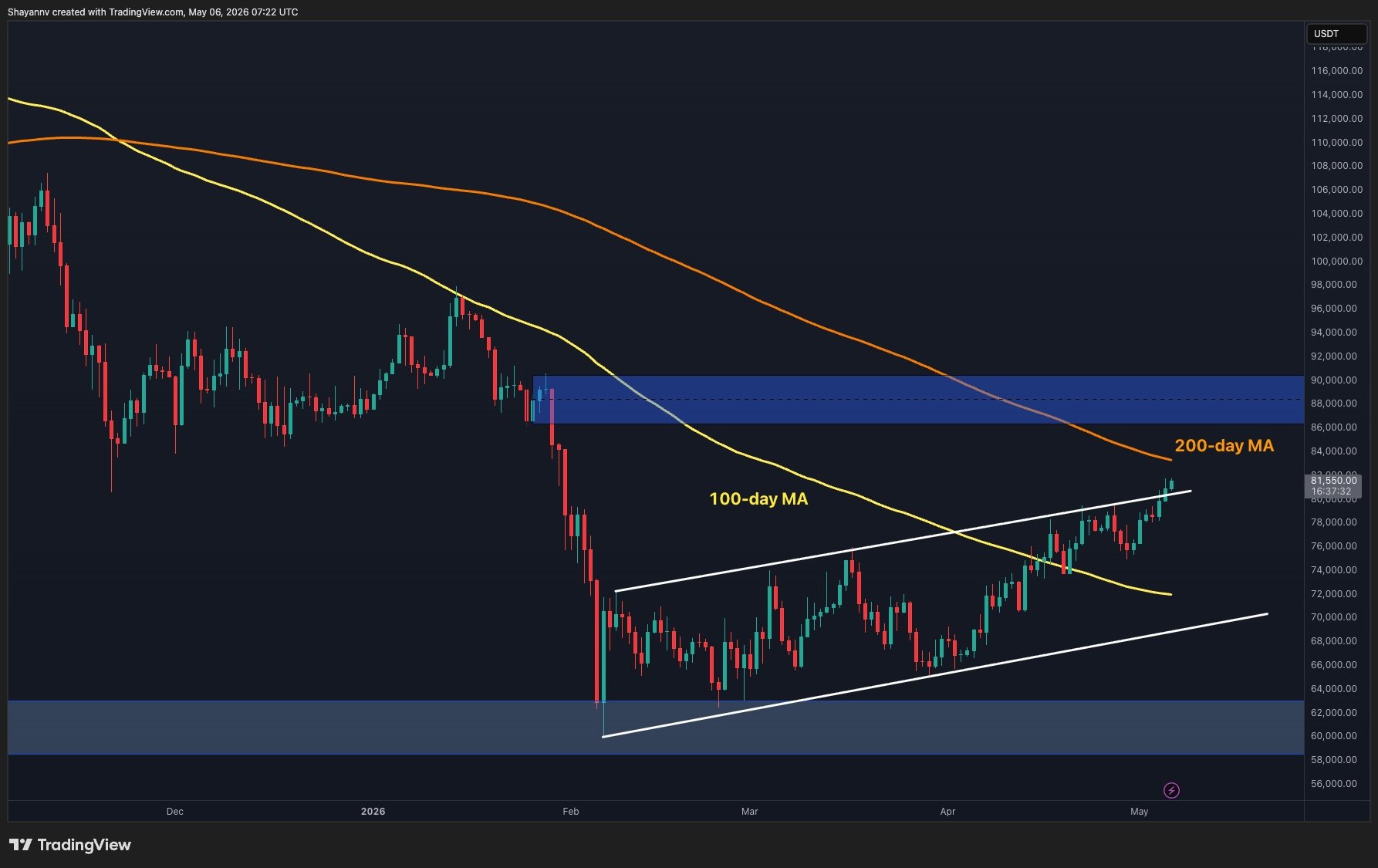
On the daily timeframe, BTC has recently displayed notable bullish momentum and managed to slightly break above the upper boundary of the ascending channel that has contained the price action for the past several months. This breakout is an important technical development, as it signals strengthening buyer dominance after weeks of gradual accumulation. Nevertheless, the breakout still requires confirmation.

If the price stabilizes above the channel’s upper boundary at $80K and forms a successful pullback toward it, the breakout would likely be validated, opening the door for another bullish leg toward higher resistance zones. At the same time, Bitcoin is approaching a major resistance confluence around the $83K range, where the 200-day moving average is currently located.

This area could temporarily slow the bullish momentum. In this structure, the broken price channel now acts as dynamic support, while the $83K-$85K region remains the next major hurdle for buyers.

BTC/USDT 4-Hour Chart

On the 4-hour chart, a new ascending price channel has emerged, highlighted by the yellow structure. The market has been respecting both the upper and lower boundaries of this formation, indicating an orderly bullish trend in the short term. Bitcoin is currently trading near a significant resistance zone around the $81K-$84K range, represented by the green supply region.

Meanwhile, the $75K-$78K region, highlighted by the brown box, is acting as the main short-term support. Given the proximity to resistance and the recent sharp rally, the market is likely to experience consolidation and fluctuating price action within this channel over the coming days. A breakout above the $81K-$84K resistance could trigger continuation toward higher levels, while a rejection and breakdown below the $75K-$78K support may lead to a deeper correction within the broader structure.

Sentiment Analysis

From a liquidation perspective, the heatmap indicates that Bitcoin has recently swept through a large portion of the liquidity concentrated around the $80K region. This suggests that a significant number of short positions have already been liquidated during the recent rally.

However, notable liquidity clusters still remain above the current market price, particularly around the $85K-$95K region, making these levels attractive targets for further upside expansion and potential short squeezes. On the other hand, substantial liquidity pools continue to exist at lower price levels, especially below the $60K-$70K range. These deeper liquidity zones could still attract price in the coming months if broader market conditions weaken or if the current breakout fails to sustain itself.

Overall, Bitcoin is showing improving bullish momentum after reclaiming key technical levels, but the market is now entering a critical resistance zone. The interaction between the broken ascending channel, the 200-day moving average around $88K-$90K, and the surrounding liquidity clusters will likely determine whether BTC can sustain a broader uptrend or enter another consolidation phase before the next major move.

Prefer CryptoPotato on Google News – Never miss a breaking move

SPECIAL OFFER (Exclusive)

Binance Free $600 (CryptoPotato Exclusive): Use this link to register a new account and receive $600 exclusive welcome offer on Binance (full details).

LIMITED OFFER for CryptoPotato readers at Bybit: Use this link to register and open a $500 FREE position on any coin!

Disclaimer: Information found on CryptoPotato is those of writers quoted. It does not represent the opinions of CryptoPotato on whether to buy, sell, or hold any investments. You are advised to conduct your own research before making any investment decisions. Use provided information at your own risk. See Disclaimer for more information.


Source link

Google search engine

Recent Posts