Google search engine
Home Blog Page 129

KelpDAO Hack Fallout Pushes Another DeFi Protocol Toward Chainlink CCIP Migration

0


Chainlink CCIP just secured another major DeFi migration.

Bitcoin-focused DeFi platform Solv Protocol announced that it is fully migrating to the Chainlink Cross-Chain Interoperability Protocol (CCIP) as part of its updated security strategy for cross-chain transactions.

The move will cover more than $700 million in Bitcoin-related assets across SolvBTC and xSolvBTC.

Solv Ends LayerZero Bridging Support

As part of the transition, Solv said it will discontinue LayerZero bridging support for SolvBTC and xSolvBTC on Corn, Berachain, Rootstock, and TAC. The platform explained that it is reducing risk exposure on its existing bridging stack and standardizing its infrastructure on Chainlink CCIP.

Solv described cross-chain bridges as one of the highest-risk areas in decentralized finance, while noting that vulnerabilities in bridge infrastructure can create significant systemic risks for the sector. The platform also confirmed carrying out a complete updated review of available cross-chain interoperability solutions before selecting Chainlink CCIP.

Commenting on the development, Chainlink Labs’ Chief Business Officer, Johann Eid, said,

“We are proud to work with the Solv team and support their migration to Chainlink CCIP as the standardized way that their wrapped Bitcoin assets are securely transferred cross-chain. Solv’s migration to CCIP reflects a broader shift across the DeFi industry of leading protocols adopting Chainlink to deliver the highest level of security required to bring the next billion users onchain.”

LayerZero Breach Fallout Deepens

Solv Protocol’s decision to migrate its cross-chain infrastructure to Chainlink comes weeks after the massive April 18 exploit involving LayerZero-powered KelpDAO, which resulted in losses of roughly $292 million. The attacker, reportedly linked to North Korea’s Lazarus Group, allegedly exploited weaknesses tied to LayerZero’s infrastructure, according to KelpDAO’s public statements.

The DeFi protocol pushed back against claims from LayerZero Labs that the breach stemmed from a configuration issue unique to KelpDAO. Instead, Kelp argued that the setup followed LayerZero’s official documentation and reflected a standard deployment model used by many applications across the ecosystem.

You may also like:

Kelp further claimed that LayerZero’s DVN signed forged transactions worth more than $100 million before the protocol paused its contracts and stopped additional losses. LayerZero later acknowledged in its postmortem that attackers gained access to RPC endpoints connected to its DVN and compromised multiple nodes during what it described as an RPC spoofing attack.

Following the exploit, KelpDAO announced plans to move away from LayerZero’s OFT standard and transition rsETH to Chainlink’s CCIP framework.


Source link

Bitcoin Price Falls Below Its Most Important Support, What Does it Mean?

0


Here’s why this analyst believes BTC could be on the verge of a more profound decline.

Bitcoin went through an impressive rally from last week’s FOMC meeting, when it dipped below $75,000, to May 6, when it surged to almost $83,000 for the first time since late January.

After gaining roughly $8,000 in less than a week, though, the bears stepped up and pushed it south by over three grand. According to Ali Martinez, this means that BTC has slipped below a crucial support.

Below $80.3K

In a blog post on X, the analyst with over 165,000 followers noted that the $80,300 level is bitcoin’s most “important” line, which now serves as resistance since the asset trades below it. He justified this narrative by indicating that this is the average cost basis of new whales (large entities that bought in the last 155 days).

“When BTC trades below this average cost basis, these whales are holding at a loss. Yesterday, bitcoin pushed to a high of $82,800, but it has since dropped back below this $80,300 level,” he added.

If the cryptocurrency remains stuck below this coveted level, these newly entered whales are likely to be incentivized to sell just to break even and avoid further losses. If this panic is to occur, it can create a wave of selling pressure that pushes the asset “much lower.”

In the opposite scenario, it could signal that the selling pressure is exhausted if bitcoin manages to flip $80,300 into solid support. Once the whales are in the green, they “stop selling and start holding for higher targets, which is exactly how new uptrends begin,” Martinez explained.

Risk Appetite Rockets

In a separate post, Martinez warned that the risk appetite for the largest cryptocurrency has hit its highest level in almost a year. Citing data from all major exchanges, he noted that the Estimated Leverage Ratio has reached a 2026 peak, indicating a “significant jump in risk appetite, as traders increasingly rely on borrowed capital to position for the next move.”

He cautioned that high leverage is a “double-edged sword,” as it can accelerate a bullish breakout, but it can also make the market highly sensitive to cascading liquidations if the price takes a sudden turn. Similar occurrences took place during the early October wipeout, when over $19 billion worth of leveraged positions were liquidated within a day as the market tumbled.

You may also like:


Source link

10 Essential Life Hacks for Remote Workers in 2026: Boost Productivity, Well-being, and Your Home Office

0

The landscape of work has fundamentally shifted, and for many, the home has become the new office. As remote work solidifies its place in the professional world, optimizing your setup and routines is crucial for success and sanity. In 2026, the challenges and opportunities of remote work continue to evolve. This guide offers ten essential life hacks designed to enhance your productivity, create an effective home office, and safeguard your mental well-being.

1. Conquer Your Commute: The Mindful Morning Ritual

One of the most significant perks of remote work is the elimination of the daily commute. However, this can blur the lines between personal and professional life. Reclaim your time by implementing a mindful morning ritual. Instead of rolling straight out of bed to your desk, dedicate 30-60 minutes to activities that energize you. This could include exercise, meditation, journaling, or enjoying a leisurely breakfast. This structured start signals the transition from personal time to work time, setting a productive tone for the day.

2. The Ergonomic Sanctuary: Crafting Your Ideal Home Office

Your home office isn’t just a desk and a chair; it’s your command center. Investing in ergonomic equipment is paramount for long-term health and productivity. Ensure your monitor is at eye level, your chair supports good posture, and your keyboard and mouse are positioned comfortably. Natural light is a powerful mood and productivity booster, so position your workspace near a window if possible. Even small adjustments, like adding a plant or organizing your desk with functional storage, can transform your space into an inspiring and efficient environment.

3. Time Blocking: The Art of Intentional Scheduling

Without the natural structure of an office environment, time can easily slip away. Time blocking is a powerful technique where you divide your day into specific blocks of time dedicated to particular tasks or activities. This prevents multitasking, reduces decision fatigue, and ensures that important projects receive the focused attention they deserve. Schedule not only work tasks but also breaks, meals, and even short periods for checking emails. Tools like Google Calendar or dedicated time-blocking apps can be invaluable for implementing this hack effectively.

4. The “Two-Minute Rule” for Small Wins

Procrastination often stems from overwhelming tasks. The “Two-Minute Rule,” popularized by David Allen, suggests that if a task takes less than two minutes to complete, do it immediately. This applies to answering a quick email, filing a document, or tidying your workspace. By tackling these small tasks promptly, you prevent them from accumulating and creating mental clutter. This also creates a sense of accomplishment and momentum that can carry you into larger projects.

5. Digital Detox: Setting Boundaries with Technology

While technology is the backbone of remote work, it can also be a major distraction. Implement a digital detox strategy to maintain focus and mental well-being. This involves setting clear boundaries for when you’ll engage with work-related digital communication and when you’ll disconnect. Turn off non-essential notifications, schedule specific times for checking emails and messages, and consider using website blockers for distracting sites during work hours. A complete shutdown of devices for a set period each evening is also highly recommended.

6. The Power of “Deep Work”: Uninterrupted Focus Sessions

Cal Newport’s concept of “Deep Work” is essential for remote workers aiming for high-value output. This involves dedicating uninterrupted blocks of time to cognitively demanding tasks. To achieve this, communicate your focus times to colleagues or family members, close unnecessary tabs and applications, and create a quiet, distraction-free environment. Regularly engaging in deep work sessions will lead to higher quality output and a greater sense of professional accomplishment.

7. Hydration and Nutrition: Fueling Your Focus

The convenience of working from home can sometimes lead to poor eating habits and dehydration, both of which significantly impact energy levels and cognitive function. Make it a habit to keep a water bottle at your desk and refill it regularly. Plan your meals and snacks in advance to avoid unhealthy impulse choices. Preparing nutritious meals and snacks can provide sustained energy throughout the day, preventing the common afternoon slump.

8. Social Connection: Combating Isolation

One of the most significant challenges of remote work is the potential for social isolation. Proactively foster social connections to maintain your mental well-being. Schedule virtual coffee breaks with colleagues, participate in online social events, or reach out to friends and family for regular check-ins. Consider joining online communities related to your hobbies or professional interests. Maintaining these connections is vital for combating loneliness and fostering a sense of belonging.

9. Movement Breaks: Integrating Physical Activity

Extended periods of sitting can be detrimental to your physical health. Incorporate short, regular movement breaks into your workday. Set a timer to remind yourself to stand up, stretch, or take a short walk every 30-60 minutes. Consider incorporating a short exercise routine before or after work, or during your lunch break. Even small bursts of physical activity can improve circulation, reduce fatigue, and boost your mood.

10. Continuous Learning and Skill Development

The remote work environment offers unique opportunities for continuous learning. Dedicate time to professional development by taking online courses, attending virtual workshops, or reading industry publications. Exploring new skills can not only enhance your career prospects but also keep your work engaging and stimulating. The digital landscape is constantly evolving, and staying updated is key to long-term success, much like the evolving trends in technology that can influence financial markets, such as the potential for Bitcoin to reach $1M on a mega adoption trend.

Summary Table: Remote Work Essentials

Hack #Life HackKey BenefitImplementation Tip
1Mindful Morning RitualSets productive tone, separates work/lifeDedicate 30-60 mins to non-work activities
2Ergonomic SanctuaryImproves health, comfort, and focusInvest in good chair/monitor; maximize natural light
3Time BlockingEnhances focus, reduces multitaskingSchedule specific time blocks for tasks and breaks
4“Two-Minute Rule”Reduces procrastination, creates momentumDo any task under 2 mins immediately
5Digital DetoxMinimizes distractions, improves well-beingTurn off non-essential notifications; schedule check-ins
6“Deep Work” SessionsBoosts high-value outputSchedule uninterrupted focus blocks; minimize distractions
7Hydration & NutritionSustains energy and cognitive functionKeep water at desk; plan healthy meals/snacks
8Social ConnectionCombats isolation and improves moodSchedule virtual coffee breaks; engage with communities
9Movement BreaksReduces fatigue, improves physical healthIncorporate short walks/stretches every hour
10Continuous LearningEnhances career, keeps work engagingUtilize online courses and virtual workshops

Conclusion

Navigating the world of remote work in 2026 requires a proactive and intentional approach. By implementing these ten essential life hacks, you can cultivate a more productive work environment, establish healthy boundaries, and significantly enhance your overall well-being. The key is to view your home office not just as a place to work, but as a dynamic space that supports your professional growth and personal health. Embrace these strategies to thrive in the evolving landscape of remote employment.

For more insights on enhancing your lifestyle and productivity, explore resources on News and related topics.


Crypto Burglar Who Broke into Homes to Steal Hardware Wallets Gets 78 Months

0


A 20-year-old California man has been sentenced to six and a half years in federal prison for his role in a crypto theft ring that defrauded victims of more than $250 million.

Marlon Ferro, of Santa Ana, known online as “GothFerrari,” was sentenced to 78 months in prison alongside three years of supervised release and $2.5 million in restitution, the US Attorney’s Office for the District of Columbia said Wednesday. Ferro pleaded guilty in October 2025 to participating in a Racketeer Influenced and Corrupt Organizations (RICO) conspiracy.

“Marlon Ferro served as the criminal enterprise’s instrument of last resort,” US Attorney Jeanine Ferris Pirro wrote, adding that when co-conspirators couldn’t talk victims into surrendering their crypto or hack into their accounts remotely, they sent Ferro to break in physically and steal the hardware wallets storing the funds.

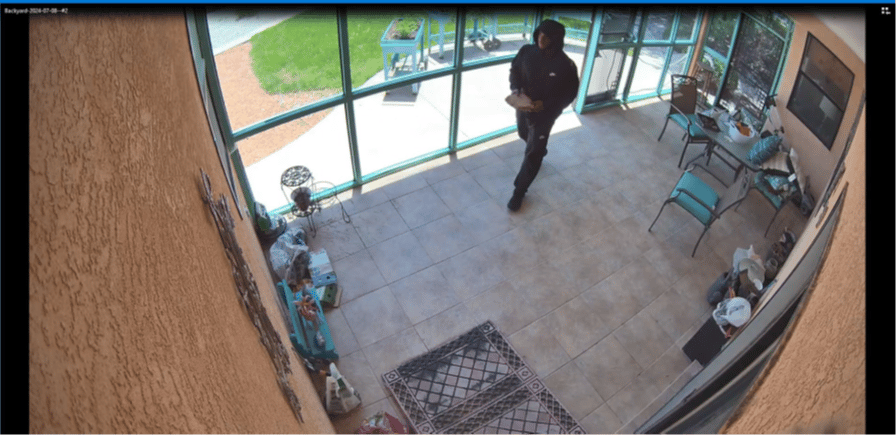
In a February 2024 incident, he traveled to Winnsboro, Texas, broke into a home and walked out with a hardware wallet holding about 100 Bitcoin worth more than $5 million at the time. Months later, he flew to New Mexico, spent days staking out a residence and used a brick to smash his way inside while co-conspirators monitored the victim’s location through his iCloud account. A home surveillance camera caught him in the act.

Ferro using a brick to break into a victim’s home. Source: Justice

Related: Coinbase faces lawsuit over frozen funds from $55M crypto theft

When hacking didn’t work, they sent a burglar

The conspiracy ran from late 2023 to early 2025, with members across California, Connecticut, New York, Florida and overseas. The conspirators each had a role, including hacking databases, identifying targets, making fraudulent calls and laundering money. When victims kept their funds on hardware wallets that couldn’t be accessed remotely, the gang turned to Ferro.

Ferro and his co-conspirators spent the stolen funds on luxury items, including Hermès Birkin bags, watches priced up to $500,000, private jets and exotic cars worth as much as $3.8 million. Nightclub tabs alone reached $500,000 in a single evening.

Ferro also laundered money using fake identification documents, purchased over $255,000 in designer goods for co-conspirators, and helped a jailed conspiracy leader by converting crypto to cash to cover legal fees.

The investigation was led by the FBI and IRS Criminal Investigation.

Related: Law enforcement freezes $41M connected to $150M crypto Ponzi collapse

Crypto hack losses top $630 million in April

April was the worst month for crypto hacks in over a year, with losses totaling $629.7 million, according to DefiLlama. KelpDAO’s $293 million exploit and Drift Protocol’s $280 million hack drove the bulk of the damage, together accounting for more than 90% of monthly losses.

According to Chainalysis security head Yaniv Nissenboim, April’s hack surge reflects a shift toward sophisticated attacks targeting the infrastructure connecting onchain protocols to offchain systems.

Magazine: AI-driven hacks could kill DeFi — unless projects act now

Cointelegraph is committed to independent, transparent journalism. This news article is produced in accordance with Cointelegraph’s Editorial Policy and aims to provide accurate and timely information. Readers are encouraged to verify information independently.


Source link

Bitcoin Analysts Say This Must Happen for a ‘Durable’ BTC Price Recovery

0


Bitcoin’s (BTC) relief rally to $82,000 appears to be cooling off, and analysts say key levels must be reclaimed for BTC price to “confirm a durable continuation higher.”

Key takeaways:

  • Bitcoin must break resistance at $85,000-$88,000 to confirm that the bottom is in.
  • Profit-taking on rallies must cool down for a sustained breakout in BTC price. 

Bitcoin must reclaim $88,000 as support

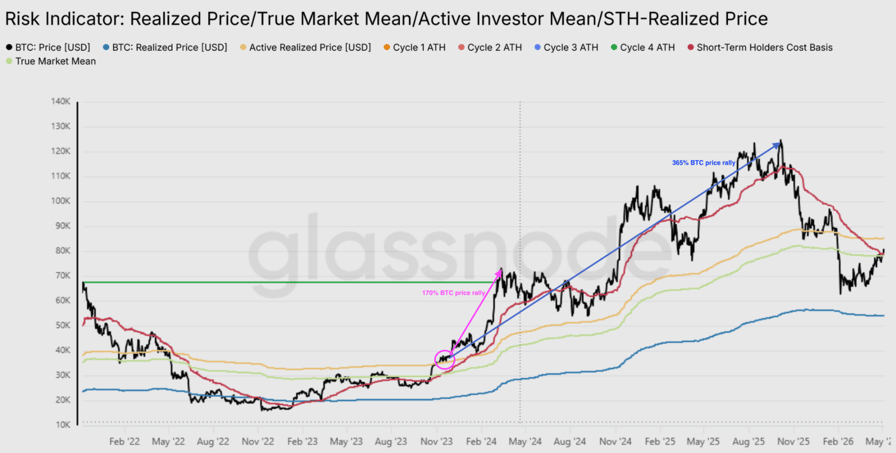
Bitcoin’s 7% climb over the last week to $81,000 saw it reclaim key levels, including the true market mean at $78,200 and short-term holder (STH) cost basis at $79,100.

If the price sustains above these two levels, the 50% drawdown from the $126,000 all-time high to sub-$60,000 levels in February “would rank among the shortest episodes of its kind in Bitcoin market history,” Glassnode said in its latest Week Onchain newsletter, adding:

“Attention now shifts to the next major resistance at the Active Realized Price near $85.2K, which tracks the cost basis of all non-dormant supply and represents the next structural threshold the market must reckon with.”

Bitcoin risk indicator. Source: Glassnode

The last time Bitcoin reclaimed its active realized price, in October 2023, it was followed by a 170% rally to its previous all-time high of $74,000 reached in March 2024. These gains increased to 365% once the price hit its current record highs above $126,000.

Related: Bitcoin Bollinger Bands push key breakout as creator acts on ‘positive’ signal 

Bitcoin’s realized price by age cohorts reveals other major levels of resistance sitting higher up: the realized price of the three- to six-month investor cohort at $88,880, the 12-month-18-month cost basis at $93,450 and the average purchase price of the six- to 12-month investor cohort at $111,850.

“For the bottom to be confirmed, price needs to clear $88.88K and hold – not wick through, not retest and fail,” CryptoQuant analyst IT Tech said in a Thursday Quicktake note, adding:

“Until then, every rally into $85K-$88K is walking straight into distribution from November 2025-Feb 2026, buyers desperate to get out flat.”

Bitcoin realized price – UTXO age bands. Source: CryptoQuant

A sustained move above that level could put recent buyers back in profit and reduce sell pressure, confirming a “durable continuation higher,” Glassnode added.

Analyst MikybullCrypto highlighted Bitcoin’s core levels of resistance before a “mega solid trend change,” including $88,000 and $92,000, based on Fibonacci level analysis. He argued that a break above those levels would strengthen the case for a move toward $100,000.

BTC/USD daily chart. Source: MikybullCrypto

Profit-taking by long-term holders could delay BTC price recovery 

Bitcoin’s current pullback below $81,000 could be attributed to increased profit-taking by long-term holders.

Additionally, the 14-day simple moving average of profit realized by investors who have held BTC for more than one year has increased to about $180 million per day following the recent rally.

Should the current recovery continue, “this distribution pressure is likely to intensify,” Glassnode said, adding:

“The market’s ability to absorb this gradual increase in supply while sustaining the price above the True Market Mean will be the defining test of whether the current recovery has genuine structural legs.”

Bitcoin realized profit by age. Source: Glassnode

Meanwhile, realized losses remain elevated at $479 million per day, approximately 140% above the $200 million per day cycle baseline. 

A sustained compression of this indicator below $200 million per day would serve as a strong indicator that selling exhaustion is setting in and confirm a “more durable recovery regime,” Glassnode said, adding:

“Until that threshold is reached, the dual weight of long-term holder profit taking and top-buyer distribution at thin loss margins is likely to anchor the current rally.”

Bitcoin realized loss. Source: Glassnode

This article is produced in accordance with Cointelegraph’s Editorial Policy and is intended for informational purposes only. It does not constitute investment advice or recommendations. All investments and trades carry risk; readers are encouraged to conduct independent research.


Source link

VanEck Sees Bitcoin Reach $1M on ‘Mega Adoption’ Trend

0


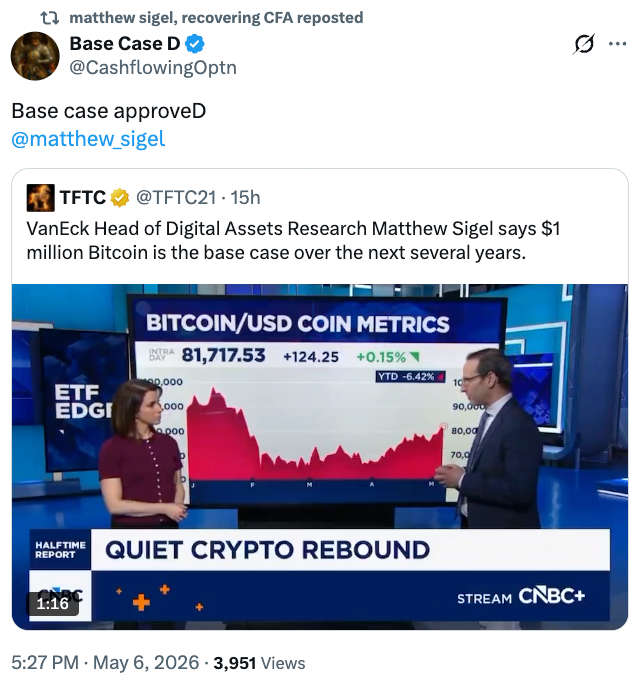
Matthew Sigel, head of digital assets research at investment manager VanEck, said he sees Bitcoin (BTC) reaching seven figures within the next five years.

“Bitcoin going up for us is the base case. We think this asset is going to reach a million dollars over the next several years,” Sigel said on CNBC’s Halftime Report on Wednesday.

Sigel later clarified that BTC is likely to reach that threshold in “half a decade,” comparing Bitcoin’s adoption to the video game industry’s, where usage has expanded across age groups after initially being limited to younger users.

“It’s going to be like the video game industry, where 30 years ago it was just kids playing video games, now Elon Musk plays video games,” he said.

Sigel’s latest projection aligns with VanEck’s base-case model, which estimates Bitcoin could reach $2.9 million by 2050, underscoring a longer-term bullish outlook despite periods of market volatility.

Bitcoin is a “mega trend,” but marked by volatility

Despite a highly bullish outlook, VanEck’s Sigel emphasized that Bitcoin is a “very cyclical asset,” saying its path toward $1 million would not be a steady upward move.

“There are no bailouts in Bitcoin, so it’s going to be cycles along the way,” Sigel said, hinting at the absence of a central authority to stabilize prices during market downturns.

Source: Matthew Sigel

“We have the first central bank buying Bitcoin for its reserves, so this is a mega trend, but it will be very volatile along the way,” Sigel added.

Near-term market positioning is negative

Addressing Bitcoin’s near-term price action, Sigel pointed to the asset’s correlation with the Nasdaq reaching its highest level in five years, suggesting the current rally is largely driven by broader macroeconomic trends.

“What keeps us encouraged even at the current levels is that we’re not seeing the froth in the derivatives markets,” he said, adding that the move appears to be driven primarily by short covering, indicating that overall positioning remains relatively bearish.

Bitcoin’s (BTC) all-time price chart. Source: CoinGecko 

Sigel’s take joins several similar views on Bitcoin’s price trajectory in the coming years, including predictions from Bernstein, Bitwise chief investment officer Matt Hougan, Jan3 CEO Samson Mow and Twitter co-founder Jack Dorsey, among others.

Cathie Wood’s ARK Invest’s 2030 Bitcoin price targets range from about $300,000 in a bear case to $710,000 in a base case and $1.5 million in a bull case, according to its Big Ideas 2025 model.

Related: Bitmine’s Tom Lee says ‘crypto spring’ has already begun

Some investors are more skeptical about Bitcoin’s adoption, though. Ray Dalio has said Bitcoin could act as a store of value but questioned its ability to scale into a global reserve asset amid regulatory and sovereign currency risks. Others, including gold advocate Peter Schiff, have argued Bitcoin lacks intrinsic value and is unlikely to displace traditional safe-haven assets like gold, casting doubt on seven-figure price forecasts.

Magazine: Adam Back says current demand is ‘almost’ enough to send Bitcoin to $1M

Cointelegraph is committed to independent, transparent journalism. This news article is produced in accordance with Cointelegraph’s Editorial Policy and aims to provide accurate and timely information. Readers are encouraged to verify information independently.


Source link

Core Scientific Q1 Loss Hits $347M As Mining Revenue Falls

0


Core Scientific (CORZ) reported a $347.2 million first-quarter net loss as its Bitcoin self-mining revenue fell sharply and high-density colocation became its largest revenue source. 

In its earnings report published on Wednesday, the company reported a net loss of $1.06 per diluted share for the quarter. A year earlier, Core Scientific reported diluted earnings of $1.24 per share.

Core Scientific said the loss included $266.5 million in non-cash impairment charges and a $30.8 million non-cash loss from changes in the fair value of warrants and contingent value rights.

Revenue rose to $115.2 million from $79.5 million a year earlier, but fell short of analyst expectations. Zacks Equity Research said analysts expected $120.2 million in revenue, with Core Scientific’s results coming in about 4.1% below expectations.

The results show Core Scientific’s transition from a Bitcoin miner into an AI infrastructure company, with high-density colocation now generating most of its revenue. The shift gives the company a larger business, but it also highlights how its legacy mining operations have weakened.

Bitcoin mining revenue falls

Core Scientific’s digital asset self-mining revenue fell to $30.1 million from $67.2 million a year earlier, with the company mining 279 Bitcoin (BTC) during the quarter, down 45% from the same period in 2025. According to its 10-Q filing, Core Scientific sold 2,385 Bitcoin during the quarter for $208.3 million to fund planned capital expenditures and other cash needs.

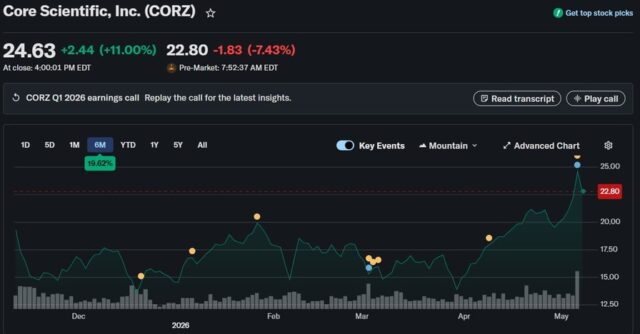
Core Scientific’s six-month price chart. Source: Yahoo Finance

Despite the weaker mining results, Core Scientific’s shares have gained over the past six months. Yahoo Finance data shows CORZ closed at $24.63 on Wednesday, up about 19.6% over six months, before falling 7.43% to $22.80 in pre-market trading at the time of writing.

In a separate announcement, Core Scientific said it plans to scale its Muskogee, Oklahoma, campus to about 1.5 gigawatts of gross power, including roughly 1.0 gigawatt of leasable capacity. The expansion would be supported partly by its planned acquisition of Polaris DS.

Related: Trump-linked American Bitcoin reports $82M Q1 loss, revenue miss

Core Scientific expands AI-linked colocation business 

Core Scientific’s first-quarter growth came from high-density colocation rather than Bitcoin production, with the company’s mining revenue and Bitcoin output falling while its AI-linked hosting business generated most of its revenue.

The company said its colocation revenue rose to $77.5 million in the first quarter from $8.6 million a year earlier, driven by additional billable customer power capacity delivered during the quarter.

The company said it was billing for 243 megawatts of capacity as of March 31, representing about $350 million in average annualized colocation revenue.

The revenue shift follows a series of hosting agreements with CoreWeave. In June 2024, Core Scientific said it signed 12-year contracts to deliver about 200 megawatts of infrastructure to host CoreWeave’s high-performance computing operations. 

The companies later expanded the relationship. In an SEC filing in February 2025, the companies said CoreWeave’s total contracted high-performance computing infrastructure with Core Scientific had increased to about 590 megawatts across six sites.

Magazine: Guide to the top and emerging global crypto hubs: Mid-2026

Cointelegraph is committed to independent, transparent journalism. This news article is produced in accordance with Cointelegraph’s Editorial Policy and aims to provide accurate and timely information. Readers are encouraged to verify information independently.


Source link

South Korea Confirms 22% Crypto Tax Goes Ahead in January 2027

0


South Korea’s Finance Ministry has confirmed that a long-delayed tax on crypto gains will take effect as scheduled in January 2027.

Moon Kyung-ho, director of the ministry’s income tax division, announced at an emergency parliamentary forum on virtual asset taxation held at the National Assembly Members’ Office Building in Seoul on Thursday, according to South Korea news outlet Edaily. The forum was hosted by Representative Park Soo-young of the People Power Party and the Korea Tax Policy Association.

“We will proceed with virtual asset taxation as scheduled in January next year,” Moon said in what appears to be the first public confirmation from the ministry that the crypto tax framework will move forward after multiple postponements.

Under the current Income Tax Act, profits generated through the transfer or lending of virtual assets will be categorized as “other income” beginning Jan. 1, 2027. Investors earning more than 2.5 million Korean won ($1,800) annually from crypto activities will face a 22% tax, including a 20% income tax and 2% local tax. The rule applies to an estimated 13.26 million investors.

Related: Bithumb wins temporary court stay on South Korea suspension: Report

South Korea prepares tax guidance

Moon said the National Tax Service is currently finalizing guidance on the new system and has held several working-level meetings with South Korea’s five major exchanges, including Dunamu (Upbit), Bithumb, Coinone, Korbit and Gopax, to prepare a draft notice.

He added that the notice would be published for legislative review during 2026. Speaking to reporters after the forum, Moon walked back his use of the word “soon,” clarifying that the notice would arrive sometime this year, not imminently.

Moon Kyung-ho at the National Assembly Members’ Office Building in Yeouido, Seoul. Source: Edaily.

South Korean regulators have delayed the crypto tax twice before, pushing the start date from 2025 to 2027 amid political disagreement and industry pushback over exchange readiness and the threshold level. More recently, the ruling People Power Party proposed a bill to scrap the tax altogether before its 2027 rollout.

Related: Samsung SDS wins deal to build South Korea’s blockchain securities system: Report

South Korea’s crypto industry pushes back on AML rules

As Cointelegraph reported, proposed changes to South Korea’s anti-money laundering (AML) rules have drawn sharp criticism from the country’s crypto industry. DAXA, an industry body representing 27 registered virtual asset service providers, warned that requiring exchanges to flag all overseas-linked transfers of 10 million won or more as suspicious would increase reported cases by 85 times, from around 63,000 last year to over 5.4 million, making compliance unworkable in practice.

The Financial Services Commission and Financial Intelligence Unit proposed the amendments on March 30, with a public comment period running through May 11 and final rules expected in July.

Magazine: South Korea gets rich from crypto… North Korea gets weapons

Cointelegraph is committed to independent, transparent journalism. This news article is produced in accordance with Cointelegraph’s Editorial Policy and aims to provide accurate and timely information. Readers are encouraged to verify information independently.


Source link

XRP May Soar to $12 as Price Holds Cycle Bottom Zone for Months

0


XRP (XRP) is retesting a long-term support zone that analysts say has historically preceded major rebounds, though the setup remains vulnerable to a breakdown.

Key takeaways:

  • XRP has jumped by roughly 30% from its February lows.
  • Multiple fractals suggest the price is bottoming out, supported by strong XRP ETF inflows.

XRP chart hints at rebound toward $12

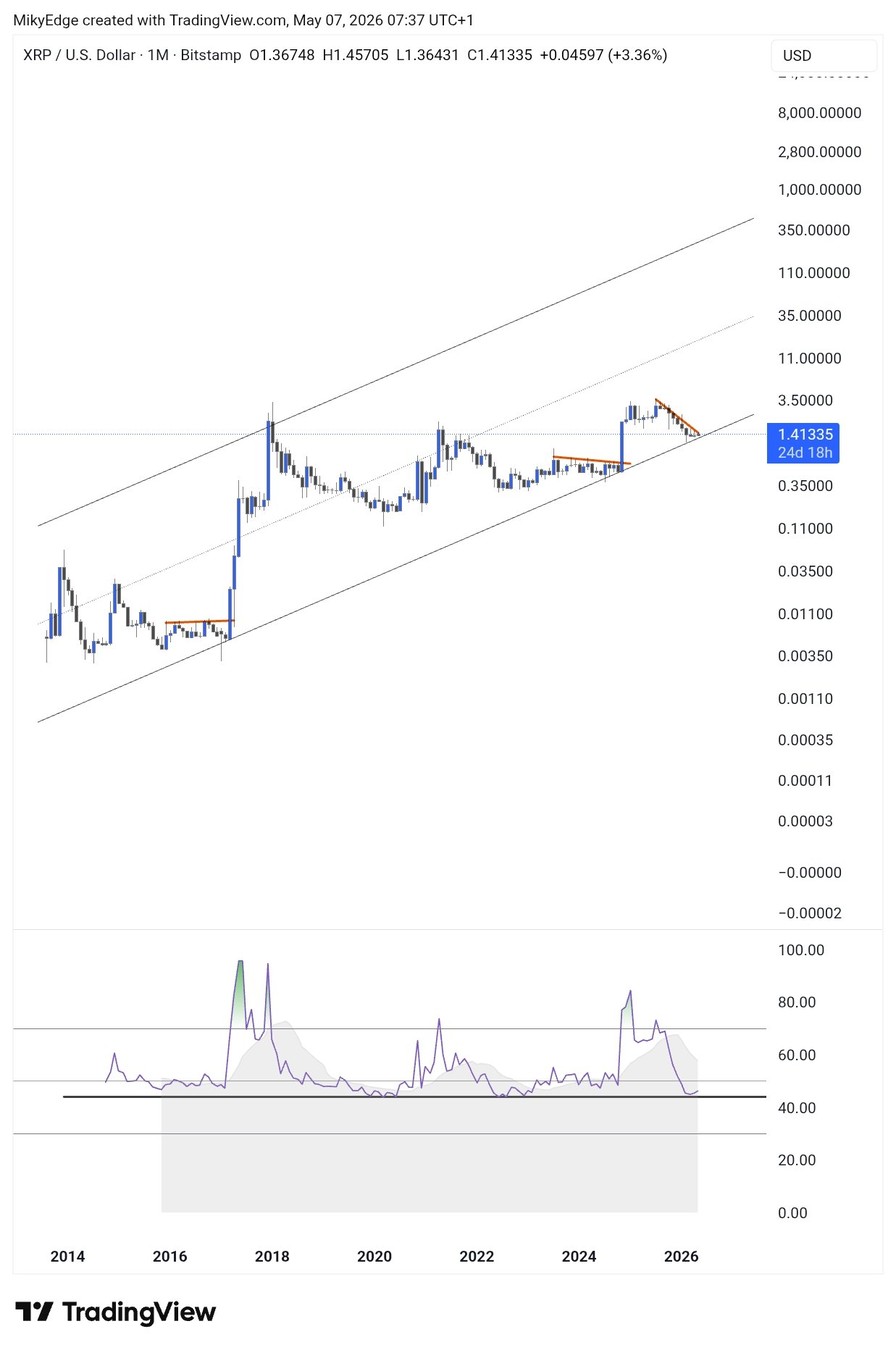
MikybullCrypto’s chart shows XRP trading inside a rising channel that has guided price action since 2014. XRP is now near the channel’s lower trendline around $1.30–$1.40, a zone that previously acted as a launchpad for large upside moves.

XRP/USD monthly chart. Source: TradingView/MikybullCrypto

The analyst says XRP is “probably going to $12,” a level that roughly aligns with the channel’s midpoint.

Momentum indicators support the rebound thesis. XRP’s monthly relative strength index (RSI) has cooled toward a historical support area near 40–45, similar to levels that appeared before past rallies.

In a Thursday post, analyst JD pointed to the same RSI support zone as a potential “cycle bottom” signal for XRP.

His two-week chart shows XRP breaking out of a multi-year symmetrical triangle, then pulling back toward the breakout area.

XRP/USD two-week chart. Source: TradingView/JD

The chart’s projected green target zone aligns with the $8–$14 range, implying strong upside if XRP holds the retest zone.

The bullish outlooks follow XRP’s sharp rebound in recent weeks, up by about 30% from its February lows at around $1.11.

Related: XRP price copies 2025 chart fractal that last time sparked 66% gains

In the period, XRP has largely benefited from renewed risk sentiment led by the US–Iran ceasefire, as well as market-specific fundamentals.

These include Rakuten Wallet’s XRP integration, which expanded the token’s reach in Japan, and $81.6 million in April inflows into US spot XRP ETFs, their strongest monthly total of 2026.

In the first week of May, XRP ETFs have attracted $28.17 million in inflows already.

US XRP ETF net flows. Source: SoSoValue

XRP still risks 2022-style bear market repeat

However, the bullish XRP setup is not guaranteed. The bears will try to pull the price down below the channel support. This would invalidate the bullish structure and put XRP at risk of deeper losses.

XRP/USD monthly chart. Source: TradingView

The support overlaps closely with XRP’s 50-month exponential moving average (50-month EMA, the red line) near $1.33.

Losing this support cluster shifts focus toward the 100-month EMA (the purple line) near $0.93, implying a roughly 30% drop from current levels. A similar plunge occurred during the 2022 bear market.

This article is produced in accordance with Cointelegraph’s Editorial Policy and is intended for informational purposes only. It does not constitute investment advice or recommendations. All investments and trades carry risk; readers are encouraged to conduct independent research.


Source link

Polygon Reduces Block Production Time to 1.75 Seconds

0


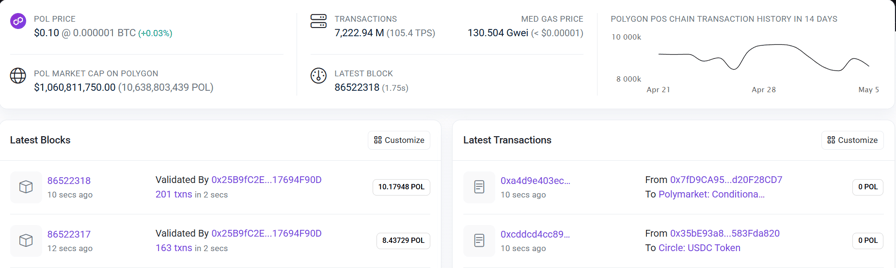
Blockchain layer-2 (L2) network Polygon reduced its average block time by 250 milliseconds to 1.75 seconds, marking its first block-time reduction since genesis as the network pushes deeper into stablecoin payments and settlement infrastructure.

Polygonscan shows that the latest blocks on the network were created in 1.75 seconds. The upgrade means that Polygon can process around 14% more payments per second, reaching a maximum theoretical throughput of about 3,260 transactions per second (TPS), according to Polygon software engineer Lucca Martins.

Shorter block times can help transaction backlogs clear faster, reducing the duration of network congestion and subsequent transaction fee spikes, which is particularly important for high-frequency use cases such as payments, stablecoins or decentralized finance (DeFi) trading.

The upgrade comes as Polygon makes efforts to position itself for use cases targeting more institutional adoption, such as private stablecoin payments. On Tuesday, Polygon introduced a new wallet feature that enables users to privately route stablecoin transactions through a shielded pool verified by zero-knowledge proofs.

The upgrade is part of the Polygon Improvement Proposal PIP-86, a two-step motion that seeks to further reduce block time to 1.5 seconds and scale down checkpoint rewards to maintain the Polygon (POL) token emissions at the target 1% after the block time reduction. 

Polygon blockchain explorer, latest blocks, production time. Source: Polygonscan

Cointelegraph reached out to Polygon for comment on its block time reduction plans, but had not received a response by publication.

Related: Morgan Stanley takes on crypto trading rivals with E*Trade pilot

Polygon targets private stablecoin payments to onboard institutions

Polygon’s new wallet feature is part of an aim to onboard more institutional users as it hides senders, receivers and amounts onchain while maintaining compliance through Know Your Transaction (KYT) screening and auditable files.

The feature introduces more privacy for businesses transacting with stablecoins, according to Polygon community lead Smokey. 

Despite the upgrade, Polygon’s (POL) token remained stagnant over the past 24 hours and traded at $0.09 at the time of writing. The token is down 54% over the past year, CoinMarketCap data shows.

POL/USD, one-year chart. Source: CoinMarketCap

Polygon has also integrated with large credit card providers. On April 29, global payments giant Visa expanded its stablecoin pilot to include support for Polygon, Base, the Canton Network, Arc and Tempo.

Launched by Visa in 2023, the pilot allows partners to settle transactions through stablecoins rather than traditional banking rails, to evaluate whether stablecoins can offer faster settlement.

Magazine: Will the CLARITY Act be good — or bad — for DeFi?

Cointelegraph is committed to independent, transparent journalism. This news article is produced in accordance with Cointelegraph’s Editorial Policy and aims to provide accurate and timely information. Readers are encouraged to verify information independently.


Source link

Google search engine

Recent Posts