
Today in crypto, Coinbase shares fell after reporting a $400 million net loss in Q1, fund managers warm back up to digital assets, with Bitcoin continuing to dominate allocation preferences, while Germany may be looking to overhaul its crypto tax rules from 2027, potentially curbing the country’s hallmark one-year tax-free holding rule.
Coinbase shares slide on $400 million Q1 loss, revenue miss
Coinbase shares slid Thursday after the US crypto exchange reported a steep first-quarter loss while revenue missed Wall Street expectations.
Coinbase reported a net loss of $394.1 million in Q1, its second consecutive quarterly loss after reporting a $667 million loss in Q4 2025. It swung from a $65.6 million profit a year earlier.
“Macro conditions were genuinely tough,” Coinbase chief financial officer Alesia Haas told investors on an earnings call. “Total crypto market cap and total crypto trading volume were both down more than 20% quarter-over-quarter.”
Coinbase’s earnings come as other crypto companies have also struggled to turn a profit in the first months of 2026 as a crypto market slump pushed some traders to other investments.
Meanwhile, Coinbase’s Q1 revenue was $1.41 billion, missing analyst estimates of $1.5 billion. Transaction revenue slumped 40%, while subscription and services revenue — representing its business outside trading — fell 13.5% from a year earlier.
Its earnings per share were a $1.49 loss, compared to analysts’ expectations of 36 cents per share, which saw Coinbase dropping by 4.7% after hours on Thursday to under $184.
Fund managers double down on Bitcoin as crypto sentiment rebounds — CoinShares
Fund managers are warming back up to digital assets, with Bitcoin continuing to dominate allocation preferences even as broader crypto sentiment improves, according to a new survey by CoinShares.
The April survey gathered responses from 26 institutional investors overseeing a combined $1.3 trillion in assets under management. Allocations to digital assets remain relatively modest, at around 1%, reflecting what CoinShares described as “typical entry sizing” in the current de-risking environment.
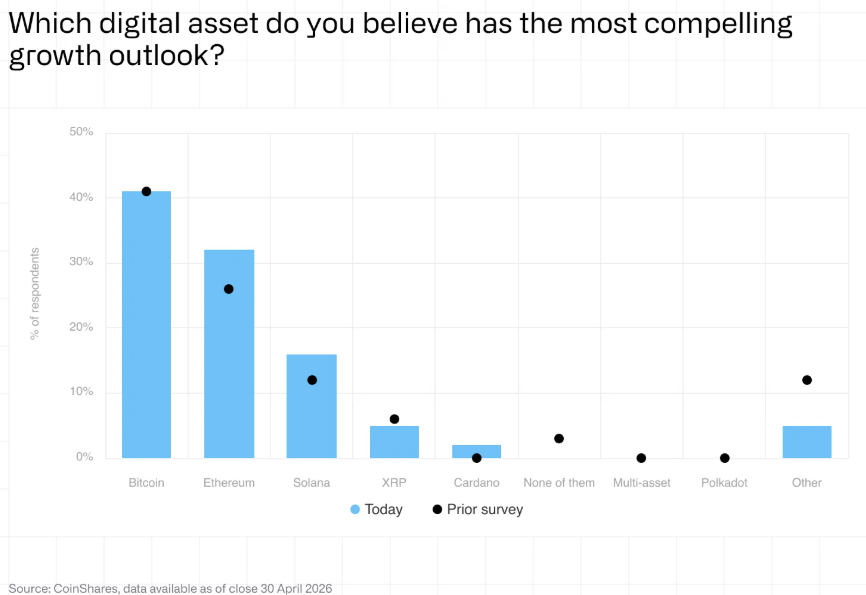
“Bitcoin remains the digital asset with the most compelling growth outlook,” CoinShares head of research James Butterfill wrote in the report. Sentiment toward Ether (ETH) and Solana (SOL) also improved modestly compared with previous quarters.
The findings suggest institutional investors are gradually increasing exposure to crypto amid improving market sentiment, growing adoption of exchange-traded funds (ETFs) and a more favorable regulatory backdrop.

Fund managers identified Bitcoin as having the strongest growth outlook among digital assets, followed by Ether and Solana. Source: CoinShares
Germany weighs 2027 crypto tax overhaul as one-year holding rule under threat
Germany is preparing to change how it taxes Bitcoin and other cryptocurrencies from 2027, potentially ending one of Europe’s most generous long-term holding exemptions as it seeks to raise additional revenue and tighten tax compliance.
Finance Minister Lars Klingbeil said at an April 29 press conference on the 2027 federal budget that the government wants to “tax cryptocurrencies differently,” and key points include an extra 2 billion euros (about $2.3 billion) in revenue from crypto taxation and measures against financial and tax crime.
Under current rules, private crypto gains in Germany are taxable if the assets are sold within one year of acquisition, but are generally tax-free after that period. The exemption has made Germany one of the more favorable European jurisdictions for long-term Bitcoin and crypto holders.
The finance ministry’s 2022 and 2025 guidance confirmed that this one-year “Haltefrist” also applies to coins used in staking and lending, after an earlier plan for 10 years was dropped. Tax advisory firms such as Blockpit describe the rule as a key advantage for German retail investors, especially long-term holders.

Germany plans to “tax cryptocurrencies differently.” Source: Bundesfinanzministerium
Klingbeil did not explicitly reference the holding period in his April remarks. However, industry groups, including the German Bitcoin Association, say the exemption is the most likely target if the government aims to generate significant revenue from crypto taxation.