Home Blog Page 91

Kenosha casino plan advances to final federal review stage


0
A picture of sailboats in the water in front of the Kenosha, Wisconsin water tower.


A picture of sailboats in the water in front of the Kenosha, Wisconsin water tower.

Federal officials have entered the final review phase for a proposed casino in Kenosha, Wisconsin, following the close of public comments on its environmental study.

At this stage, the Bureau of Indian Affairs and the U.S. Department of the Interior are reviewing the full administrative record for the draft environmental assessment. What they decide next will determine whether the project clears the federal hurdle. If it does, the proposal will land on Gov. Tony Evers’ desk for another review and the ultimate call.

Under the plan, the Menominee Indian Tribe of Wisconsin would own the casino and its related operations. Hard Rock International is slated to build and run the development, which would sit on roughly 60 acres just west of Interstate 94.

What the federal review phase means for the Kenosha casino project

With public comments now closed, federal agencies are evaluating whether the project meets all regulatory requirements. Their decision will determine if the proposal advances to the state level, where final approval would rest with the governor.

Project details and economic impact

Developers envision a sizable entertainment destination centered on a casino floor featuring 1,500 slot machines, more than 50 table games and a sportsbook. The complex would also include a 150-room Hard Rock Hotel, a Hard Rock Cafe, seven more restaurants, a Hard Rock Live venue, three bars and a retail shop.

Backers continue to emphasize the project’s economic upside. Plans estimate about 1,000 construction jobs over an 18-month buildout, generating a combined payroll of $104 million. Once open, the casino and hotel are expected to employ more than 1,000 people, with average yearly pay projected at $54,000.

Environmental assessment findings and regulatory outlook

The draft environmental assessment previously concluded the development could proceed under federal law without causing significant environmental harm. That finding has helped draw support from state and local leaders, many of whom submitted comments urging federal regulators to give the green light.

Support from Wisconsin lawmakers and local officials

A bipartisan group of Wisconsin lawmakers also weighed in, including senators Robert Wirch, D-Pleasant Prairie, and Van Wanggaard, R-Racine, along with representatives Elijah Behnke, R-Oconto, Ben DeSmidt, D-Kenosha, Tip McGuire, D-Kenosha, and Jeff Mursau, R-Crivitz. In their letter, they pointed to ongoing cooperation between the Menominee Tribe and state officials.

Kenosha County Executive Samantha Kerkman pushed for the process to move ahead without requiring additional environmental review.

The county supports the Menominee Tribe’s Kenosha Gaming Project, which will bring employment and economic development to the county, and urges the BIA to move the project forward by making the requisite findings and sending it to the governor for his concurrence,” Kerkman wrote.

She also pointed to years of consistent backing. “The county has long supported a planned Menominee casino in Kenosha,” she said. “The proposal continues to have broad support. A countywide referendum in 2004 showed 56% in favor of a Menominee casino, and polling from 2022 and 2025 has continued to show strong support with 60% in favor.”

Kenosha Mayor David Bogdala said the proposal aligns with the city’s development vision. “The city anticipates the project will have a positive impact on the city’s social structure and community character,” Bogdala wrote, adding it would expand entertainment options while aligning with existing land uses.

Tribal leadership perspective on project readiness

Menominee Indian Tribe Chairman Joey Awonohopay said the backing reflects the project’s readiness to proceed. “The strong support expressed by state and local elected leaders reinforces what the environmental assessment clearly demonstrates: that this project has been thoroughly vetted and is ready to move forward, and any efforts calling for more ‘detailed’ environmental review are just an attempt to delay a project that will benefit the region and the Tribe,” he said.

“We appreciate the leadership shown by our partners at the local and state levels and their confidence that the assessment provides a complete and responsible record for decision-making,” he said.

What happens next in the approval process

The next step depends on the outcome of the federal review. If approved, the proposal will move to Gov. Tony Evers, whose decision will ultimately determine whether the Kenosha casino project moves forward.

The post Kenosha casino plan advances to final federal review stage appeared first on ReadWrite.
Ukraine and Russia fight on despite US-mediated ceasefire

0


Russia ​and Ukraine on Monday reported fighting along their long front line despite a US-mediated ceasefire, and each accused the other of launching drone and artillery strikes. Ukraine and Russia agreed on Friday to a ​ceasefire from ‌May 9 to May 11 as part of a US-led push ⁠for peace under President Donald Trump after more than four years of war following Russia’s full-scale invasion in 2022. FRANCE 24’s International Affairs Editor Kethevane Gorjestani tells us more.

2025 Reflections

0
2025 Reflections


A look back at 2025, reflections on our industry, and what it means for Blockworks in 2026

Banks Sound Alarm as Senate Prepares CLARITY Act Markup

0
Banks Sound Alarm as Senate Prepares CLARITY Act Markup


The Senate Banking Committee is set to mark up the sweeping crypto market structure bill on Thursday.

The makers of security-first GrapheneOS are putting Google and Apple’s tactics on blast

0


Google’s reCAPTCHA is testing a system that requires you to scan a QR code with an Apple or Google-certified phone. Here’s why that matters more than it sounds.

What to Expect From Stable’s v1.3.0 Mainnet Upgrade

0
Stable mainnet upgrade


  • Stable’s v1.3.0 is an upgrade focused on execution safety, EVM consistency, and stronger RPC reliability.

  • EIP-7702 support is being hardened with stricter authorization and rollback checks.

  • Several edge-case fixes target gas accounting, failed ERC20 behavior, COINBASE handling, and blocked precompile ranges.

​As the global stablecoin market pushes toward a record-breaking $316 billion capitalization, the underlying infrastructure is undergoing a massive “safety-first” recalibration. This morning, the development team behind Stable announced the upcoming v1.3.0 Mainnet protocol upgrade, set for activation on May 13, 2026. This mandatory, non-backward compatible release is designed to transform the network into a production-grade highway for institutional stablecoin transactions, focusing on execution security and network-wide consistency.

​Scheduled for approximately 07:00 UTC at block height 24,077,500, the v1.3.0 upgrade marks a critical technical pivot. Following the recent regulatory shifts in the CLARITY Act, which moved stablecoins closer to the traditional financial “plumbing,” the Stable protocol is tightening its internal validation logic to prevent the edge-case vulnerabilities that often haunt high-volume blockchains.

​Hardening the Execution Layer: EIP-7702 and Beyond

​The centerpiece of the Stable Mainnet v1.3.0 upgrade is a significant hardening of the network’s execution safety. Developers have introduced enhanced system transaction handling that validates not just the sender, but also the destination and method selector. This granular approach effectively closes execution gaps that could theoretically be exploited in complex smart contract interactions.

Perhaps most importantly for the 2026 landscape, Stable is doubling down on its support for EIP-7702, a proposal that allows externally owned accounts (EOAs) to temporarily adopt smart contract features. The v1.3.0 release introduces stricter checks on structure and authorization handling for these formats. By aligning EIP-7702 authorization rollback with the official specification, Stable ensures that as users transition toward “Smart Accounts,” their security remains anchored in a predictable, verifiable framework.

​EVM Refinements and Protocol-Level Protections

​Beyond transaction safety, the upgrade addresses several lingering edge cases within the Ethereum Virtual Machine (EVM) execution environment. Notable fixes include corrected gas accounting for failed stateful precompile calls and improvements to refund behavior following internal failure of ERC20 calls—a critical fix for stablecoin transfers that require absolute precision. The update also aligns the COINBASE opcode behavior with the latest industry standards, ensuring that rewards and block-level data remain consistent across the network.

To further insulate the network from unintended execution paths, Stable is introducing a new range of blocked addresses, specifically covering the Prague precompile address range. Unknown precompile methods will now require query gas, a move that reduces the risk of low-level contract interactions being used to drain network resources or bypass traditional safety checks. This “defensive programming” approach is aimed directly at the institutional partners who require the same level of predictability from a blockchain that they expect from a legacy wire system.

​Elevating RPC Reliability for Production Infrastructure

​For indexers, explorers, and backend application developers, the RPC layer is where the “real world” meets the blockchain. Stable v1.3.0 brings a much-needed wave of reliability improvements to this layer. The upgrade ensures that non-public namespaces are no longer exposed by default, and signing APIs are strictly limited to secure configurations. Address formatting will now enforce EIP-55 standards, adding a layer of checksum protection that helps prevent costly human errors during manual address entry.

​The team has also resolved several system transaction response issues—notably fixing the “from = 0x0” error—and improved error logging for fee history. These changes are designed to provide a more stable foundation for the developers building the next generation of on-chain settlement products that global payment firms like Worldpay and Mastercard are now deploying on-chain.

Action Plan for Node Operators and Partners

​Because v1.3.0 is a non-backward compatible upgrade, node operators must act before the May 13 deadline. Nodes running older versions after activation at block 24,077,500 will essentially be cut off from the network, losing the ability to process transactions or sync new blocks.

​Self-hosted infrastructure partners are advised to stage the new binary in advance, especially if utilizing tools like Cosmovisor for automated transitions. For those managing nodes manually, the team recommends a scheduled restart at the upgrade height to avoid any disruption in deposit or withdrawal flows. Importantly, the upgrade does not involve a chain reset or state migration; all existing chain data will be preserved, ensuring a seamless experience for end-users and holders of the $STABLE token.

The Era of Mature Stablecoin Infrastructure

​The v1.3.0 upgrade is more than just a routine patch; it is a statement of intent. As Stable continues to scale for real-world usage, the move toward stricter validation and EVM consistency highlights the protocol’s maturity. By hardening the network against edge-case risks today, Stable is positioning itself as the preferred destination for the trillions of dollars in global liquidity that are expected to move on-chain over the next five years.

​For node operators and partners, the message is simple: upgrade now or risk being left behind as the network enters its most secure and consistent phase to date. The future of decentralized finance is built on execution safety, and on May 13, Stable is setting the new gold standard.

NBC is debuting a Wordle game show, with Savannah Guthrie serving as host

0


Wordle, the game originally designed as a gift for the creator’s partner, has been a national obsession for years. Now it’s becoming a television game show.

NBC has greenlit a new series centered around the game, which will run in prime time. Today anchor (and self-confessed Wordle megafan) Savannah Guthrie will host. The show will be executive produced by Jimmy Fallon and The New York Times, which owns Wordle.

The show is scheduled to premiere in 2027 and casting is underway. If you’re interested in being a contestant on the show, you can apply at wordle.castingcrane.com. (The game will be played in teams of three, so you’ll need to find a couple of buddies or family members to join you.) Note you’ll be asked to include your Wordle stats to show your proficiency at the game.

“Wordle is one of the most successful and culturally resonant games of the past decade,” said Sharon Vuong, executive vice president of unscripted programming at NBC in a statement. “This series is a natural extension of NBC’s legacy in the game show space, and . . . we’re excited to bring a smart, joyful and distinctly NBC take to this global phenomenon.”

The format of the show will challenge players to solve five-letter word puzzles, much like the daily game, but with an added element of speed.

A long time coming

The New York Times has been developing Wordle as a game show for several years. Once the paper began working with Fallon, things began to gel, said Caitlin Roper, executive editorial director of film and tv at the Times.

“We wanted to honor the specific thrill of Wordle, the way people play and share their scores with each other, but also make something new for TV,” she said.

Wordle was created by Josh Wardle in 2021 as a game he and his partner could play together during the pandemic. He later released it on his website and it quickly went viral. The New York Times bought it in January of 2022 for an undisclosed amount in the “low seven figures.”

The game has continued to attract players since then, boosting subscriptions to both the Times and New York Times Games. To encourage that, the paper began offering access to over 1,000 past puzzles two years ago—ensuring that player efforts on those did not impact streaks or other statistics, data that regular players are quite protective about.

The NYT doesn’t give precise user numbers, but Jonathan Knight, general manager of New York Times Games, says “tens of millions” of people play each week. That has created a dedicated community around the game.

Wordle, like the Times’ other games, has a human curator and that creates a constructor/solver relationship. (The Times mandated that change in November of 2022.) There’s a component of one person trying to trick the player—and whether you succeed or fail on any particular day, it makes you want to return. At the same time, there’s a large group of players that share their triumphs and upsets—and chat daily about the puzzles on Times-run forums.

The success of Wordle has also helped boost the Times‘ other games, such as Spelling Bee, which launched online in 2018, and Pips, which was made a permanent addition to the company’s collection last year.

Wordle’s creator, meanwhile, released his latest game two months ago. Parseword is a much more challenging game. It has a more advanced ruleset and if who don’t have an especially firm grasp on the English language, you could find frustrating.

It requires you to analyze clue words, swap them out for synonyms and combine them to find two synonymous words. It’s not a game where random guesses will get you very far, but it has already amassed a dedicated group of players.

LayerZero loses $2B in protocol TVL after exploit fallout – What next?

0
LayerZero loses $2B in protocol TVL after exploit fallout – What next?


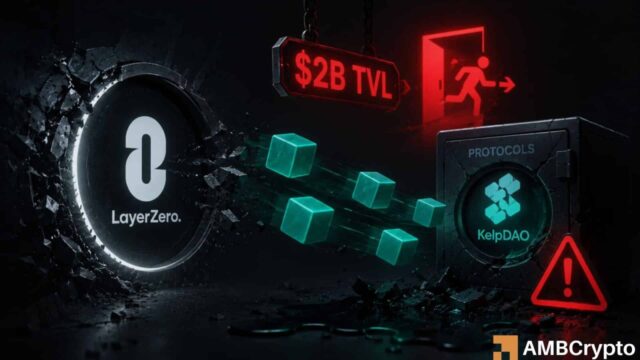
Protocols with $2 billion in combined Total Value Locked, including Kelp, Solvprotocol, and Re, left LayerZero following a recent security incident.

Macron announces €23 billion investment in Africa at Kenya summit

0


French President Emmanuel Macron on Monday announced €23 billion investment in Africa focused on energy transition, digital and AI, the maritime economy and agriculture. Macron was attending the two-day Africa Forward summit in Nairobi aimed at renewing France’s engagement with the continent.

How Bitcoin Outperformed ETH, XRP, BNB, and SOL During 2025-2026 Market Stress

0
How Bitcoin Outperformed ETH, XRP, BNB, and SOL During 2025-2026 Market Stress


A comparative analysis published on May 11 by XWIN Japan tracked how Bitcoin, Ethereum, XRP, BNB, and Solana held up during the six months of market stress between October 2025 and April 2026.

According to the report, that downturn was less about panic selling alone and more about “internal selection,” with investors separating Bitcoin from the broader altcoin market amid macro stress and shrinking liquidity.

Bitcoin Stayed Ahead While Altcoins Took Deeper Losses

Going by XWIN’s data, BTC dropped 52.5% in that period, going from a peak of around $126,000 to roughly $60,000. And while that was a brutal fall in absolute terms, compared to the rest of the group, the flagship crypto held up better.

Solana got battered the most. It fell 71.6% from its highest level of $238 to $67. At the same time, Ethereum and XRP declined by 63%, while Binance Coin dropped 59%.

In terms of recovery from their bottom prices, SOL enjoyed the biggest bounce at 38%, with Bitcoin the second-best at 34.7%.

XWIN Japan’s analysis divided the six-month period into three phases, namely a derivatives-driven unwind in late 2025, a macro fear and liquidity contraction phase in early 2026, and an institutional-led recovery this spring.

What it found, broadly, is that BTC’s relative resilience wasn’t accidental, with the report pointing to ETF inflows, corporate treasury buying, and demand as a geopolitical hedge as ongoing sources of support through the worst of the selling.

“Even during market stress, capital consistently returned to Bitcoin,” the analysis stated, describing BTC as having become a global macro asset rather than just a crypto token.

ETH, by contrast, saw its price collapse despite network activity holding up. The report noted that staking growth, Layer-2 usage, and stablecoin settlement stayed strong throughout the drawdown period, even as the price fell from around $4,700 to below $1,800.

On the other hand, XRP’s relative performance was tied mostly to regulatory narrative and ETF expectations around cross-border payment themes, while BNB stayed somewhat steadier due to activity within the Binance ecosystem.

Where Things Stand

We can get an indication of how much progress has been made so far by looking at present-day prices for the assets XWIN quoted in its research. For instance, Bitcoin is trading at around $81,000, which is an 11% increase from the previous month.

ETH is around $2,300, up about 4% on the month, while XRP gained some 7.5% in the same period and was changing hands near $1.45 at the time of writing.

Solana, however, has had the strongest performance of them all, up more than 12% in the past month and about 12% on the week, and is currently trading near $95.

The post How Bitcoin Outperformed ETH, XRP, BNB, and SOL During 2025-2026 Market Stress appeared first on CryptoPotato.

Recent Posts