Home Blog Page 92

Crypto Market Climbs 11% in April Led by Bitcoin & Memecoins
0
Memecoins Dominates Crypto in April 2026


  • The COIN50 Index has soared by around 11.05% following a strong rally in Bitcoin and Ethereum, which boosted confidence among investors. 
  • U.S. spot Bitcoin ETFs have recorded around $1.7 billion in net inflows, the highest since October 2025, which is supported by strong institutional demand. 
  • In April, memecoins became the top performer after the overall sector soared by around 15.60% following a rally that started in March. 

Amid the bullish sentiment in the cryptocurrency market after Bitcoin (BTC) reclaimed its $81,000 mark this week, Coinbase released COIN50 Index data for April 2026, where the overall crypto market witnessed strong performance over the last month. 

According to the official data shared by Coinbase Institutional, the COIN50 Index has jumped by approximately 11.05% in the last month. One of the major reasons behind this surge is the easing of geopolitical tensions in the Middle East after the U.S. and Iran returned to peace talks following a ceasefire.

The upward momentum in the crypto market was witnessed after initial shocks earlier this year, when Bitcoin drastically plunged below $70,000. In April, Bitcoin price increased by around 16%, while Ethereum shot up by around 14%. 

Bitcoin Triggers Correlation in Altcoins, Ethereum Follows the Lead

After the bear run at the beginning of this year, Bitcoin entered the month of April with around $67,000. By the end of April, BTC price soared to around $76,000. On the other hand, the second biggest cryptocurrency, Ethereum, started the month at around $2,100 and wrapped up at around $2,300.

After the rough start of 2026, in April, the crypto sector has witnessed strong institutional adoption. In the last month, Bitcoin ETFs have witnessed impressive steady inflows as U.S. spot Bitcoin ETFs recorded around $1.7 billion in net flows. These constant inflows in the biggest cryptocurrency have boosted investors’ confidence to some level and sparked bullish sentiment in the overall crypto market.

At the time of writing, Bitcoin (BTC) price is trading at around $81,505 with a 16.58% gain in the last 30 days, according to CoinMarketCap.

Apart from this, U.S. President Donald Trump declared a ceasefire in the intense war between the U.S. and Iran, which provided temporary relief in the global energy crisis. While the Strait of Hormuz is still closed for all commercial shipping, this ceasefire announcement has helped stop missile attacks on oil refineries in the Middle Eastern countries.

On this ceasefire news, the crypto market has reacted quickly and helped Bitcoin (BTC) to soar above $70,000 in the first few days. According to the official tweet, the announcement of a ceasefire has “helped foster a risk-on move across markets.”

Memecoin Sector Dominates Crypto Sector with Strong Rally in April 

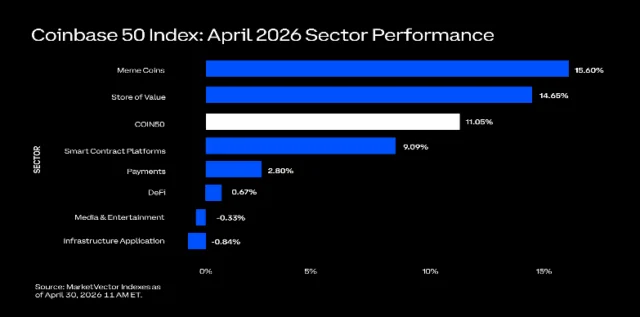
According to the Coinbase Institutional report, memecoins were the top-performing sector in April after they maintained the upward trajectory started in March. In the Coinbase 50 Index, the memecoin category has dominated after a 15.60% gain in one month.
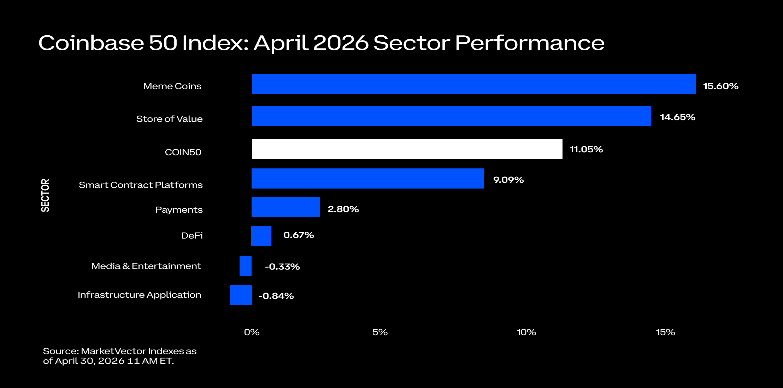
Memecoins Dominates Crypto in April 2026

According to CoinMarketCap, the cumulative market capitalisation of memecoins is hovering around $39 billion after jumping by around 31% in the last 30 days. The daily trading volume also increased by around 106%. 

Dogecoin, the biggest memecoin, has soared over 20% in 30 days. 

DeFi Sector Took a Hit from the Kelp DAO Hack

While the crypto sector was following a rebound trajectory, a very unfortunate event took place, which shook the entire DeFi sector for a while. On April 18, Kelp DAO suffered the biggest exploit of this year, where it lost around $292 million in rsETH after hackers exploited a vulnerability present in the cross-chain bridge with LayerZero.

This hack has created panic in the entire DeFi market. People have started pulling out their money from the lending platforms. In a very short time, Aave has witnessed withdrawals of around $6 billion. The total value locked in DeFi has dropped by more than $13 billion in just two days. After this hack, many protocols and L2s have immediately stopped withdrawals to avoid “bad debts.” 

In order to resolve this catastrophic situation, Aave has immediately launched the DeFi United program to take quick action and absorb losses. 

Bittensor (TAO) Plunged After Biggest Subnet Departure

Bittensor (TAO) has turned out to be the worst performer of April after the controversy around its biggest subnet operator. Last month, one of the biggest subnets, Convenant AI, announced its departure from the project. It slammed the project for how it is governing the project, calling it “decentralisation theatre.”

“When a single actor can suspend a subnet’s emissions, override an owner’s authority over their own community spaces, publicly deprecate projects without process, and use token sales as a coercive mechanism to compel compliance, that is not decentralization. It is centralized control with decentralized branding,” stated in the official post from Covenant AI.

The cryptocurrency fell more than 20% in a very short period of time, wiping out hundreds of millions in market capitalisation. 

Arbitrum and Algorand Became Top Gainers

Despite all odds in the DeFi sector, Arbitrum and Algorand have managed to become top gainers of April after surging by around 37% and 27%, respectively. 

ARB, a leading Ethereum L2, benefited from ETH’s strong momentum in April, and ALGO shot higher after Google’s Quantum AI paper cited it as a real-world deployed example of post-quantum cryptography,” Coinbase Institutional stated.

Also Read: Bitcoin Surges Past $81K While Altcoins Hint at a Comeback

Senator accuses ‘banking cartel’ of trying to kill stablecoin legislation

0
Senator accuses 'banking cartel' of trying to kill stablecoin legislation


A public clash erupted between crypto allies and the U.S. banking industry after banks warned stablecoins could drain deposits from traditional financial institutions.

Discord Nitro now includes Xbox Game Pass as a freebie

0


Discord Nitro now comes with Xbox Game Pass Starter Edition, making it a more tempting option for users who spend most of their time gaming with friends.

Senate to probe sports betting boom and risks to game integrity in May 20 hearing

0
The exterior of the US Capitol building.


The exterior of the US Capitol building.

Lawmakers in Washington are preparing to take a deeper look at the booming sports betting business, zeroing in on how it could be reshaping competition and trust in games across the country.

Sen. Marsha Blackburn, who leads the Senate Commerce Subcommittee on Consumer Protection, Technology, and Data Privacy, has scheduled a May 20 hearing to dig into the issue. The session will explore how legalized betting, now widespread, is influencing both pro leagues and college athletics.

Rapid expansion of legalized sports betting

Since the U.S. Supreme Court struck down the Professional and Amateur Sports Protection Act (PASPA) in 2018, states have moved quickly to legalize wagering. What used to be tightly controlled has turned into a $165 billion industry spanning 39 states and Washington, D.C., with betting now just a tap away on mobile apps and newer prediction-style platforms.

Growing concerns over integrity and oversight

That rapid shift is raising alarms. Reports of suspicious activity, including possible manipulation of player performance and misuse of inside information, have surfaced across many prominent sports leagues, including the NBA, MLB, UFC, MLS, and the NCAA. Regulators and researchers are also pointing to growing public concern, with recent surveys showing many Americans believe betting expansion is outpacing safeguards.

Examining risks to fair play

The hearing, titled “No Sure Bets: Protecting Sports Integrity in America,” will bring in voices from across the ecosystem. Scheduled witnesses include Bill Miller of the American Gaming Association, Mary Beth Thomas of the Tennessee Sports Wagering Council, Scott Sadin of Integrity Compliance 360, and former congressman Patrick McHenry, now tied to the Coalition for Prediction Markets. Another witness could still be added.

Blackburn framed the discussion as a necessary response to warning signs.

Fair play is the foundation of American sports, but recent match-fixing scandals in professional sports have put a spotlight on the risks facing the integrity of competition,” she said.

“As traditional online betting platforms and new entrants like prediction markets continue to intersect with sports, we need a clear understanding of how these platforms operate and what they mean for the integrity of the game. This hearing will examine how we strengthen oversight, protect the credibility of competition, and address the growing exposure of young people and children to betting platforms.”

International warnings and rising domestic scrutiny

Concerns are not limited to the U.S. Overseas regulators have issued similar warnings, including in Europe, where officials have cautioned athletes against betting on their own competitions. Back home, scrutiny is increasing as well. New York regulators are revisiting the role of player prop bets, and college sports leaders continue to wrestle with how gambling is affecting student-athletes, some of whom report harassment tied to betting outcomes.

Sen. Ted Cruz, who chairs the full Commerce Committee, said the core issue is whether fans can still trust what they’re watching. “Fans shouldn’t have to wonder if their favorite player missed a buzzer-beater or dropped a touchdown pass because of a secret bet,” he said. “Unfortunately, recent episodes have planted that seed of doubt and raised questions about whether changes are necessary to integrity in sports. I look forward to a productive conversation about the state of sports betting in the United States.”

The post Senate to probe sports betting boom and risks to game integrity in May 20 hearing appeared first on ReadWrite.

When enterprise AI finally works, it won’t look like AI

0


In an article a couple of weeks ago, I argued that the failure of enterprise AI was not really about enthusiasm, adoption, or even model capability. It was architectural: large language models were never built to run a company. Companies run on memory, context, feedback, and constraints, while LLMs remain, at their core, systems for predicting text. 

In a second one, I argued that the answer was not “better prompts,” but a deeper shift: from tools to systems, from answers to outcomes, from copilots to systems of action, and from prompts to constraints. Enterprise AI cannot be session-based. It has to remember. 

That argument now needs a third step, because something important is starting to happen: the systems that are beginning to work in enterprise AI don’t look like better chatbots, better copilots, or even better prompt chains. They look like something else entirely. And if you look closely, the evidence is already there. 

The shift from tools to systems is no longer theoretical 

For the last two years, the AI industry has mostly optimized the visible layer: bigger models, better interfaces, more polished copilots, and now, more ambitious agents. But the clearest signals of value are not coming from that visible layer alone: they are coming from organizations that are redesigning workflows, embedding AI into processes, and treating intelligence less like a tool and more like infrastructure. McKinsey’s latest global survey says it plainly: AI use is broad, but most organizations still have not embedded it deeply enough into workflows and processes to create material enterprise-level benefits. It also finds that workflow redesign is one of the strongest contributors to meaningful business impact. 

That matters because it confirms the core argument of my first two articles: the problem was never just whether models could answer well. The problem was where we were putting them. The organizations getting further are not simply “using more AI.” They are redesigning the company around it. 

The systems that work don’t start from prompts 

This is where the real change begins.

The most interesting enterprise AI systems emerging today do not start from a prompt in the narrow sense; they start from context: persistent, structured, governed context. Anthropic’s own engineering team now describes context engineering as the natural progression beyond prompt engineering, arguing that the real challenge is no longer just how to phrase instructions, but how to manage the entire context state around the model: system instructions, tools, external data, message history, and environment. 

That is a profound shift. It means the center of gravity is moving away from “what should I ask the model?” toward “what environment, state, and constraints should the system already know before any question is asked?” Anthropic reinforces the same point in its guidance for long-running agents, where it emphasizes environment management and the need to set up future agents with the context they will need to work effectively across multiple windows and longer time horizons. 

This is starting to get close to what my previous two pieces were getting at. A company is not a session: it is an evolving system with memory. Enterprise AI that keeps rebuilding context from scratch is already starting from the wrong premise. 

The biggest change is not intelligence. It’s disappearance 

This is the part many people still miss. 

The next phase of enterprise AI will not necessarily be defined by systems that feel more obviously intelligent. It will be defined by systems that feel less visible. When intelligence is embedded into workflows, linked to systems of record, aligned with rules, and continuously updated by outcomes, it stops behaving like a separate layer that users “go to.” It becomes part of how the organization itself works. 

Microsoft’s 2025 Work Trend Index points in that direction when it argues that companies are moving from rigid org charts toward more dynamic, outcome-driven “work charts,” powered by humans and agents working together around goals rather than functions. That is not just a statement about new tools. It is a statement about a new organizational substrate. 

Accenture is making a similar argument from a different angle, describing AI as something that is beginning to flatten structures and create more adaptive, self-organizing forms of work rather than simply bolting intelligence onto old hierarchies. 

So the deepest shift is not that the models are getting smarter. It is that intelligence is starting to disappear into the fabric of the company. 

Why copilots and agents were always transitional 

None of this means the last wave was irrelevant. 

Copilots, assistants, and agents were important transitional forms. They made AI tangible. They taught people how to interact with these systems. They helped organizations discover use cases. But they also anchored the conversation at the interface layer. 

That was always going to be temporary. 

A copilot suggests. An agent can plan and execute. But a company requires continuity, coordination, governance, permissions, risk thresholds, and feedback loops. That is why so many current implementations still feel impressive in demos and frustrating in operations. The intelligence is visible, but the architecture underneath remains thin. That pattern now shows up not only in the earlier MIT-related failure analyses I cited before, but also in more recent work from McKinsey and Deloitte, both of which point to the same issue: layering AI onto legacy workflows is not enough; organizations have to redesign operations and architectures around it. 

Deloitte puts it bluntly in its recent agentic AI strategy: many enterprises are hitting a wall because they are trying to automate processes designed for humans instead of reimagining the work itself. Its conclusion is almost identical to the one we’ve been building: value comes from redesigning operations and building agent-compatible architectures, not layering agents onto old workflows. 

The real architecture shift is already underway

This is why I think this third article has to say something stronger than “we need better systems.” It has to posit that those systems are already beginning to emerge. 

Look at where the energy is going. Anthropic is writing about context engineering and long-running agent harnesses. IBM is writing about context engineering for trusted agentic AI, stressing that enterprises need lineage, provenance, auditability, runtime governance, and the ability to inspect and redirect agents in motion. 

McKinsey is finding that the organizations getting the most value are the ones redesigning workflows, embedding AI in processes, and building management practices around validation, governance, data, and operating models. 

Microsoft is explicitly describing a move toward firms built around intelligence on tap, human-agent teams, and dynamic operating structures rather than static hierarchies. 

Deloitte is warning that many agentic implementations are stalling because legacy systems cannot support modern AI execution demands and because enterprises are still trying to automate the wrong things. 

These are not random observations. They all point in the same direction: the architecture shift is no longer hypothetical. 

The real divide will not be “uses AI” versus “doesn’t use AI” 

That divide is already meaningless. 

McKinsey’s data shows that nearly nine out of ten organizations are using AI in at least one business function, yet most are still in experimentation or pilot mode, and only about one-third report that they have begun to scale their AI programs. In other words, usage is widespread, but transformation remains uneven. 

So the meaningful divide is becoming something else entirely: it is the divide between companies that treat AI as a visible tool layer and companies that treat it as a systemic capability. One group will continue to generate outputs. The other will begin to change outcomes. One will keep adding assistants and interfaces. The other will embed memory, constraints, workflow logic, and learning into the operating core of the organization. That is the discontinuity my previous article was already pointing toward. 

And when that discontinuity becomes visible, it will probably feel sudden, even if the groundwork has been building quietly for months. 

The moment it becomes visible, it won’t look like progress 

It will look like something else. 

MIT Sloan has been arguing that leaders need to rethink how they manage people, processes, and projects around AI rather than simply add the technology to existing routines. Its framing is revealing: the real challenge is organizational redesign, not just access to models. 

That is why the next winners in enterprise AI may not look, from the outside, like companies with the fanciest assistant or the most visibly “AI-powered” products. They may look like companies whose internal systems have quietly become more adaptive, more context-aware, more constraint-sensitive, and more capable of acting coherently across functions. 

In other words, when enterprise AI finally works, it will not feel like another tool adoption cycle. 

It will feel like the company itself just got smarter. 

The future of enterprise AI is not something you use. It’s something your company becomes. 

That is the shift my first two pieces were already preparing: the first established that LLMs were never enterprise architecture. The second argued that enterprise AI must move from tools to systems. The next step is clear, since this transition is no longer theoretical: the evidence across research, consulting practice, vendor engineering, and organizational design all suggests that the real frontier lies several layers deeper than the chatbot. 

And when that layer becomes visible, it will not look like better prompts, better copilots, or better demos. 

It will look like a different kind of company.

A sleeper in the perps category

0
A sleeper in the perps category


As Hyperliquid and Lighter battle for perps DEX dominance, Boros could capture the structural upside

Africa Forward Summit in Kenya: France offers ‘third way’ in Africa’s AI race

0


This Monday, French President Emmanuel Macron is in Nairobi, where he is co-hosting the Africa Forward Summit with his Kenyan counterpart William Ruto – a summit focused on trade, investment and tech. Kenya is hoping to scale up its ability to meet Africa’s growing artificial intelligence needs. For France, this summit is an opportunity to offer a third way between US and Chinese tech, as FRANCE 24’s team on the ground reports.

Bitcoin Hits 3-Month High As Iran Truce Holds

0
Bitcoin Hits 3-Month High As Iran Truce Holds


BTC hit an intraday high of $82,800, even as Strategy’s chairman opened the door to selling Bitcoin to fund preferred dividends.

10 Proactive Strategies for Thriving in the 2026 Digital Landscape

0

In the rapidly evolving digital realm of 2026, mere effort is insufficient; strategic action is paramount. At Nova Astrax, our mission is to equip you with practical insights that foster genuine progress. Whether you’re a seasoned technologist or seeking to refine your daily routines, these ten astute strategies will equip you to navigate the intricacies of 2026 with confidence.

Fortify Your Digital Defenses

The proliferation of advanced AI-powered cyber threats necessitates robust protection for your digital assets. Implement multi-factor authentication (MFA) universally and consider hardware wallets for your cryptocurrency holdings to ensure the highest level of security.

Harness AI for Enhanced Efficiency

Move beyond mere usage of AI; strive for mastery. Tools such as automated content generators and AI-powered scheduling assistants can drastically reduce time spent on manual tasks. The most effective users leverage AI for ideation and organization, reserving their unique creative input for the final stages.

Elevate Website Performance for Optimal Engagement

As noted by Hostinger, a high-performing website is fundamental to a successful online presence. Ensure your images are optimized through compression and regularly clear your cache to deliver a smooth and uninterrupted experience for your visitors.

Broaden Your Information Horizons

Avoid limiting your knowledge to a single domain. While sectors like cryptocurrency may be experiencing significant growth, staying informed about developments in Fintech, Global Ventures, and Health & Wellness is equally vital for a comprehensive understanding of the modern landscape.

Embrace a “Privacy-First” Ethos

With the growing availability of privacy-centric cryptocurrencies and digital tools, safeguarding your personal data is critically important. Exercise diligence regarding the permissions you grant to applications and web browsers.

Cultivate Sustainable Organic SEO

While paid advertising offers immediate visibility, organic search traffic provides enduring stability. Employ pertinent keywords and deliver high-quality content that genuinely addresses user needs to improve your search engine rankings.

Conduct Regular Technology Reviews

Dedicate time each month to assess your website and devices. Keep your WordPress themes and plugins updated to mitigate security vulnerabilities and ensure all functionalities are operating optimally.

Implement Astute Financial Planning

In the dynamic world of Fintech and finance, trends can shift with remarkable speed. Diversify your investments and avoid concentrating all your capital into a single asset, even if it appears exceptionally promising.

Commit to Lifelong Learning

The digital environment of 2026 is in constant flux. Allocate a minimum of 30 minutes daily to study emerging topics such as AI agents, blockchain advancements, and future technologies to maintain your relevance.

Prioritize Excellence in All Endeavors

Whether it pertains to the content you publish or the tools you utilize, a focus on quality is essential. A limited number of well-researched, professionally presented pieces will consistently outperform numerous lower-quality contributions.

Achieving success in the contemporary era hinges on making well-informed decisions. By adopting these Smart Tips, you can cultivate a digital life that is more secure, efficient, and ultimately, more rewarding. Stay connected with Nova Astrax for ongoing global insights, accessible whenever and wherever you need them!

TrustedVolumes Hack Drains $6.7M, Team Opens Bounty Talks

0
TrustedVolumes Exploit Another Alarm Bell for DeFi Security


  • TrustedVolumes was exploited today, May 7, 2026 and has lost almost $6.7 million.
  • The attackers discovered a flaw in the proxy contract and by exploiting the flaw, the attackers managed to drain funds.
  • The breach highlights rising security threats across DeFi infrastructure.

Today, on May 7, 2026, alerts from blockchain security firm Blockaid signaled that TrustedVolumes, a major liquidity provider and market maker for the 1inch ecosystem, had been exploited on the Ethereum network. The attacker extracted approximately $6.7 million in assets (according to TrustedVolumes), including 1,291.16 WETH, 206,282 USDT, 16.939 WBTC, and 1,268,771 USDC, according to Blockaid and Web3 security firms.

The incident is being investigated as a sophisticated smart-contract exploit rather than a traditional phishing smart-contract exploit or social engineering attack, underlining persistent vulnerabilities in decentralized finance (DeFi) protocols.

What Went Wrong in the TrustedVolume Exploit?

At the centre of all this chaos was a custom RFQ (Request for Quote) swap proxy contract, 0xeeee….1756, controlled by TrustedVolumes. The attacker, operating from the address 0xc3eb….9100, deployed a malicious contract that first called ‘registerAllowedOrderSigner(signer=0xc3eb…9100, allowed=true)’ on the settlement contract, effectively granting itself authorization to execute trades.

Leveraging the TrustedVolumes Market Maker’s unlimited approval to the settlement contract, the attacker initiated multiple settlement transactions, using selector 0x4112e1c2 to withdraw large amounts of WETH, USDT, WBTC and USDC units to the market maker. This allowed the attacker to drain the liquidity pool before the funds were transferred back to the exploit address.

Security analyses indicate that the vulnerability stemmed from insufficient access controls and lack of strict validation checks in the RFQ swap proxy. A core admin function was left publicly accessible and it did not have any restrictions. This allowed the attacker to bypass security checks and exploit the contract.

This mirrors earlier incidents, such as the March 2025 1inch Fusion v1 exploit, where similar oversights in legacy smart contracts allowed attackers to drain liquidity, though the current exploit targets different contract components. The attack indicates the risks of custom, high risk pathways in DeFi systems that interact directly with large liquidity pools.

TrustedVolumes Opens Bug Bounty Talks After $6.7 Million Exploit

TrustedVolumes publicly acknowledged the recent exploit and confirmed through an X (formerly known as Twitter) post that several wallet addresses are currently holding the stolen funds. The team in the post also talks about the estimated loss which was around $6.7 million across multiple Ethereum addresses.

In its statement, TrustedVolumes said that the platform is open to discuss with the attacker over a possible bug bounty agreement and a workable resolution.

The protocol also shared direct contact details, including ProtonMail and Telegram, so anyone with useful information can reach out and potentially help recover stolen assets. The incident once again highlights rising security risks for DeFi protocols and liquidity providers.

Is This Exploit Similar to Recent DeFi Attacks?

The TrustedVolumes exploit shares parallels with several high-profile DeFi breaches in 2026, particularly those involving cross-chain and restaking protocols. Moreover, the Drift Protocol exploit on Solana, which resulted in a $285 million loss, utilized social engineering to compromise the protocol’s multisig governance and durable nonces, allowing pre-signed transactions to be executed.

In the same way, KelpDAO exploit, linked to approximately $292-294 million in losses, exploited vulnerabilities in its LayerZero-based rsETH bridge, where manipulated cross-chain messaging led to the issuance of unsupported rsETH tokens.

These incidents collectively highlight a trend: custom, high-complexity components in DeFi, such as RFQ proxies, cross-chain bridges, and governance mechanisms, are prime targets for sophisticated actors. The TrustedVolumes exploit, like the Drift and KelpDAO cases, demonstrates how single points of failure in smart contracts or infrastructure can trigger cascading effects across the ecosystem.

Additionally, the Lazarus Group, a North Korea-linked hacking collective, has been associated with such large-scale DeFi heists, leveraging their expertise in cross-chain attacks and operational flaws.

The Role of AI in Exploits: The Lazarus Theory

There are speculations going around that the Lazarus group may be leveraging artificial intelligence (AI) to accelerate and automate exploit discovery. AI tools can analyze vast amounts of on-chain data, identifying patterns in contact interactions, gas usage, and user behaviour to pinpoint vulnerabilities faster than traditional methods.

For example, machine learning models can simulate attack scenarios, optimizing for maximum yield in minimal time, as seen in cross-chain exploits targeting protocols like KelpDAO.

Impact on DeFi and the Broader Ecosystem

The TrustedVolumes exploit adds to a wave of high-value DeFi hacks in 2026, contributing to more than $13-15 billion in TVL (Total Value Locked) outflows across major protocols like Aave and Compound. These incidents have eroded user confidence, with many platforms halting operations or implementing emergency pauses to mitigate further losses.

The repeated targeting of market makers and liquidity providers highlight systemic risks, as disruptions in these roles can cascade into broader liquidity crunches and price volatility.

For protocols like KelpDAO and Drift, the impact includes not only direct financial losses but also reputational damage and regulatory scrutiny. The KelpDAO rsETH bridge exploit, for example, led to questions about the security of cross-chain infrastructure, prompting calls for enhanced audits and isolations of critical components.

Similarly, the Drift exploit emphasized the need for robust governance and multi-signature safeguards. The TrustedVolumes incident serves as a reminder that even well-audited projects with established security measures remain vulnerable to evolving attack vectors.

Recommendations for the DeFi Community

To avoid such exploits in the future, DeFi protocols should adopt strict allowlists and invariant checks for all swaps and proxy pathways, treating resolver/operator flows as high-risk surfaces.

There should be continuous on-chain monitoring, emergency kill-switch mechanisms, and regular audits are essential to detect and respond to anomalies promptly.

Additionally, isolating custom components behind robust access controls can prevent unauthorized interactions, as highlighted by the TrustedVolumes vulnerabilities.

As AI-driven attacks become more sophisticated, collaboration between security firms and AI developers is crucial to develop proactive defenses. The DeFi ecosystem must prioritize transparency, resilience, and rapid response to maintain trust and make sure there is sustainable growth.

With the KelpDAO and Drift Protocols under increased scrutiny, the lessons from incidents like TrustedVolumes could shape a more secure future for decentralized finance.

Also Read: Bitcoin Surges Past $81K While Altcoins Hint at a Comeback

Recent Posts